
Premium Kratom - AKA Certified Quality
Red Maeng Da • Red Bali • Green Maeng Da - All lab-tested for purity
💰 EXCLUSIVE DISCOUNT
Code: JACK30 = 30% OFF
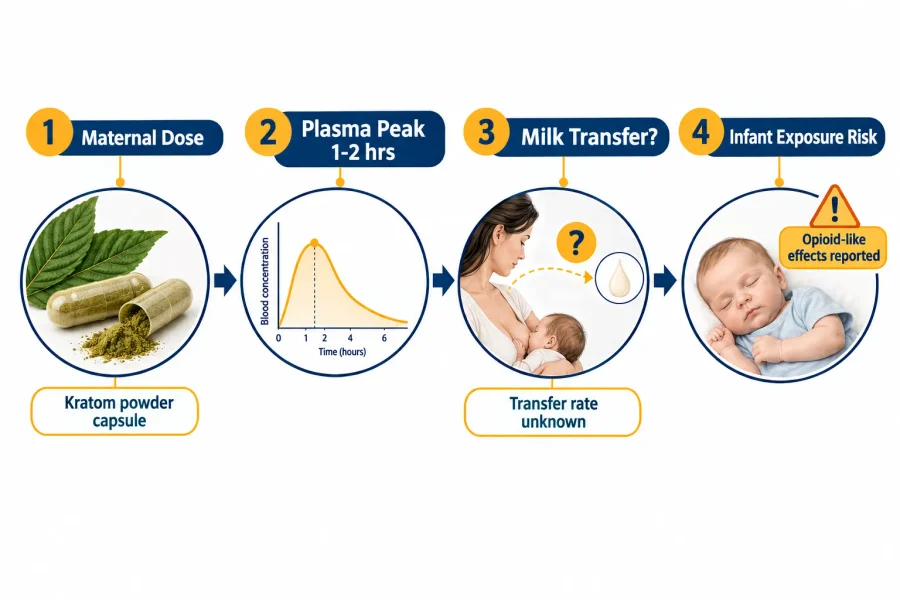
No published study has measured how does long kratom stay in breastmilk or what concentrations reach a nursing infant. Based on adult pharmacokinetics, plasma peaks around 1-2 hours after a dose and a prolonged elimination phase, kratom alkaloids could plausibly remain in breastmilk for 24 hours or longer after a single dose, and potentially several days with repeated use. Because no safe waiting window has been established, every major clinical resource advises against kratom use while breastfeeding [2][6][11].
- No clinical data exists measuring how long kratom stays in breastmilk or at what concentration [2][6]
- Mitragynine and 7-hydroxymitragynine are expected to transfer into breastmilk based on their chemistry, but transfer rates are unquantified [11]
- Plasma peaks occur 1-2 hours post-dose; elimination is prolonged, suggesting milk presence could extend beyond 24 hours [3]
- Neonatal opioid-like withdrawal has been reported in infants exposed to kratom in utero and via breastmilk [3][5]
- Poison control data from 2011-2017 identified at least one kratom exposure occurring through breastmilk [3]
- No “pump-and-dump” window has been validated for kratom, any such strategy is extrapolated from general medication principles, not kratom-specific data [10]
- The InfantRisk Center, LactMed-derived monographs, and WebMD all advise avoiding kratom while nursing [2][6][11]
- Clinicians often apply opioid breastfeeding guidelines to kratom because of its opioid-like pharmacology [2][14]
- Safer alternatives exist for pain and anxiety management during lactation, discuss them with a physician
Does Kratom Pass Into Breastmilk?
Yes, some transfer into breastmilk is expected. The InfantRisk Center states that based on the chemistry of mitragynine and 7-hydroxymitragynine, transfer into breastmilk and to the fetus can be anticipated [11]. Neither the amount transferred nor the infant dose has been measured in any published study.
Here’s the thing: most lipid-soluble compounds with moderate molecular weight cross into breastmilk at some fraction of maternal plasma concentration. Mitragynine fits that profile. It binds to opioid receptors, crosses biological membranes, and has a prolonged elimination curve in adults. That combination makes zero transfer biologically implausible.
What remains unknown is the milk-to-plasma ratio, peak milk concentration, and how long those levels stay elevated after a maternal dose. Until that data exists, the working assumption from every authoritative source is that exposure occurs and poses risk [2][6][11].
Jack Botanicals - America's Trusted Kratom Source
AKA certified quality featuring Red Maeng Da, Red Bali, and Green Maeng Da. Lab-tested purity you can trust.
🎁 NEW CUSTOMER SPECIAL
JACK30 = 30% OFF
How Long Does Kratom Stay in Breastmilk: What the Data Actually Shows
Here’s the deal: there is no direct data. No published pharmacokinetic study has measured kratom levels in human breastmilk at any time point [2][4][6][11]. The exact duration of how long kratom stays in breastmilk is, as of 2026, completely unestablished.
What can be inferred from adult plasma data:
- Plasma peak: Mitragynine reaches peak plasma concentration roughly 1-2 hours after an oral dose [15]
- Elimination half-life: Adult studies suggest a relatively prolonged elimination phase, with enterohepatic recycling producing secondary plasma peaks
- Estimated milk presence: Extrapolating from general pharmacokinetic principles, kratom alkaloids could plausibly remain detectable in breastmilk for at least 24 hours after a single dose and potentially 2-3 days or longer with regular use
The key word is “plausibly.” These are conservative risk estimates, not verified clearance times [11]. For verified clearance data on how kratom moves through the adult body, see this guide on how long kratom stays in your body.
Bottom line: No one can tell a nursing mother exactly when her milk is safe after taking kratom. The data does not exist.
Kratom Alkaloids and Breastmilk Transfer Rate
The transfer rate of kratom alkaloids into breastmilk is unknown. No study has calculated a milk-to-plasma ratio for mitragynine or 7-hydroxymitragynine in humans [2][11].
Several chemical properties suggest meaningful transfer is likely:
| Property | Mitragynine | Implication for Milk Transfer |
|---|---|---|
| Lipid solubility | Moderate-high | Favors passive diffusion into milk |
| Molecular weight | ~398 g/mol | Below 500 Da threshold, easier transfer |
| Protein binding | Moderate | Some free drug available for transfer |
| Opioid receptor activity | Partial agonist | Pharmacologically active in infants |
The 7-hydroxymitragynine metabolite is estimated to be 13 times more potent than morphine at opioid receptors [4]. Even low milk concentrations could produce effects in a newborn whose opioid receptor system is immature and highly sensitive.
For broader context on how kratom’s alkaloids behave in the body over time, the kratom detection methods and system clearance guide covers the pharmacokinetic timeline in detail.
What Are the Risks of Kratom in Breastmilk for Babies?
The risks are real and documented, even without precise milk concentration data. Poison control surveillance covering 2011-2017 identified one kratom exposure that occurred via breastmilk, plus multiple cases of neonatal withdrawal attributed to in-utero kratom exposure [3]. The authors specifically flag that the possibility of breastmilk exposure should be communicated to new mothers who use kratom [3].
A case report describes a newborn initially receiving breastmilk whose neurological symptoms worsened during the first week of life, ultimately requiring a switch to formula [5]. The clinical course supports concern about ongoing postnatal exposure through milk, even though milk kratom levels were not measured [5].
Documented risks in infants include:
- Opioid-like neonatal withdrawal syndrome (tremors, irritability, poor feeding, seizures)
- Central nervous system depression
- Respiratory depression at higher exposures
- Developmental effects, currently unknown because no long-term studies exist
The LactMed-derived monograph on kratom (updated June 24, 2025) concludes that nursing mothers should generally avoid kratom because infant health effects from exposure to kratom and other CNS-acting substances in milk are unknown [2].
How Long After Taking Kratom Can I Breastfeed Safely
No safe waiting window has been established. This is the most direct answer available from the current evidence base: there is no validated “how many hours to wait” figure for kratom and breastfeeding [2][6][11].
Some consumer guidance sites suggest taking kratom immediately after a feeding session and using pump-and-dump strategies to reduce exposure [10]. Kratom.org explicitly acknowledges these suggestions are extrapolated from general medication-in-milk principles and are not supported by kratom-specific data [10].
Here’s why a waiting window is hard to define even in theory:
- The elimination half-life of mitragynine in humans varies considerably based on dose, frequency of use, and individual metabolism
- Regular users accumulate alkaloids in tissues, meaning a single “last dose” does not clear the system quickly
- 7-hydroxymitragynine’s milk kinetics are entirely unstudied
- Infant metabolism of opioid-like compounds is slower than adult metabolism, amplifying exposure risk
For context on how long kratom effects and active compounds persist in adults, the how long kratom lasts duration guide provides useful pharmacokinetic framing, though it covers adult clearance, not infant exposure.
The takeaway: Any waiting period chosen without clinical data is a guess. Clinicians applying opioid breastfeeding guidelines to kratom typically recommend sustained abstinence rather than short washout windows [2][14].
What Do Doctors Say About Kratom and Breastfeeding
The medical consensus is consistent: avoid kratom during lactation. This position is held by the InfantRisk Center, LactMed-derived drug monographs, WebMD’s clinical overview (last updated April 17, 2026), and pediatric clinical commentary [2][4][6][11].
WebMD states that it is not known whether kratom passes into breastmilk and advises breastfeeding individuals to inform their healthcare provider if they are using kratom [6]. The InfantRisk Center goes further, explicitly not recommending kratom use in pregnant or breastfeeding women [11].
Pediatric commentary notes that even the American Kratom Association, a kratom advocacy organization, recommends that pregnant or breastfeeding women avoid kratom use [4]. When both mainstream medicine and the industry’s own advocacy group align on avoidance, the signal is clear.
Clinicians who treat patients using kratom for pain or opioid use disorder often apply Academy of Breastfeeding Medicine guidance for nonprescribed opioids: avoid breastfeeding during ongoing use, maintain milk supply by pumping, and resume breastfeeding only after sustained abstinence is confirmed [14].
Kratom Metabolism in Nursing Mothers
Kratom metabolism in nursing mothers follows the same hepatic pathway as in non-nursing adults, primarily through CYP3A4 and CYP2D6 enzymes. The key metabolites are mitragynine pseudoindoxyl and 7-hydroxymitragynine, both pharmacologically active [4].
What changes during lactation:
- Increased blood volume during the postpartum period can dilute plasma concentrations slightly
- Hormonal shifts may affect CYP enzyme activity, potentially altering elimination speed
- Sleep deprivation and stress common in new mothers can impair liver metabolism efficiency
- Frequency of use matters significantly, daily kratom use leads to alkaloid accumulation that extends clearance timelines well beyond a single dose’s half-life
For nursing mothers who have been using kratom regularly, clearance is not a matter of hours. Understanding how long kratom takes to fully clear the system gives important context for how prolonged that process can be in adult users, and why infant exposure risk extends beyond the immediate post-dose window.
If dependence has developed, the kratom detox timeline guide outlines what the withdrawal and clearance process looks like.
Has Kratom Caused Problems in Breastfed Babies
Yes, documented cases exist. The 2011-2017 poison control surveillance data identified at least one case of kratom exposure occurring through breastmilk [3]. Multiple cases of neonatal withdrawal following in-utero kratom exposure have also been reported, with opioid-like symptoms including tremors, poor feeding, and irritability [3][5].
A case report describes neurological symptom progression in a newborn who received breastmilk from a kratom-using mother, with clinical deterioration prompting the switch to formula during the first week of life [5]. While this case does not prove causation through milk alone (in-utero exposure was also present), it illustrates the clinical concern about ongoing postnatal exposure.
The pattern from poison control data: kratom exposure in infants produces opioid-like toxicity. The exposure route, whether prenatal, via milk, or both, does not change the clinical presentation or the risk.
Should I Stop Breastfeeding If I Take Kratom
If kratom use is ongoing, most clinical sources recommend either stopping kratom or switching the infant to formula or donor milk [2][11][14]. The decision depends on several factors:
- Frequency and dose of kratom use: Occasional low-dose use carries different (though still unquantified) risk than daily high-dose use
- Availability of alternatives: Formula and donor milk are safe, established options
- Maternal health context: If kratom is being used to manage opioid withdrawal, a physician-supervised medication-assisted treatment program (buprenorphine, methadone) is both safer for the infant and more effective for the mother [7][14]
The breastfeeding benefits, immune protection, bonding, nutrition, are real. But they do not override the risk of exposing a newborn to pharmacologically active opioid-like compounds at unknown doses [2][11].
Indiana’s 2025 breastfeeding and substance use guidance recommends individualized clinical assessment for mothers using substances, with harm reduction strategies and treatment referral as core components [7].
Alternatives to Kratom While Breastfeeding
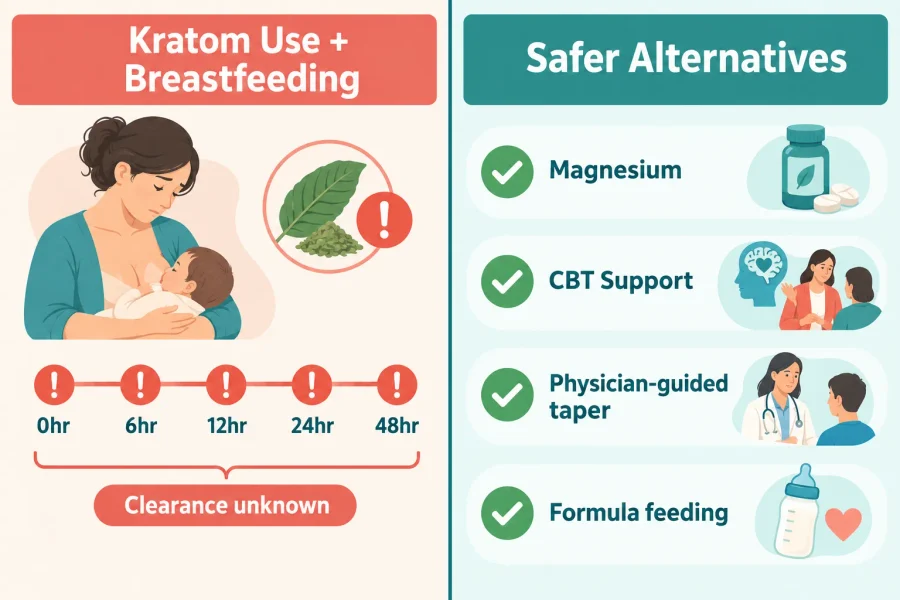
Safer options exist for the conditions kratom is commonly used to manage. The key is working with a physician to find alternatives that have established safety profiles in lactation.
Kratom Alternatives for Nursing Mothers
Pain Management Alternatives
- Acetaminophen (physician-approved dosing)
- Ibuprofen (short-term, after feeds)
- Physical therapy and stretching
- Topical analgesics (lidocaine-based)
Anxiety / Stress Alternatives
- Cognitive behavioral therapy (CBT)
- Magnesium glycinate (discuss with OB)
- Mindfulness-based stress reduction
- Postpartum support groups
Opioid Use Disorder Alternatives
- Buprenorphine (MAT, safe in lactation)
- Methadone (MAT, physician-supervised)
- SAMHSA treatment referral (1-800-662-4357)
Energy / Fatigue Alternatives
- Iron-level check (postpartum anemia is common)
- Structured sleep scheduling with partner support
- Low-dose caffeine (under 200mg/day is generally accepted)
Always confirm any supplement or medication with your healthcare provider before use while breastfeeding.
For pain management, acetaminophen and ibuprofen have well-established safety data in breastfeeding. For opioid use disorder, buprenorphine and methadone used in physician-supervised medication-assisted treatment (MAT) are both considered compatible with breastfeeding by major clinical guidelines [7][14], and are far safer for the infant than unmonitored kratom use.
For anxiety and low energy, cognitive behavioral therapy, magnesium supplementation (discussed with a physician), and structured sleep support address root causes without pharmacological risk to the infant.
Is Kratom Safe While Breastfeeding
No. The current evidence base does not support kratom use as safe during breastfeeding. Every authoritative source reviewed, LactMed-derived monographs, the InfantRisk Center, WebMD’s April 2026 clinical overview, pediatric clinical commentary, and poison control surveillance, reaches the same conclusion: avoid kratom while nursing [2][3][4][6][11].
The absence of safety data is itself the problem. When no study has measured how long kratom stays in breastmilk, what concentration reaches the infant, or what developmental effects occur, the precautionary principle applies. Documented neonatal withdrawal cases and at least one confirmed breastmilk exposure case from poison control data confirm that the risk is not theoretical [3][5].
How Long Does Kratom Stay in Breastmilk – FAQs
1. How long does kratom stay in breastmilk?
There is currently no reliable research establishing how long kratom remains in breastmilk after use. Kratom contains active compounds, including mitragynine and 7-hydroxymitragynine, but their transfer into human breastmilk and clearance times are not well studied. The duration may vary depending on the amount used, frequency of use, individual metabolism, and product composition.
2. Can kratom pass into breastmilk?
Kratom contains biologically active compounds that may potentially pass from the bloodstream into breastmilk. However, direct human studies measuring mitragynine or other kratom alkaloids in breastmilk are lacking. This means the amount transferred, its concentration, and how long a breastfed infant could be exposed remain uncertain.
3. How long should someone wait to breastfeed after taking kratom?
No scientifically established waiting period exists for breastfeeding after kratom use. Because researchers have not determined its clearance time in breastmilk, a specific number of hours cannot be considered reliably safe. Important considerations include:
- The amount and frequency of kratom use.
- The specific product and its alkaloid content.
- The infant’s age and feeding needs.
- Advice from a qualified healthcare professional.
4. Does kratom stay in breastmilk longer with regular use?
Repeated kratom use may cause its active compounds to accumulate in the body, depending on the dose, frequency, and individual metabolism. However, there is insufficient research to determine whether regular use leads to higher breastmilk concentrations or a specific longer exposure period. Occasional and frequent use cannot be compared reliably using current breastmilk data.
5. Can pumping and dumping remove kratom from breastmilk?
Pumping and discarding breastmilk does not speed up the body’s elimination of kratom compounds. Their levels, if present in breastmilk, would depend on how the body processes and eliminates them. Pumping may help maintain milk production, but it does not establish when breastmilk is free of kratom or make a particular waiting period safe.
6. What are the possible effects of kratom exposure through breastmilk?
The effects of kratom exposure through human breastmilk have not been adequately studied. Because kratom can affect the nervous system, exposure may be a concern for infants. Potential warning signs requiring prompt medical attention include:
- Unusual sleepiness or difficulty waking.
- Difficulty feeding or poor feeding.
- Unusual breathing or breathing difficulties.
- Unusual limpness or reduced responsiveness.
Seek emergency medical care if an infant has trouble breathing or cannot be awakened.
7. Is there a test to determine whether kratom is present in breastmilk?
Specialized laboratory methods can detect certain kratom alkaloids in biological samples, but routine breastmilk testing is not widely available. There is no established clinical test that confirms breastmilk is free of kratom or determines a universally safe time to resume breastfeeding. A healthcare professional or poison control service can help assess an individual exposure and discuss appropriate next steps.
Conclusion
The bottom line on how long kratom stays in breastmilk: no one knows. No pharmacokinetic study has measured kratom alkaloid levels in human breastmilk, established a milk-to-plasma ratio, or defined a safe waiting window after maternal dosing [2][6][11].
What the evidence does show:
- Transfer into breastmilk is expected based on mitragynine’s chemical properties [11]
- Plasma kinetics in adults suggest milk presence could extend 24+ hours after a single dose, and longer with regular use
- Neonatal opioid-like withdrawal and at least one confirmed breastmilk exposure case are documented in the literature [3][5]
- No major clinical organization or expert center has identified a safe dose or timing window for kratom during lactation [2][4][6][11]
Understanding how long kratom stays in your system as an adult is a starting point, but infant exposure risk requires clinical guidance that goes beyond adult clearance estimates.
References
[1] Other Substances – https://www.perinatalharmreduction.org/other-substances
[2] Kratom (Breastfeeding Monograph) – https://www.drugs.com/breastfeeding/kratom.html
[3] Post S, Spiller HA. Kratom Exposures Reported to US Poison Control Centers 2011-2017 – https://henryspiller.org/wp-content/uploads/2020/07/Post-s-Spiller-HA-Kratom-exposures-reported-to-US-poison-control-centers-2011-to-2017-clin-tox-2019.pdf
[4] Kratom: An Opioid-like Herbal Supplement Pediatricians Should Know About – https://www.pediatricsresearchjournal.com/articles/kratom-an-opioidlike-herbal-supplement-pediatricians-should-know-about.html
[5] Neonatal Withdrawal (Case Report) – https://monroecommunitycoalition.org/wp-content/uploads/2026/04/NeoNatal-Withdrawal.pdf
David is an ethnobotany enthusiast who has spent years studying the role of plants in both ancient and modern communities. His curiosity has taken him from libraries filled with old manuscripts to landscapes where indigenous traditions still thrive. David enjoys connecting the dots between the past and present, showing how nature continues to inspire human life. His work emphasizes thoughtful exploration, cultural respect, and the joy of discovering connections in the natural world.