Premium Kratom - AKA Certified Quality
Red Maeng Da • Red Bali • Green Maeng Da - All lab-tested for purity
💰 EXCLUSIVE DISCOUNT
Code: JACK30 = 30% OFF
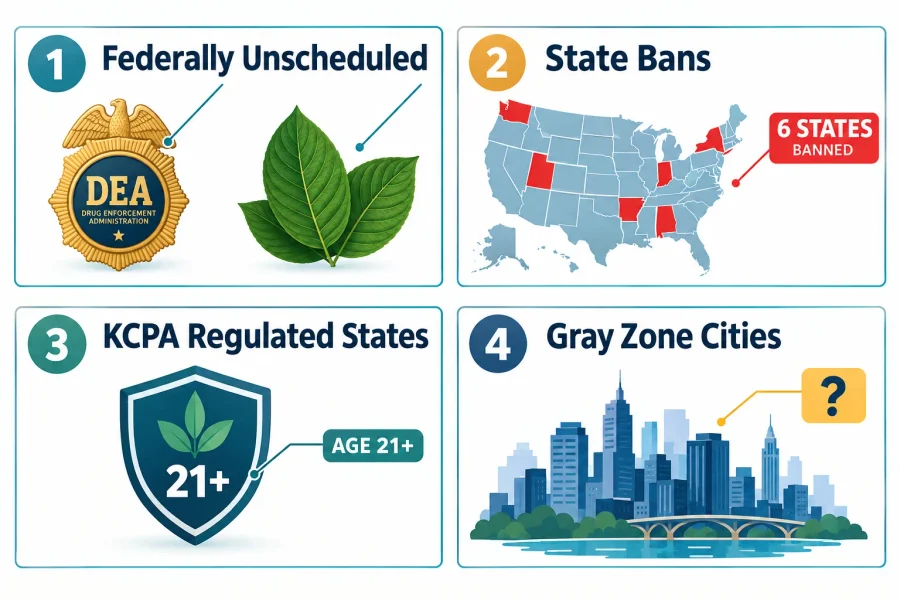
Kratom legal status in the United States is a patchwork: federally unscheduled at the leaf level, but banned or restricted in roughly a dozen states and several municipalities. The FDA has not approved kratom as a food, supplement, or drug. Internationally, kratom is banned outright in several countries while remaining in a legal gray zone in others.
- Kratom leaf is not a federally scheduled substance in the U.S., but the DEA and FDA are actively targeting synthetic derivatives like 7-hydroxymitragynine (7-OH)
- Six states have banned kratom entirely: Alabama, Arkansas, Indiana, Rhode Island, Vermont, and Wisconsin
- California announced 95% compliance with its prohibition on illegal kratom products in March 2026 [2]
- North Dakota signed a law in 2026 banning synthetic kratom and restricting natural kratom sales to adults 21 and older [6]
- The FDA does not allow kratom to be marketed lawfully as a food, dietary supplement, or drug [5]
- Kratom is not controlled under major UN drug conventions, but dozens of countries restrict or ban it
- The Kratom Consumer Protection Act (KCPA) has passed in several states, creating age limits and labeling requirements
- Drug tests do not detect kratom on standard panels, but specialized tests can identify mitragynine
- No prescription is required to buy kratom in states where it is legal
- The regulatory trend in 2026 points toward tighter controls on synthetic derivatives, with uneven state-level rules for natural leaf
Is Kratom Legal in the US? Federal Status Explained
Kratom leaf is federally unscheduled in the United States as of 2026. That means the DEA has not classified it as a controlled substance under the Controlled Substances Act. However, “unscheduled” does not mean “approved.”
Here’s the deal: the FDA has made clear that kratom cannot be lawfully sold as a food, dietary supplement, or drug product in the U.S. [5]. The agency has issued import alerts and seized shipments. The DEA, meanwhile, is now focused on 7-hydroxymitragynine (7-OH), a concentrated kratom derivative. The HHS and FDA formally supported the DEA’s move to schedule 7-OH as a Schedule I substance [3].
The pattern here is important. The federal government is not going after dried kratom leaf directly. It is targeting synthetic, concentrated, and extracted forms. That distinction matters for buyers and vendors right now.
For a deeper breakdown of federal law, see Is Kratom Legal In The United States? Federal Laws Explained.
Jack Botanicals - America's Trusted Kratom Source
AKA certified quality featuring Red Maeng Da, Red Bali, and Green Maeng Da. Lab-tested purity you can trust.
🎁 NEW CUSTOMER SPECIAL
JACK30 = 30% OFF
Kratom Legal Status by State: The Full Breakdown
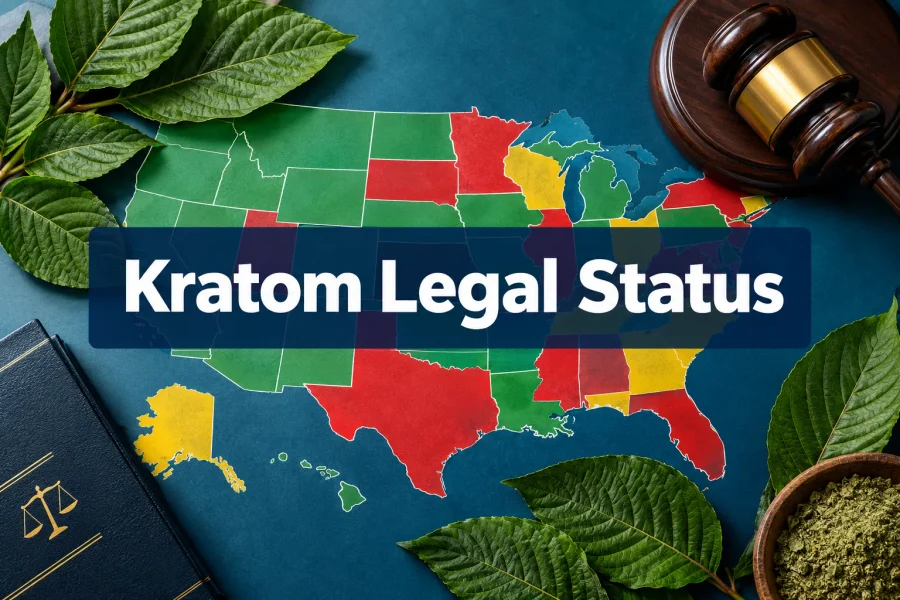
The majority of U.S. states allow kratom with varying degrees of regulation. A significant minority have banned it entirely or imposed strict controls. [1]
States where kratom is fully banned (Schedule I or equivalent):
- Alabama
- Arkansas
- Indiana
- Rhode Island
- Vermont
- Wisconsin
States with Kratom Consumer Protection Act (KCPA) regulations:
States including Arizona, Georgia, Nevada, Oklahoma, and Utah have passed KCPA laws. These set age limits (typically 18+), require accurate labeling, and prohibit adulterated products.
States with active 2026 legislative movement:
North Dakota signed HB 1628 in 2026, banning synthetic kratom and restricting natural kratom to buyers 21 and older. Sales remain paused pending finalized rules [6][7].
State-specific guides worth checking:
- Kratom Legal In NC Status
- Kratom Wisconsin Legal Status 2026
- Is Kratom Legal In Washington State?
- Is Kratom Legal In Indiana 2026?
- Is Kratom Legal In Alabama 2026
For a visual overview, the Kratom Legal Map Showing State Laws is a useful quick reference.
Why Is Kratom Banned in Some States?
States that have banned kratom typically cite safety concerns, lack of FDA approval, and the potential for misuse. The core argument is that mitragynine and 7-hydroxymitragynine act on opioid receptors, which regulators treat as a red flag even without formal scheduling.
Turns out, many state bans predate the current federal scrutiny of synthetic derivatives. Indiana, Alabama, and Wisconsin banned kratom years before the DEA began targeting 7-OH specifically. The reasoning varied: some states pointed to poison control data, others to law enforcement concerns about unregulated herbal products.
The 2026 trend is worth noting. More states are actively considering bans or tighter controls, partly driven by incidents involving high-potency kratom extracts and concentrated products [9]. The distinction between natural leaf and synthetic derivatives is not always reflected in state law, which is why some bans cover all kratom products regardless of form.
Kratom Legal Status in Europe and Asia: What Countries Have Banned Kratom?
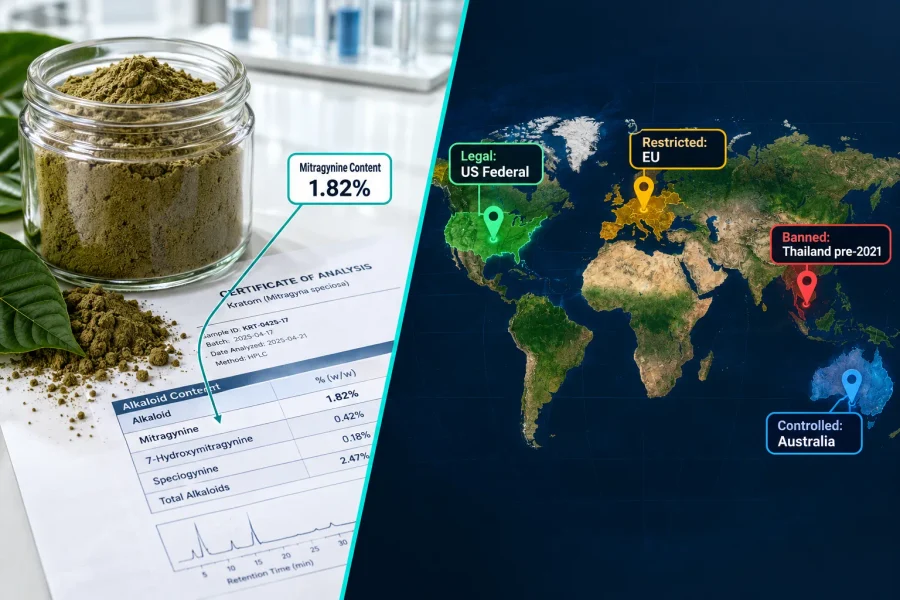
Kratom is not controlled under major UN drug conventions, but individual countries have moved aggressively on their own. [4]
Countries where kratom is banned or heavily restricted:
- Thailand: Kratom was illegal for decades but was decriminalized in 2021 for traditional use. Current rules allow limited personal use and licensed cultivation, but export remains tightly controlled. See Is Kratom Legal In Thailand Facts for the current picture.
- Malaysia: Kratom (locally called “ketum”) remains a controlled substance despite being native to the region
- Australia: Kratom is a Schedule 9 prohibited substance. Full details at Is Kratom Legal In Australia?
- Sweden, Denmark, Poland, Lithuania: Controlled or banned under national drug laws
- Germany: Kratom is not listed as a controlled narcotic but faces restrictions under food and medicine law
- Italy: Restricted. See Is Kratom Legal In Italy Exposed
The bottom line: if traveling internationally with kratom, check the destination country’s specific law. Carrying kratom into Malaysia or Australia carries serious criminal penalties.
Kratom Legal Gray Area: What Does That Mean?
A “legal gray area” means kratom is neither explicitly legal nor explicitly illegal under current law. This applies at both the federal and some state levels.
Here’s the thing: the FDA has not approved kratom, but it also has not scheduled it. That creates a space where vendors can sell it, buyers can purchase it, and law enforcement can still seize it under food safety or drug analog laws depending on the jurisdiction. Some states have no kratom-specific law at all, which leaves enforcement to local interpretation.
Cities have moved to fill that gap. Municipal bans exist in cities within states that have not yet regulated kratom at the state level. This is the core of the gray area problem: legality can change block by block in some metro areas.
For a thorough breakdown of how this plays out legally, How Is Kratom Legal Policies covers the regulatory mechanics in detail.
Kratom Drug Test: Will It Show Up?
Standard 5-panel and 10-panel drug tests do not screen for kratom or its alkaloids. Kratom will not trigger a positive result for opioids on these tests because mitragynine has a different molecular structure than traditional opioids.
However, specialized kratom-specific urine tests do exist and can detect mitragynine and its metabolites. Some employers, probation programs, and military branches have begun using expanded panels that include kratom. The detection window for mitragynine in urine is estimated at 5 to 7 days for regular users, though this varies with dose, frequency, and individual metabolism.
The takeaway: standard workplace drug tests will not flag kratom. Specialized tests will. If the testing context is high-stakes (probation, federal employment), confirm which panel is being used.
Is Kratom Addictive and Why Isn’t It Regulated?
Kratom’s alkaloids, particularly mitragynine and 7-OH, bind to opioid receptors. Regular use can produce physical dependence, and withdrawal symptoms (irritability, muscle aches, insomnia) are documented. The American Kratom Association and some researchers argue the risk profile is lower than pharmaceutical opioids, but dependence potential is real.
The reason kratom remains largely unregulated at the federal level comes down to a few factors:
- No scheduling action has been finalized for kratom leaf itself
- The DEA’s 2016 attempt to emergency-schedule kratom was withdrawn after significant public and congressional pushback
- The FDA lacks clear authority to ban a botanical that is not a drug, food additive, or supplement under current law [5]
- Industry groups like the American Kratom Association have lobbied effectively for the KCPA framework as an alternative to outright bans [7]
The CNN reporting from August 2026 on the 7-OH synthetic ban captures the current regulatory split: federal action is targeting the most potent derivatives while natural leaf remains in a policy limbo [10].
Can You Bring Kratom Through Airport Security?
In states where kratom is legal, TSA does not specifically screen for kratom. Kratom is not on the TSA’s prohibited items list. In practice, if kratom is in a clearly labeled container and you are traveling between two states where it is legal, you are unlikely to face issues at security.
The risk comes from destination and layover states. Flying from a legal state to a banned state (Indiana, Wisconsin, Alabama, etc.) with kratom in your luggage puts you in violation of the destination state’s law. International travel with kratom is a different matter entirely, with serious legal consequences in countries like Australia and Malaysia.
For a full breakdown of flying rules, Is It Legal To Fly With Kratom Facts covers TSA policy, state destination rules, and international risk in detail.
Kratom vs Kava: Legal Differences
Kava is legal at the federal level and in all 50 states. Kratom is federally unscheduled but banned in 6 states and restricted in several others. That is the core legal difference.
Kava (Piper methysticum) has a longer history of use in Western markets and has not triggered the same FDA enforcement actions. The FDA has issued warnings about kava and liver risk, but it has not pursued the same import alert and seizure strategy it has used against kratom.
The comparison shows:
| Factor | Kratom | Kava |
|---|---|---|
| Federal status | Unscheduled (leaf); 7-OH targeted | Legal, unscheduled |
| State bans | 6 states | None |
| FDA position | Cannot be marketed as food/supplement/drug | Generally sold as dietary supplement |
| Prescription needed | No | No |
| Drug test detection | Specialized test only | Not detected |
Bottom line: kava faces fewer legal barriers than kratom in the U.S. right now. That gap may narrow if KCPA adoption continues, but as of 2026, kava is the legally simpler option.
Kratom Legal Alternatives
If kratom is banned in your state or you want options with clearer legal standing, several botanical alternatives exist.
Common alternatives:
- Kava: Legal in all 50 states, acts on GABA receptors rather than opioid receptors
- Akuamma seeds: Legal in most jurisdictions, contain alkaloids with mild analgesic properties
- Blue lotus: Legal in most U.S. states, mild sedative effects
- Mitragyna hirsuta: A related plant species, currently unscheduled, though regulatory status could change
Testing reveals that none of these alternatives produce effects identical to kratom. Users looking for kratom’s specific alkaloid profile (mitragynine at 1.2-1.6% in quality leaf) will not find a direct substitute. The legal alternatives are worth knowing, but they are not equivalent products.
How Much Does Kratom Cost?
Kratom pricing varies significantly by form, quantity, and vendor quality. Here are current market benchmarks:
- Powder (bulk): $60-$120 per kilogram from reputable vendors
- Powder (retail, 1 oz): $10-$20
- Capsules (standard dose): $15-$35 per 60-count bottle
- Extracts and 7-OH products: $20-$60 per small unit (these are the products now facing federal scheduling action)
The results show that bulk powder from vendors with third-party lab testing (confirming mitragynine content and heavy metal/pathogen absence) runs $80-$100/kg. Vendors without lab documentation tend to price lower but carry higher quality risk.
Pricing is not regulated in KCPA states, but labeling requirements mean compliant products must disclose alkaloid content. That data point is worth more than price when comparing batches.
Kratom Legal Status – FAQs
Is kratom legal in the United States?
Kratom’s legal status in the United States varies by location. It is not federally scheduled as a controlled substance, but individual states, counties, and cities may have their own restrictions. Laws can change over time, so legality may depend on the specific jurisdiction where kratom is possessed, sold, or used.
Which states have restrictions on kratom?
Some states and local jurisdictions have enacted restrictions or bans involving kratom. Depending on the location, rules may address:
- Possession or personal use
- Sale or distribution
- Minimum age requirements
- Specific kratom products or compounds
Is kratom federally legal in the United States?
Kratom is not currently listed as a federally controlled substance under the United States Controlled Substances Act. However, federal status does not determine every local rule. States and municipalities can establish their own laws or regulations, meaning kratom may have different legal treatment depending on the jurisdiction.
Is kratom legal in every state?
No. Kratom does not have the same legal status everywhere in the United States. Some jurisdictions permit it, while others have restrictions or prohibitions. Certain locations may also regulate particular products or impose age-related rules. Because regulations can change, the applicable state and local law should be considered separately.
Can cities or counties ban kratom if state law allows it?
In some circumstances, local governments can adopt rules that differ from broader state requirements, depending on that state’s laws and local authority. This means kratom’s status can sometimes vary between nearby jurisdictions. Checking both state-level and applicable local regulations is important when determining the rules for a particular location.
Does kratom’s legal status change from state to state?
Yes. Kratom regulations can differ significantly between states. Common approaches include:
- No specific state prohibition
- Age restrictions
- Product or labeling requirements
- Restrictions on particular compounds
- Complete or partial prohibitions
How can I check the current legal status of kratom?
The most reliable approach is to check the current rules for the exact jurisdiction involved. Relevant information may come from state statutes, local ordinances, and official government sources. Pay attention to recent amendments because kratom regulations can change, and a rule applying in one jurisdiction may not apply in another.
Conclusion
The kratom legal status landscape in 2026 is more complex than a simple legal or illegal answer. Federally, kratom leaf remains unscheduled, but the FDA actively restricts its marketing and the DEA is moving to schedule its most potent derivative, 7-OH. At the state level, six states maintain outright bans while the majority allow kratom under varying degrees of regulation.
The pattern is clear: natural kratom leaf is not going away, but the era of zero regulation is ending. KCPA-style frameworks are the most likely outcome for most states, while synthetic derivatives face much harder federal scrutiny.
References
[1] Kratom Summary Of State Laws – https://legislativeanalysis.org/kratom-summary-of-state-laws/
[2] Governor Newsom Announces 95% Compliance With Prohibition Of Illegal Kratom Products – https://www.gov.ca.gov/2026/03/03/governor-newsom-announces-95-compliance-with-prohibition-of-illegal-kratom-products/
[3] HHS FDA Support DEA 7-OH Scheduling – https://www.hhs.gov/press-room/hhs-fda-support-dea-7-oh-scheduling.html
[5] FDA And Kratom – https://www.fda.gov/news-events/public-health-focus/fda-and-kratom
[6] Updated Armstrong Signs Bill Banning Synthetic Kratom Restricting Natural Kratom 21 And Older – https://www.governor.nd.gov/news/updated-armstrong-signs-bill-banning-synthetic-kratom-restricting-natural-kratom-21-and-older
Jonathan is an enthusiast of traditional plant practices and cultural history. His work reflects a genuine fascination with how nature has shaped human stories throughout time. Jonathan believes that sharing knowledge about plants can build connections across cultures and generations. Through careful research and respectful exploration, he hopes to provide readers with thoughtful perspectives that celebrate heritage, encourage curiosity, and inspire a greater awareness of our relationship with nature.