Premium Kratom - AKA Certified Quality
Red Maeng Da • Red Bali • Green Maeng Da - All lab-tested for purity
💰 EXCLUSIVE DISCOUNT
Code: JACK30 = 30% OFF
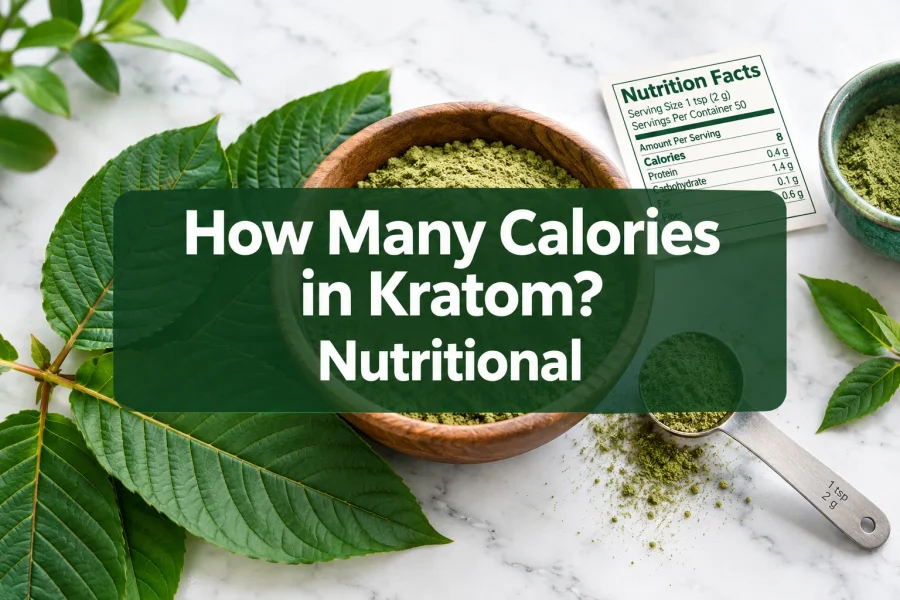
A standard 3-5 gram dose of kratom powder contains roughly 2-15 calories, depending on the form and what it’s mixed with. The leaf itself is nutritionally insignificant as an energy source. Most calories in a kratom serving come from the mixer, not the kratom.
- A single gram of dried kratom powder contains approximately 1-1.5 calories [4]
- A typical 3-5 g dose delivers only about 5-15 kcal on its own [4]
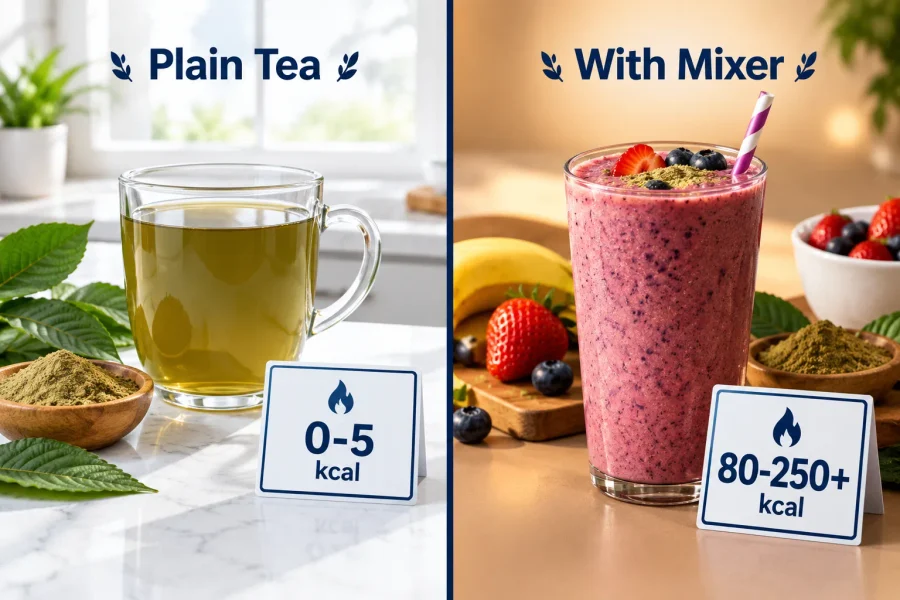
- Strained kratom tea has near-zero calories (0-5 kcal per cup) [4]
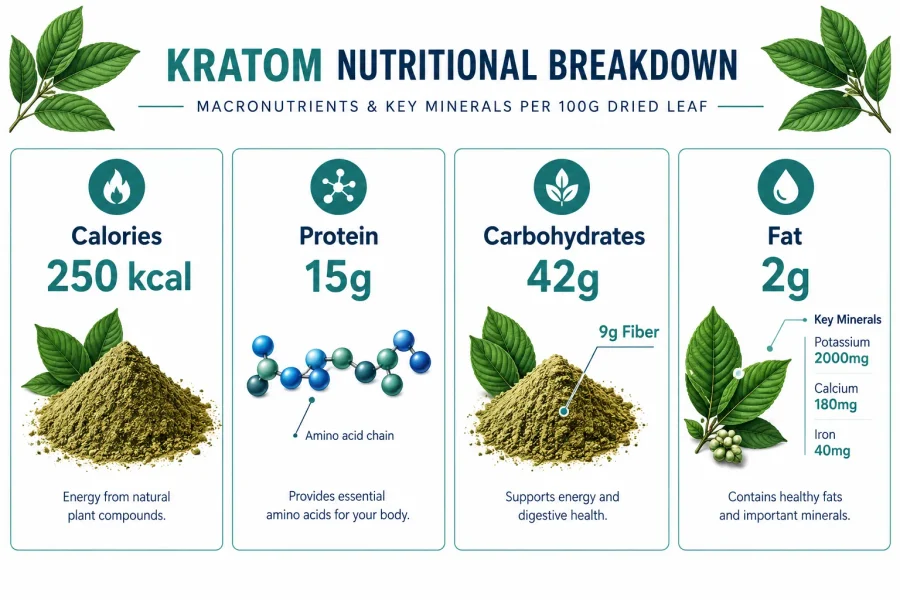
- Per 100 g, kratom leaf contains roughly 250 kcal, 15 g protein, 42 g carbohydrates, and 2 g fat
- Capsules add minimal extra calories from the gelatin shell [4]
- Kratom products carry no standardized FDA nutrition label in the United States
- Mixing kratom into juice or smoothies can spike the calorie count to 80-250+ kcal, all from the mixer [4]
- Kratom does not meaningfully break a fast at standard doses
- Hospitalizations linked to kratom have surged dramatically in 2026, so calorie content is the least of the safety concerns [5]
What Is Kratom and How Is It Used?
Kratom (Mitragyna speciosa) is a tropical tree native to Southeast Asia. Its dried leaves are ground into powder and consumed for stimulant effects at low doses and sedative effects at higher doses. The primary active compounds are mitragynine and 7-hydroxymitragynine.
Users take kratom as loose powder (toss-and-wash), brewed tea, capsules, or liquid shots. Doses typically range from 2-8 grams depending on the goal and tolerance. For a detailed breakdown of safe dose ranges, see this guide on how many grams of kratom to take.
Kratom is not FDA-approved and is categorized as a “new dietary ingredient” in the United States, meaning it carries no standardized nutrition facts panel.
Jack Botanicals - America's Trusted Kratom Source
AKA certified quality featuring Red Maeng Da, Red Bali, and Green Maeng Da. Lab-tested purity you can trust.
🎁 NEW CUSTOMER SPECIAL
JACK30 = 30% OFF
How Many Calories in Kratom Powder Per Teaspoon?
Here’s the deal: one teaspoon of kratom powder weighs approximately 2.5-3 grams. At roughly 1-1.5 calories per gram [4], that puts a single teaspoon at about 2.5-4.5 calories total.
That’s less than a stick of celery. For context:
| Amount | Estimated Calories |
|---|---|
| 1 gram kratom powder | ~1-1.5 kcal |
| 1 teaspoon (~2.5-3 g) | ~2.5-4.5 kcal |
| Standard dose (3-5 g) | ~5-15 kcal |
| 100 g dried leaf | ~250 kcal |
For accurate weight-based measurements, check the guide on how many grams are in a teaspoon of kratom.
Kratom Nutritional Facts and Macronutrients
Per 100 grams of dried kratom leaf, the estimated nutritional profile breaks down as follows:
- Calories: ~250 kcal
- Protein: ~15 g
- Carbohydrates: ~42 g
- Dietary fiber: ~9 g
- Fat: ~2 g
- Calcium: ~180 mg
- Phosphorus: ~120 mg
- Potassium: ~2,000 mg
- Iron: ~40 mg
- Small amounts of vitamin C and vitamin A
The pattern here fits a low-fat, moderately fibrous plant material. Most calories come from carbohydrates and protein, not fat. But nobody takes 100 g of kratom. A real-world dose is 3-5 g, which means the macronutrient contribution is nutritionally trivial.
Important caveat: These figures come from nutritional estimates, not FDA-approved nutrition labels. Kratom products are not required to carry standardized nutritional data in the United States. A 2026 investigation found approximately 85% of kratom products were mislabeled regarding active compounds, which means any calorie or nutrient figure on commercial packaging should be treated as an estimate at best.
I Looked Into Kratom’s Calorie Content While Tracking My Diet
Researched this about six months ago when I started paying closer attention to everything I consumed daily. Kratom powder contains roughly 4–7 calories per gram — mostly from carbohydrates and trace proteins. A typical 3–4g dose adds around 15–25 calories total, which is genuinely negligible for most people. Tea preparation doesn’t significantly change the calorie count either. Downsides: calorie content is the least of kratom’s dietary concerns — some users experience appetite suppression with regular use which can affect overall nutrition, nausea on an empty stomach is common and forces food timing adjustments, and long term daily use has been linked to weight changes in both directions. Calorie count is essentially a non-issue — other health considerations around kratom use matter significantly more.
Does Kratom Have Calories If You Just Drink the Tea?
Strained kratom tea contains 0-5 calories per 250-400 ml serving [4]. That’s essentially zero.
Here’s why: when you brew kratom and strain out the plant material, you remove most of the fiber, protein, and carbohydrates. What remains in the liquid are water-soluble alkaloids and trace compounds. The calorie-containing macronutrients stay in the filtered-out powder.
So if calorie tracking is the goal, strained tea is the lowest-impact preparation by a wide margin.
Kratom vs. Coffee Calories Comparison
Plain black coffee has roughly 2 calories per 240 ml cup. Plain strained kratom tea sits at 0-5 calories per serving [4]. They’re essentially equivalent from a calorie standpoint.
The comparison shifts when additives enter the picture:
- Black coffee: ~2 kcal
- Kratom tea (strained, plain): ~0-5 kcal
- Coffee with cream and sugar: ~50-100+ kcal
- Kratom powder mixed into a smoothie: ~80-250+ kcal [4]
Turns out, both kratom and coffee are near-zero calorie options in their plain forms. The calorie load always comes from what’s added, not the botanical itself.
Best Low-Calorie Ways to Take Kratom
For anyone tracking macros or cutting calories, the preparation method matters. Here’s the breakdown by form [4]:
- Strained kratom tea: 0-5 kcal. Lowest calorie option.
- Plain powder (toss-and-wash): 5-15 kcal for a 3-5 g dose.
- Capsules: 10-25 kcal including the gelatin shell material.
- Extract/enhanced powder (0.5-1.5 g): ~2-5 kcal.
- Powder mixed into juice or smoothies: 80-250+ kcal, almost entirely from the mixer.
The takeaway: toss-and-wash or strained tea keeps calorie impact near zero. Mixing kratom into a protein shake or juice adds meaningful calories, but those come from the shake or juice, not the kratom.
For capsule-specific dosing, see how much kratom is in a capsule and how many kratom capsules to take for effective dosage.
Kratom With Milk or Water: Calorie Difference
Water adds zero calories. Milk adds roughly 60-150 kcal per 240 ml depending on fat content (skim vs. whole). Almond milk runs about 30-40 kcal per cup.
The kratom itself contributes the same 5-15 kcal regardless of the mixer. So the calorie difference between taking kratom with water versus whole milk is entirely the milk’s contribution.
For anyone on a strict calorie deficit, water or strained tea is the obvious choice.
Does Kratom Break a Fast?
At a standard 3-5 g dose delivering 5-15 kcal, kratom is unlikely to meaningfully break a fast for most intermittent fasting protocols [4]. Most fasting frameworks treat anything under 50 kcal as negligible.
Strained kratom tea at 0-5 kcal is even less likely to trigger an insulin response or interrupt ketosis. Plain powder at 5-15 kcal sits in a gray zone that most practitioners would still consider fasting-compatible.
The bigger concern during a fast is kratom’s pharmacological effects on appetite and nausea, not its calorie content. Users report that kratom can suppress appetite at moderate doses, which may actually extend fasting periods unintentionally.
Kratom Capsules vs. Powder Calories
The calorie difference between capsules and loose powder is minimal. A gelatin capsule shell adds roughly 3-5 kcal per capsule [4]. A standard dose using 4-6 capsules adds maybe 12-30 kcal from the shells on top of the kratom powder inside.
Vegetarian (HPMC) capsules are comparable. The real variable is the powder dose inside, not the shell.
For anyone obsessing over this difference: it’s not worth the math. Both forms are nutritionally negligible at standard doses. The more useful question is potency and alkaloid content, not calories. See how much kratom to take for safe dosing for a more practical breakdown.
Why Does Kratom Have So Few Calories?
Kratom is a plant leaf. Dried plant material is mostly fiber, water-binding compounds, and a relatively small amount of digestible carbohydrates and protein. Fat content is minimal at around 2 g per 100 g.
Because doses are small (3-5 g) and the macronutrient density per gram is low, the math produces negligible calorie numbers. Compare that to 5 g of olive oil, which delivers about 44 kcal, or 5 g of sugar at 20 kcal. Plant leaf material just doesn’t pack energy the way fats and simple sugars do.
The alkaloids responsible for kratom’s effects (mitragynine, 7-hydroxymitragynine) are present in tiny amounts, typically 1.5-2% of the leaf by weight, and contribute no meaningful caloric value.
Kratom Calorie Estimator
Kratom for Weight Loss: Does It Help?
Kratom is not a weight loss supplement. There are no clinical trials establishing it as an effective tool for fat loss.
That said, users report appetite suppression at moderate doses, which could reduce overall calorie intake indirectly. This is a pharmacological effect of the alkaloids, not a nutritional one. The near-zero calorie content of kratom itself is not the mechanism.
The pattern in user feedback suggests stimulant-leaning strains (white and green vein) are more associated with appetite suppression than sedative red vein strains. But this is user-reported data, not clinical evidence.
The bigger picture: kratom hospitalizations have surged dramatically in 2026 [5], and poison control calls have reached record highs. Using kratom as a weight loss tool adds risk without established benefit.
For strain-specific effects, the guide on what kratom is best for pain and comfort covers how different vein colors affect user experience.
How Much Kratom Should I Take Per Dose?
Standard dose ranges vary by experience level and goal:
- Beginner: 1-2 g
- Moderate: 3-5 g
- Experienced: 5-8 g
- High dose (not recommended for new users): 8+ g
At 1-1.5 kcal per gram [4], even an 8 g dose delivers only about 8-12 kcal. The calorie question is irrelevant at any dose level.
What matters more is mitragynine concentration, which varies significantly across vendors and batches. For safe dosing guidance, see how many mg of kratom is safe and how long kratom lasts by dose.
Kratom Side Effects and Calorie Content
The calorie content of kratom is not the safety concern. The alkaloids are.
A March 2026 report documented a 1,150% surge in hospitalizations linked to kratom [5]. Poison control calls have hit record highs. Reported side effects include:
- Nausea and vomiting
- Constipation
- Drowsiness
- Loss of appetite
- Muscle pain
- Dependence and withdrawal
Clinical studies through 2026 confirm kratom acts on opioid receptors. The largest randomized controlled trial to date (116 healthy volunteers over 47 days) found no serious adverse events at controlled doses, but mild dose-related side effects did occur.
A 2026 cross-sectional study in Southern Thailand found no clinically significant blood abnormalities in chronic kratom users after adjusting for confounders [2]. But that research involved traditional leaf consumption, not the high-potency extracts now dominating the U.S. market [3].
Bottom line: the 5-15 calories in a kratom dose are not the issue. The alkaloid variability, product mislabeling, and rising potency of commercial products are the real concerns.
Kratom Powder Ingredients and Nutrition Label
Most commercial kratom products in the United States do not carry a standardized nutrition facts panel. Kratom is categorized as a “new dietary ingredient” and has not been approved by the FDA.
What you typically find on a kratom label:
- Serving size (usually in grams or capsule count)
- Strain name and vein color
- Sometimes: mitragynine percentage (though 85% of products are mislabeled on this metric)
- Rarely: any macronutrient breakdown
The absence of standardized labeling means consumers cannot reliably verify calorie content, alkaloid concentration, or ingredient purity from packaging alone. Third-party lab testing is the only reliable verification method.
How Many Calories in Kratom – FAQs
How many calories are in kratom?
Kratom powder contains a small amount of calories because it is made from dried plant leaves. The exact amount can vary depending on the serving size and preparation. A typical small serving may contribute only a modest number of calories, but nutrition information for kratom products is not always standardized or provided by manufacturers.
Does kratom powder have calories?
Yes, kratom powder contains calories because the powdered leaf contains plant material, including carbohydrates, fiber, and small amounts of protein and other compounds. However, the amount consumed in a typical serving is relatively small compared with many foods. The precise calorie content depends on the quantity of powder consumed and its composition.
How many calories are in one teaspoon of kratom?
The calorie content of one teaspoon of kratom can vary because teaspoon measurements do not always contain the same weight of powder. Factors such as how tightly the powder is packed can change the amount. For a more accurate estimate, the powder’s weight in grams and any available nutrition information should be considered together.
Does kratom tea have calories?
Plain kratom tea made by steeping kratom powder or leaf in water generally contains very few calories, particularly when the plant material is removed before drinking. However, added ingredients can increase the calorie content. Common additions include:
- Sugar or sweeteners containing calories
- Honey or syrups
- Milk or cream
- Fruit juice
Does kratom extract contain calories?
Kratom extracts can contain calories, but the amount depends on how the extract is prepared and what other ingredients are included. A concentrated extract may contain less plant material by volume than powdered leaf, but added sugars, flavorings, or other ingredients can change its nutritional content. Product-specific information is needed for an exact calorie estimate.
Can kratom calories affect a daily calorie count?
Kratom can contribute some calories when the powdered leaf or other calorie-containing ingredients are consumed. For most people tracking total calorie intake, the amount depends mainly on the quantity used and the preparation method. Plain preparations generally contribute fewer calories than products containing sugar, honey, milk, juice, or other calorie-containing ingredients.
Are kratom calories listed on nutrition labels?
Not every kratom product provides a standardized nutrition label showing calorie content. If calorie information is important, check the specific product packaging or manufacturer information. The listed serving size should also be considered because calorie estimates can differ depending on the amount of kratom and any additional ingredients contained in the product.
Conclusion
How many calories in kratom? The number is small enough to ignore for most practical purposes. A standard 3-5 gram dose delivers 5-15 kcal. Strained tea drops that to near zero. The only time kratom meaningfully adds calories to a diet is when it’s mixed into high-calorie beverages, and those calories come from the mixer.
The nutritional profile of kratom leaf (250 kcal per 100 g, 15 g protein, 42 g carbs, 2 g fat) is interesting as a data point but irrelevant at real-world doses. No one is getting meaningful macronutrients from a 3-gram serving.
What actually matters with kratom in 2026 is product quality, alkaloid concentration, and safety. Mislabeling is rampant. Hospitalizations are up sharply [5]. High-potency extracts are increasingly common [3]. Treat kratom as a pharmacologically active botanical, not a supplement with a nutrition label worth tracking.
If you’re using kratom, verify lab results, stick to measured doses, and understand what you’re actually taking. The calorie count is the least of the variables.
References
[1] Pmc12834682 – https://pmc.ncbi.nlm.nih.gov/articles/PMC12834682/
[2] Pmc12881633 – https://pmc.ncbi.nlm.nih.gov/articles/PMC12881633/
[3] Pmc12799471 – https://pmc.ncbi.nlm.nih.gov/articles/PMC12799471/
[4] Does Kratom Have Calories Macro Impact – https://theworkoutmag.com/supplements/does-kratom-have-calories-macro-impact
[5] Hospitalizations From Natural Supplement Have Shot Up 1150 – https://nypost.com/2026/03/26/health/hospitalizations-from-natural-supplement-have-shot-up-1150/
David is an ethnobotany enthusiast who has spent years studying the role of plants in both ancient and modern communities. His curiosity has taken him from libraries filled with old manuscripts to landscapes where indigenous traditions still thrive. David enjoys connecting the dots between the past and present, showing how nature continues to inspire human life. His work emphasizes thoughtful exploration, cultural respect, and the joy of discovering connections in the natural world.