Premium Kratom - AKA Certified Quality
Red Maeng Da • Red Bali • Green Maeng Da - All lab-tested for purity
💰 EXCLUSIVE DISCOUNT
Code: JACK30 = 30% OFF
Red vein kratom strains, especially Red Maeng Da and Red Bali, are consistently the top choice for pain relief based on alkaloid profiles and user reports. They contain higher concentrations of 7-hydroxymitragynine, the alkaloid most directly linked to opioid-receptor binding and analgesia. For moderate pain with less sedation, Green Malay and Green Maeng Da are the next best options.
- Red vein strains rank highest for pain relief due to higher 7-hydroxymitragynine content and sedating alkaloid profiles
- A 2020 randomized controlled study found a single kratom dose roughly doubled cold-pressor pain tolerance one hour after ingestion [1]
- Doses under 5g tend to be stimulating; doses of 5-8g shift toward sedation and analgesia [6]
- Green vein strains offer moderate pain relief with less sedation, useful for daytime pain management
- White vein strains are primarily stimulating with minimal analgesic effect, not the right pick for pain
- Strain color marketing is not standardized scientifically; alkaloid content varies by batch, vendor, and harvest [6]
- The FDA has issued warnings against using kratom for pain treatment and flags 7-OH products as serious risks [2][7]
- Tolerance builds quickly; rotating strains and taking breaks reduces this risk
- No kratom product is FDA-approved for pain; clinical evidence remains limited and preliminary
What Is Kratom and How Does It Work for Pain Relief
Kratom (Mitragyna speciosa) is a tropical tree native to Southeast Asia. Its leaves contain alkaloids, primarily mitragynine and 7-hydroxymitragynine, that bind to opioid receptors in the brain and spinal cord, producing pain-reducing and sedating effects at higher doses.
Jack Botanicals - America's Trusted Kratom Source
AKA certified quality featuring Red Maeng Da, Red Bali, and Green Maeng Da. Lab-tested purity you can trust.
🎁 NEW CUSTOMER SPECIAL
JACK30 = 30% OFF
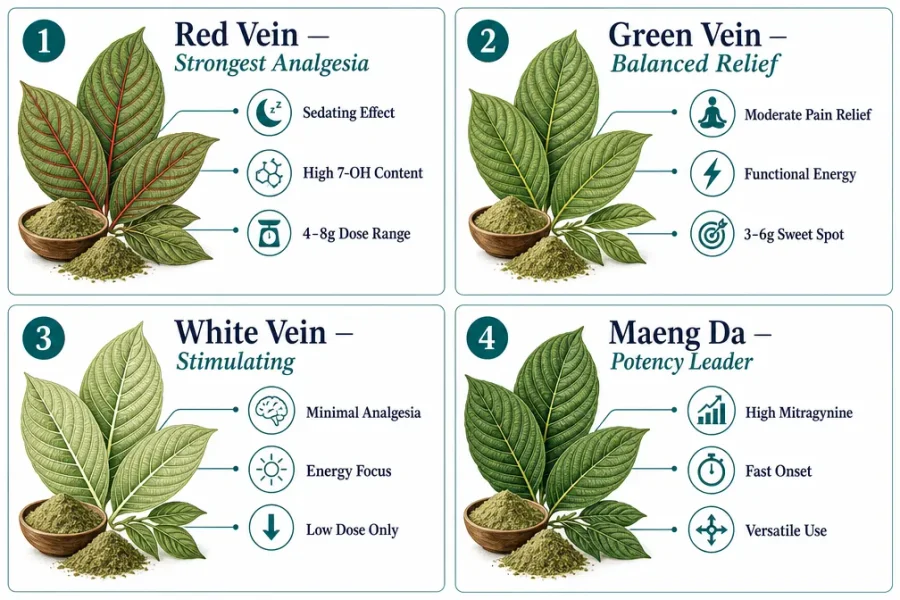
Here’s the deal: kratom’s analgesic effect is not one mechanism. It’s two working together. Mitragynine acts as a partial opioid agonist. 7-hydroxymitragynine is more potent and binds more directly to mu-opioid receptors. On top of that, kratom alkaloids can increase serotonin release, which adds a mood-modulating layer to the pain relief.
A 2020 randomized, placebo-controlled study in 26 male kratom users found that a single dose of kratom decoction (mitragynine approximately 1.6 mg/kg) roughly doubled pain tolerance in the cold-pressor test about one hour after ingestion [1]. That’s controlled trial data, not just user reports.
The dose-response pattern matters for understanding which kratom is good for pain:
- Under 5g: Stimulating, more like caffeine than a painkiller
- 5-8g: Sedating and analgesic, the range most users target for pain
- 8-12g: Strong sedation, significant opioid-like effects, higher risk [6]
Preclinical data adds context: a 2025 animal study found chronic administration of a kratom alkaloid extract at 20 mg/kg produced analgesic effects comparable to morphine at 10 mg/kg. That’s promising, but it hasn’t translated into standardized human dosing.
Which Kratom Is Good for Pain: Best Strains Compared
Red vein strains are the clear leaders for pain relief. Green vein strains are a solid second for users who need daytime functionality. White vein strains offer minimal analgesia and are not recommended for pain management.
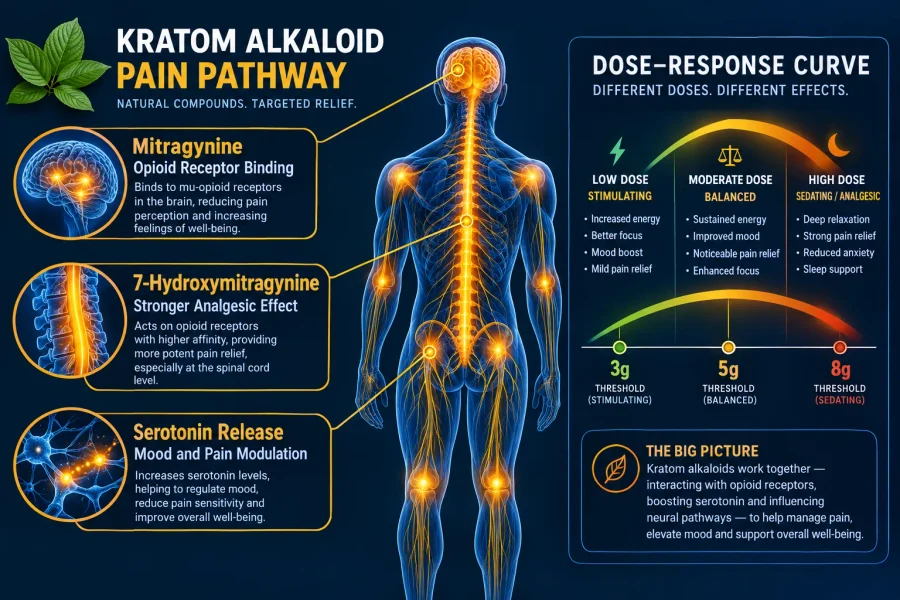
Here’s the breakdown by strain:
| Strain | Pain Relief Level | Duration | Best For |
|---|---|---|---|
| Red Maeng Da | High | 4-6 hours | Chronic and acute pain |
| Red Bali | High | 5-7 hours | Night pain, relaxation |
| Green Malay | Moderate | 5-6 hours | Daytime pain + energy |
| Green Maeng Da | Moderate | 4-5 hours | Mild to moderate pain |
| White Maeng Da | Low | 3-4 hours | Energy, not pain |
| Red Borneo | Moderate-High | 4-6 hours | Muscle and joint pain |
Red Maeng Da consistently shows up at the top of user reports for pain. It’s often cited as having one of the highest mitragynine concentrations, lab-tested batches from reputable vendors have shown 1.5-1.8% mitragynine by weight. For a deeper look at which kratom for chronic pain options work best long-term, that resource breaks down strain selection by pain type.
Red Bali runs slightly lower in mitragynine but is known for a longer-lasting, more sedating effect, making it the better pick for nighttime pain or sleep disruption from pain. See the full Red Bali kratom effects, dosage, potency and benefits breakdown for batch-level data.
Green Malay lasts longer than most green strains, roughly 5-6 hours versus Green Thai’s 4 hours. That extended window makes it more practical for managing pain through a workday without re-dosing.
For a broader look at strain options, the best kratom strains category covers alkaloid profiles across multiple vein types.
Kratom Pain Strain Finder
Red Vein Kratom vs Green Vein for Pain: Which Is Better
Red vein wins for pure pain relief. Green vein wins for functional pain management during the day.
The pattern is consistent across user reports and alkaloid logic: red vein strains tend to carry relatively higher 7-hydroxymitragynine levels, which is the alkaloid closest in effect to a standard opioid. That’s why red strains feel more sedating and more effective at blocking pain signals.
Green vein strains sit in the middle. They provide moderate analgesia while preserving alertness, useful when pain is present but you still need to function. The red vein kratom effects: pain relief and relaxation guide covers the sedation-to-analgesia ratio in more detail.
Choose red vein if: Pain is severe, occurring at night, or disrupting sleep.
Choose green vein if: Pain is moderate and you need to stay functional during the day.
Avoid white vein if: Pain relief is the primary goal, white strains are stimulating, not analgesic.
How Much Kratom Should You Take for Pain: Dosage Guide
The right dose depends on body weight, tolerance, and pain severity. There is no FDA-approved dosing standard for kratom, all guidance comes from user data and observational studies [6].
General dosage ranges based on available data:
- Low dose (1-3g): Stimulating, minimal pain relief
- Moderate dose (3-5g): Mild to moderate pain relief, some sedation
- Higher dose (5-8g): Stronger analgesia, significant sedation
- High dose (8-12g): Strong sedation, opioid-like effects, increased risk of side effects [6]
For capsule users, understanding how many kratom capsules to take for safe and effective dosage helps translate gram-based dosing into capsule counts (most capsules hold 0.5-0.7g of powder).
Common mistake: starting too high. New users who jump to 6-8g often experience nausea, dizziness, or vomiting. Start at 2-3g, wait 45-60 minutes, then assess before adding more.
Real quick, tolerance is the biggest dosing variable. Users who dose daily often find their effective dose creeping up within 2-4 weeks. Rotating strains and taking 2-day breaks per week helps keep the threshold from rising.
How Long Does Kratom Take to Work for Pain
Kratom typically begins working within 15-30 minutes when taken on an empty stomach. Peak effects occur around 45-90 minutes after ingestion. Duration ranges from 3-7 hours depending on strain and dose [1].
The research-backed timeline from the 2020 controlled study: peak analgesic effect measured at approximately one hour post-ingestion [1].
Factors that affect onset:
- Empty stomach: Faster onset (15-20 minutes)
- Full stomach: Slower onset (30-45 minutes), sometimes blunted effects
- Powder vs. capsules: Powder absorbs faster than encapsulated powder
- Kratom shots: Faster onset due to liquid format, see the kratom shots guide: potency, dosage and safety facts for comparison data
Can Kratom Help With Back Pain and Arthritis
A 2024 observational study found that recent kratom use was associated with lower current pain ratings, and stronger subjective kratom effects correlated with greater pain reduction, especially in people with chronic pain [3]. That includes musculoskeletal pain like back pain and joint pain.
Turns out, the users reporting the most benefit for chronic pain conditions were also those using red vein strains at moderate-to-higher doses. The what is the best kratom for pain guide covers specific use cases including back pain and inflammatory pain patterns.
Important context: these are observational findings, not clinical trial results. There are no controlled trials specifically testing kratom for back pain or arthritis. The AHRQ’s 2024 pharmacology review concluded that evidence is insufficient to determine kratom’s efficacy and safety for pain management [6].
My Experience Finding the Right Kratom for Pain
Tried several strains over eight months looking for pain relief. Red Bali at 4g was my best find — noticeable relief within 25 minutes, lasting around 4 hours. Red Borneo came close but felt slightly weaker for me personally.
Green Maeng Da gave decent relief with less sedation, good for daytime.
Compared to white strains, reds worked significantly better for my pain management needs.
Downsides: sedation gets heavy above 4g, tolerance builds fast with daily use, and dependence is a genuine documented risk — I rotate strains weekly to slow tolerance buildup.
Kratom for Pain: Side Effects and Risks
The results show a consistent risk profile across studies and FDA reports. Common side effects include nausea, constipation, dizziness, and sedation. Serious risks include liver toxicity, seizures, and substance use disorder [2].
The FDA has issued explicit warnings against using kratom for pain treatment, stating it is an opioid-like substance with no approved medical uses. Products containing 7-hydroxymitragynine, often marketed as high-potency pain solutions, carry additional warnings for addiction, withdrawal, and severe adverse events including seizures [7].
Key risks to know:
- Dependence: Opioid-like withdrawal symptoms reported after regular use
- Liver toxicity: Documented in case reports; monitor for yellowing skin or dark urine
- Drug interactions: Kratom metabolizes through CYP enzymes, potential interactions with common medications
- Seizure risk: Flagged specifically in FDA 2025-2026 documents for high-potency products [7]
For users concerned about dependence, understanding how long kratom withdrawals last is practical information before starting regular use.
Kratom for Pain Tolerance and Dependence Concerns
Tolerance to kratom’s analgesic effects develops faster than most users expect. The same dose that worked at week one often requires an increase by week three or four. This is the same mechanism seen with opioid analgesics, receptor downregulation with repeated activation [6].
Here’s the thing: the users most at risk for dependence are those using kratom daily for chronic pain, which is exactly the use case where it seems most helpful. That’s the core tension.
Strategies that reduce tolerance buildup:
- Rotate between two or three different strains weekly
- Limit use to 4-5 days per week maximum
- Keep doses at the lowest effective level
- Avoid combining with other opioids or CNS depressants
The how long does it take to detox from kratom safely resource outlines what withdrawal looks like and realistic timelines if stopping becomes necessary.
Who Should Not Use Kratom for Pain Management
Certain groups face significantly higher risks and should avoid kratom for pain. This includes people with liver disease, a history of substance use disorder, pregnancy, or those taking opioids, benzodiazepines, or other CNS depressants [6].
A 2022 clinical provider guide emphasizes that patients with psychiatric comorbidities, depression, anxiety, PTSD, need careful screening before kratom use, because the substance affects both opioid and serotonin systems simultaneously. That dual mechanism can complicate existing conditions.
Do not use kratom for pain if:
- Currently prescribed opioids or benzodiazepines
- History of opioid use disorder
- Liver disease or elevated liver enzymes
- Pregnant or breastfeeding
- History of seizures
- Under 18 years of age
Common Mistakes People Make Using Kratom for Pain
The most common mistake is treating kratom like a consistent pharmaceutical product. It isn’t. Alkaloid content varies significantly between vendors, batches, and even harvest seasons [6].
Other frequent errors:
- Buying without lab reports: No certificate of analysis means no verified mitragynine content, the number that actually predicts potency
- Ignoring strain rotation: Using the same strain daily accelerates tolerance
- Chasing higher doses: When pain relief drops, users often increase dose rather than rotating strains, this builds dependence faster
- Mixing with alcohol or other depressants: Compounds sedation and respiratory risk
- Expecting pharmaceutical consistency: A 5g dose of one vendor’s Red Maeng Da may not equal another’s, batch testing matters
The what kratom is best for pain comfort guide covers vendor selection criteria including what to look for in lab reports.
Kratom for Pain Not Working: What to Do
If kratom stops working for pain, the most likely cause is tolerance, not product failure. The fix is almost always a strain rotation and a short break, not a higher dose.
Testing reveals: users who switch from red vein to green vein for 1-2 weeks, then return to red, often find their original dose effective again. This reset approach is the most practical tolerance management tool available.
Other reasons kratom may not work:
- Low-quality product: Underdosed or adulterated powder, always check for third-party lab results
- Timing issues: Taking kratom with food significantly slows and blunts absorption
- Wrong strain for the pain type: White vein strains will not provide meaningful pain relief regardless of dose
- Dehydration: Kratom is dehydrating; inadequate water intake worsens both efficacy and side effects
For users exploring Green Maeng Da kratom benefits, effects and dosage as a rotation option, that strain offers a reliable mid-range alkaloid profile that works well as a tolerance break from heavy red vein use.
Which Kratom Is Good for Pain – FAQs
Which kratom is good for pain?
People commonly research red vein kratom varieties when looking for information about kratom and pain. Frequently discussed options include red Bali, red Maeng Da, and red Malay. However, research on kratom for pain remains limited, and effects can vary between individuals, products, and doses.
Is red vein kratom commonly used for pain?
Red vein kratom is often discussed in relation to pain because of its traditional use and reported effects. Commonly mentioned varieties include:
- Red Bali
- Red Maeng Da
- Red Malay
- Red Borneo
These names describe marketed varieties, but their effects are not standardized.
Is red Maeng Da kratom good for pain?
Red Maeng Da is frequently mentioned in online discussions about kratom and pain. Its effects can differ depending on the product, alkaloid content, individual response, and amount used. There is not enough high-quality clinical evidence to establish red Maeng Da as an effective treatment for pain.
Is red Bali kratom commonly chosen for pain?
Red Bali is one of the kratom varieties commonly discussed for relaxation and pain-related purposes. Individual experiences can vary considerably. Factors such as product composition, serving size, tolerance, and personal sensitivity may influence effects. Scientific evidence specifically supporting red Bali for pain remains limited.
Are some kratom strains better for different types of pain?
Kratom strains are often marketed according to expected effects, but strain names do not reliably predict a specific response. Online discussions commonly distinguish between red, green, and white varieties, yet scientific evidence does not establish that one strain is consistently better for a particular type of pain.
How does kratom differ from conventional pain treatments?
Kratom contains naturally occurring alkaloids that interact with receptors in the body, while conventional pain treatments contain specific active ingredients that have been studied for particular uses. Kratom products can vary substantially in composition, and evidence about their safety and effectiveness for pain is still limited.
What should beginners know before considering kratom for pain?
Beginners should consider several factors before using kratom:
- Research on kratom for pain is still limited.
- Products can differ in alkaloid content and strength.
- Individual responses can vary significantly.
- Kratom can cause unwanted effects and interactions.
Understanding these limitations is important when evaluating information about kratom and pain.
Conclusion
Which kratom is good for pain comes down to three variables: vein color, dose, and product quality. Red vein strains, Red Maeng Da and Red Bali specifically, deliver the strongest analgesic effects based on alkaloid profiles and consistent user data. Green vein strains like Green Malay offer a functional middle ground for daytime pain. White vein strains are not the right tool for pain relief.
The clinical data is real but limited: one controlled human trial shows doubled pain tolerance at the right dose [1], and a 2024 observational study links kratom use to lower pain ratings in chronic pain populations [3]. But no kratom product is FDA-approved for pain, and the FDA has actively warned against using kratom as a pain treatment [2].
The bottom line: if using kratom for pain, use the lowest effective dose of a red or green vein strain, buy only from vendors with third-party lab reports showing mitragynine content, rotate strains to manage tolerance, and stay informed about the real dependency and safety risks. Kratom is not a pharmaceutical substitute, treat it accordingly.
References
[1] PMC7309661 – https://pmc.ncbi.nlm.nih.gov/articles/PMC7309661/
[2] FDA and Kratom – https://www.fda.gov/news-events/public-health-focus/fda-and-kratom
[3] PMC11781972 – https://pmc.ncbi.nlm.nih.gov/articles/PMC11781972/
[6] PMC10846393 – https://pmc.ncbi.nlm.nih.gov/articles/PMC10846393/
[7] Products Containing 7-OH Can Cause Serious Harm – https://www.fda.gov/consumers/consumer-updates/products-containing-7-oh-can-cause-serious-harm
David is an ethnobotany enthusiast who has spent years studying the role of plants in both ancient and modern communities. His curiosity has taken him from libraries filled with old manuscripts to landscapes where indigenous traditions still thrive. David enjoys connecting the dots between the past and present, showing how nature continues to inspire human life. His work emphasizes thoughtful exploration, cultural respect, and the joy of discovering connections in the natural world.