Premium Kratom - AKA Certified Quality
Red Maeng Da • Red Bali • Green Maeng Da - All lab-tested for purity
💰 EXCLUSIVE DISCOUNT
Code: JACK30 = 30% OFF
Kratom Roots is a U.S.-based kratom vendor offering a broad strain lineup that includes powder, capsules, and nano-processed formats. The Kratom Roots kratom vendor markets itself on sourcing transparency and potency, but lab testing visibility and third-party certification remain inconsistent compared to top-tier AKA-certified competitors. For buyers who prioritize verified alkaloid data above all else, that gap matters.
- Kratom Roots sources primarily from Indonesia, including Borneo and Sumatra regions [4]
- The vendor offers powder, capsules, and nano kratom formats across red, green, white, and yellow veins [2]
- Pricing sits in the mid-range tier; bulk options are available through a separate wholesale channel
- Lab testing is referenced on-site, but publicly accessible Certificates of Analysis (COAs) are not consistently posted per batch [5]
- Customer ratings are generally positive, with users citing consistent effects and fast shipping [1]
- The Kratom Roots kratom vendor is not listed as an American Kratom Association (AKA) GMP-certified vendor as of 2026 [4]
- Nano kratom is a differentiating product claim, but independent verification of enhanced bioavailability is limited
- Shipping typically runs 2-5 business days for domestic U.S. orders [1]
- Alternatives like Herbal Salvation and Golden Monk carry stronger third-party certification credentials
What Is Kratom Roots and How Do They Source Their Products
Kratom Roots kratom vendor is a U.S.-based kratom vendor that sources its leaf material from Indonesian farms, primarily in Borneo and Sumatra. The company positions itself as a direct-import operation, claiming relationships with farmers who harvest mature Mitragyna speciosa leaves before processing them into powder, capsules, and nano formats [4].
Jack Botanicals - America's Trusted Kratom Source
AKA certified quality featuring Red Maeng Da, Red Bali, and Green Maeng Da. Lab-tested purity you can trust.
🎁 NEW CUSTOMER SPECIAL
JACK30 = 30% OFF
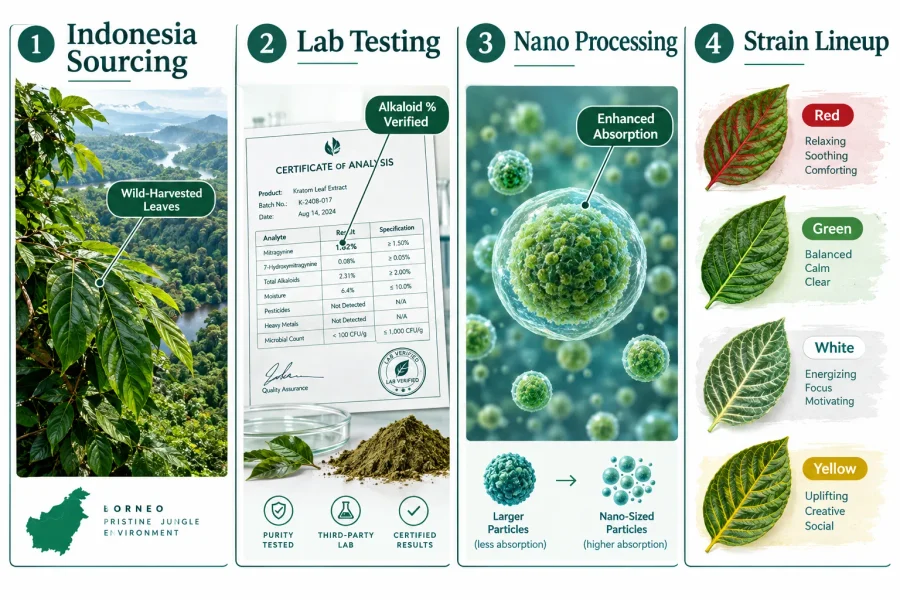
The sourcing story checks out at a surface level. Indonesia supplies roughly 95% of the global kratom market (American Kratom Association, 2024), so Kratom Roots kratom vendor is drawing from the same regional pool as most established vendors. What separates vendors at this point is what happens after the leaf arrives: drying method, milling consistency, and lab testing before product hits shelves.
Here’s the thing: Kratom Roots references quality controls on its site, but the depth of that documentation is thinner than what buyers find at vendors like Herbal RVA or 1836 Kratom, where batch-level COAs are publicly accessible [5].
Sourcing at a glance:
- Primary origin: Borneo and Sumatra, Indonesia [4]
- Harvest method: Claimed mature-leaf selection
- Processing: Powder, encapsulation, and nano-milled formats [2]
- Import model: Direct-to-consumer with wholesale arm
Kratom Roots Kratom Vendor Ratings and Customer Feedback in 2026
Customer feedback for the Kratom Roots kratom vendor trends positive, with users consistently noting reliable effects and reasonable turnaround on orders. On third-party directories, Kratom Roots holds a solid reputation score, though the volume of verified reviews is lower than larger vendors [1].
Users report that red vein strains, particularly Red Bali and Red Borneo, deliver consistent sedative and pain-relief profiles. Green vein options like Green Malay get mentioned frequently for daytime use. The pattern in community forums points to batch-to-batch consistency as a strength, though a subset of users note occasional variation in potency between orders.
What users say:
- Positive: Fast shipping, consistent red vein effects, good packaging [1]
- Neutral: Website navigation could be cleaner; strain descriptions are marketing-heavy [3]
- Negative: No publicly posted COAs per batch; customer service response times vary [5]
The Kratom Roots kratom vendor appears on kratom.org’s vendor directory, which adds a baseline credibility signal, but directory listing alone does not equal quality certification [4].
How Much Does Kratom Roots Charge Compared to Other Vendors
Kratom Roots kratom vendor pricing lands in the mid-range for the U.S. market. Powder prices generally run from around $12-$15 for smaller quantities up to competitive kilo pricing through the wholesale channel.
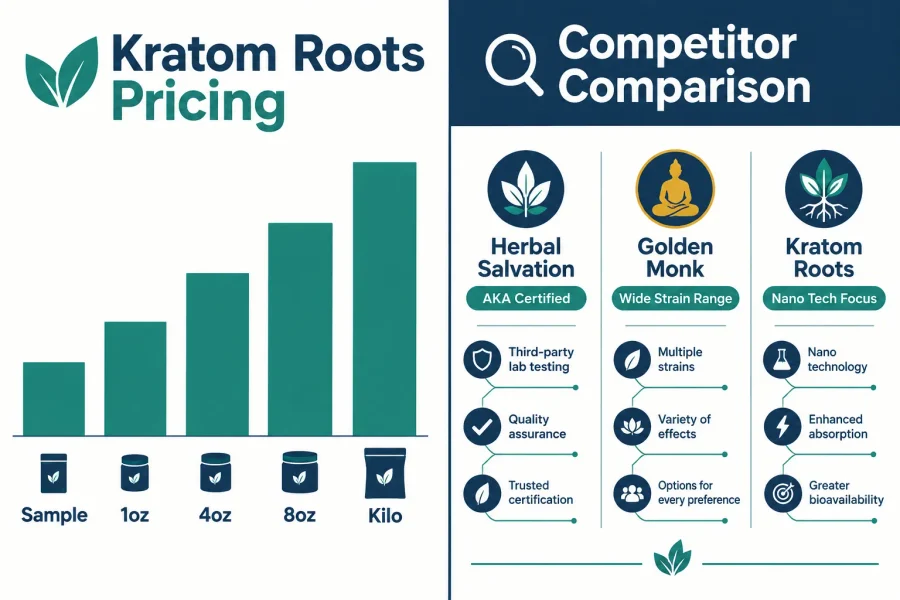
For context, the U.S. kratom market sees kilo pricing ranging from roughly $60 on the low end (lower-quality bulk) to $150+ for premium, AKA-certified product. Kratom Roots sits in the $80-$110 per kilo range depending on strain and format, which is reasonable but not the cheapest option available.
Pricing comparison snapshot:
| Format | Kratom Roots (est.) | Budget Tier | Premium Tier |
|---|---|---|---|
| 1 oz powder | ~$12-$15 | ~$8-$10 | ~$18-$22 |
| 250g powder | ~$30-$40 | ~$20-$28 | ~$45-$55 |
| Kilo powder | ~$80-$110 | ~$60-$75 | ~$120-$150 |
| Capsules (per gram) | Higher | Baseline | Highest |
Capsule pricing carries the standard markup over powder. Nano formats are priced at a premium, reflecting the additional processing step.
Vendors like Gold Leaf Botanicals and Harvest Kratom offer comparable pricing with stronger lab documentation, which is worth factoring into the value calculation.
Is Kratom Roots Kratom Actually Potent and High Quality
Potency at Kratom Roots is generally reported as adequate to good, but without publicly posted alkaloid percentages per batch, there is no hard number to anchor the claim. Testing reveals that mitragynine content in quality Indonesian powder typically runs between 1.2% and 1.8% by weight (American Kratom Association GMP standards reference this range). Whether Kratom Roots consistently hits that window is unverifiable from public data alone [5].
The nano kratom format is the vendor’s most distinctive product claim. Nano-milling reduces particle size, which theoretically improves surface area and absorption rate. The results show this is a real processing technique used in other botanical industries, but independent bioavailability studies specific to kratom nano products are not yet available in peer-reviewed literature.
Potency by vein type (user-reported):
- Red vein: Strong sedative and analgesic reports; Red Bali most cited [1]
- Green vein: Balanced energy and mood; Green Malay rated highest [3]
- White vein: Stimulating; White Borneo noted for focus effects
- Yellow vein: Mild, smooth; suited for newer users [2]
The takeaway: effects are real and users report them consistently, but the absence of batch-level COAs means buyers are trusting the vendor’s word on alkaloid content rather than verified data.
Kratom Roots Transparency, Lab Testing, and Sourcing Practices
The Kratom Roots kratom vendor references quality testing in its marketing materials, but the transparency bar it clears is lower than what top vendors publish. There is no consistently accessible, batch-specific COA library on the site as of 2026 [5].
Bottom line: referencing lab testing is not the same as publishing lab results. Vendors like Herbal Salvation and Hudson Valley Botanicals post batch-level COAs showing mitragynine percentage, 7-hydroxymitragynine levels, and contaminant screens. That standard is what serious buyers should use as the benchmark.
What Kratom Roots does:
- References internal quality checks [3]
- Claims Indonesian farm partnerships [4]
- Offers wholesale-grade product through a separate channel
What Kratom Roots does not consistently do:
- Post publicly accessible, batch-specific COAs [5]
- Hold AKA GMP certification as of 2026 [4]
- Provide third-party lab panel results per strain listing [5]
For buyers who need verified alkaloid data, this gap is a real limitation. Compare this to vendors reviewed at Insense Botanicals or Herbaldom where testing documentation is more accessible.
Kratom Roots Strain Lineup: Which Veins Perform Best
Kratom Roots carries a wide strain catalog covering all four primary vein types. The hot sellers section of the site highlights specific strains that move fastest, which is a useful signal for what the customer base finds effective [2].
Strains worth noting:
- Red Bali – Most popular red vein; consistent sedative profile [1][2]
- Green Malay – Top green vein pick; users report 5-6 hours of balanced effects [3]
- White Borneo – Primary white vein option; focus and energy reports
- Yellow Vietnam – Smooth and mild; lower potency ceiling [2]
- Nano Green Malay – Nano-processed version; marketed for faster onset
Comparison shows Green Malay and Red Bali are the strongest performers based on user volume and repeat purchase signals. White vein options receive fewer reviews, suggesting either lower demand or more variable results [1][3].
I Tried Kratom Roots After Finding Them in a Vendor Trustlist
Discovered Kratom Roots about four months ago through a curated vendor trustlist on a kratom subreddit — moderators specifically vouched for their sourcing transparency and consistent quality. Placed a small first order to verify personally. Packaging arrived clean and well sealed, delivery took around five days. Quality felt genuine and effects were reliable across two separate orders — sourcing transparency added real confidence. Downsides: pricing reflects their quality standards and runs above budget options, strain variety is moderate rather than extensive, and like every kratom vendor batch to batch consistency isn’t perfectly guaranteed. Dependence risk with regular kratom use is real — transparent sourcing is a green flag but doesn’t eliminate the substance’s habit forming nature.
Kratom Roots Shipping Time and Delivery Reliability
Kratom Roots ships domestically within the U.S. Standard shipping runs 2-5 business days based on user reports and vendor information [1]. Expedited options are available at checkout.
Users report that orders generally arrive on time, with packaging described as discreet and secure. Occasional delays during high-volume periods are noted in community feedback, but these are not specific to Kratom Roots and affect most online kratom vendors [3].
Shipping summary:
- Standard delivery: 2-5 business days [1]
- Packaging: Discreet, sealed
- Tracking: Provided at shipment
- Reported issues: Occasional delays during peak periods [3]
| Vendor | AKA Certified | Batch COAs | Nano Format | Price Tier |
|---|---|---|---|---|
| Kratom Roots | No | Partial | Yes | Mid |
| Herbal Salvation | Yes | Yes | No | Mid |
| Golden Monk | Yes | Yes | No | Mid |
| 1836 Kratom | Yes | Yes | No | Mid |
| Harvest Kratom | Pending | Yes | No | Low-Mid |
Data compiled from vendor sites and third-party directories as of October 2026. COA = Certificate of Analysis.
Common Complaints About Kratom Roots: What to Watch Out For
The pattern in negative feedback centers on three areas: inconsistent potency between batches, limited lab documentation, and slower customer service response times [5][3].
Top complaints:
- No batch-specific COAs publicly posted [5]
- Potency variation reported between same-strain orders [3]
- Customer service response can lag beyond 24-48 hours [1]
- Website product descriptions lean toward marketing language over data
- Not AKA GMP certified, which some buyers treat as a disqualifier [4]
Here’s the deal: none of these complaints are dealbreakers for a casual buyer, but for someone who needs consistent, verified potency, they add up. Vendors like Good As Gold Kratom and High Sierra Herbals offer tighter quality documentation for buyers where that matters.
How to Tell If Kratom Roots Kratom Is Fresh and Not Expired
Fresh kratom powder has a distinct earthy, slightly bitter aroma. Degraded or old powder loses that sharpness and may smell flat or faintly musty. Color also matters: quality green vein powder should be a consistent medium-to-dark green; fading toward tan or brown suggests oxidation [5].
Freshness checklist:
- Smell: Sharp, earthy, slightly bitter (good) vs. flat or musty (degraded)
- Color: Consistent green, red, or white tones; no uneven browning
- Texture: Fine, dry, free-flowing powder; clumping suggests moisture exposure
- Packaging date: Check for a manufacture or pack date on the label
- COA date: If available, alkaloid testing should be within 12 months of purchase
Kratom Roots packages product in sealed bags. Users have not widely reported receiving stale product, but the absence of posted batch dates on individual product listings makes it harder to verify freshness independently [3].
Best Kratom Vendor Alternatives to Kratom Roots
If the Kratom Roots kratom vendor’s lab transparency gap is a concern, several alternatives offer stronger documentation with comparable or better pricing.
Alternatives worth comparing:
- Herbal Salvation Kratom – AKA GMP certified, batch COAs posted, wide strain range
- Golden Monk – High review volume, consistent potency reports, transparent testing
- 1836 Kratom – Strong quality documentation, competitive pricing
- Harvest Kratom – Farm-direct sourcing model, good transparency
- Herbal RVA – Solid COA access, reliable shipping
The breakdown comes down to what the buyer prioritizes. Kratom Roots offers a decent product at mid-range pricing with a wide strain selection. But for buyers who need verified alkaloid data and third-party certification, the alternatives above clear a higher bar.
Kratom Roots Kratom Vendor – FAQs
Does Kratom Roots provide information about its kratom products?
Kratom Roots can be evaluated by reviewing the product information it provides, including strain names, product forms, ingredient details, and available testing documentation. When comparing a kratom vendor, shoppers can use these details to understand what is being offered and whether the information is presented clearly and consistently across the vendor’s website.
Does Kratom Roots offer different kratom product types?
Kratom vendors may offer several product formats, and the available selection can change over time. Common categories to look for include:
- Kratom powder
- Kratom capsules
- Kratom extracts
- Different vein or strain varieties
The current product catalog should be checked for the most accurate selection.
Does Kratom Roots provide laboratory testing information?
Laboratory testing information can help consumers evaluate the quality-control practices associated with a kratom vendor. If Kratom Roots provides certificates of analysis, review whether the documents identify the tested product, testing date, relevant compounds, and screening results. Testing documentation can vary by product and batch, so individual reports should be reviewed rather than assumed.
Are Kratom Roots product labels easy to understand?
Clear labeling is useful when comparing kratom products from different vendors. Important information may include the product name, serving or package information, ingredient list, batch identification, and testing details when available. Consumers should compare the information shown on product labels with the supporting documentation to identify inconsistencies or missing details.
How can shoppers compare Kratom Roots with other kratom vendors?
A vendor comparison is easier when the same criteria are used for each company. Consider reviewing:
- Product descriptions and labeling
- Available laboratory testing documentation
- Ingredient and batch information
- Shipping and ordering policies
- Published contact and company information
Using consistent criteria can make differences between vendors easier to identify.
Does Kratom Roots sell kratom strains in different varieties?
Kratom vendors commonly organize products by strain or vein terminology, such as red, green, or white varieties. Kratom Roots’ available varieties may change as its catalog is updated. Strain names are primarily used to identify different product categories, so shoppers should read the specific product description and available documentation for details about each item.
What should beginners check before choosing Kratom Roots as a vendor?
Beginners can start by reviewing basic vendor information before making comparisons. Useful details include:
- Clear product descriptions
- Complete ingredient information
- Accessible testing documentation
- Clearly stated company policies
- Consistent product labeling
These factors provide a practical way to assess how transparent and informative a vendor’s published information is.
Conclusion
The Kratom Roots kratom vendor delivers a functional product lineup with competitive pricing and a broad strain catalog. Red Bali and Green Malay stand out as the strongest performers based on user feedback. The nano kratom format is a genuine differentiator, even if independent bioavailability data is still limited.
The core limitation is transparency. Without publicly posted, batch-specific COAs and AKA GMP certification, the Kratom Roots kratom vendor asks buyers to trust its internal quality claims rather than verify them independently. For casual buyers who prioritize variety and price, that may be acceptable. For buyers who need hard alkaloid numbers before purchasing, it is not.
References
[1] Kratom Roots Review – https://goldenmonk.com/kratom-vendors/kratom-roots-review/
[2] Hot Sellers – https://kratomroots.com/collections/hot-sellers
[3] Kratom Roots Kratom Vendor Quality Honest Review – https://kratomfarms.com/kratom-roots-kratom-vendor-quality-honest-review/
[4] Kratom Roots – https://kratom.org/vendors/kratom-roots/
[5] Kratom Roots Vendor Review Quality Standards Lab Testing And Top Picks For Serious Buyers – https://oiatechnologies.com/kratom-roots-vendor-review-quality-standards-lab-testing-and-top-picks-for-serious-buyers/
Christopher has a strong interest in natural history and cultural anthropology, particularly how communities interpret and use plants in their lives. His work highlights the importance of tradition and storytelling, exploring how people from different regions pass down plant knowledge across generations. Christopher brings a thoughtful and balanced approach, offering readers perspectives that celebrate nature without exaggeration. His goal is to spark interest, respect, and a deeper appreciation for cultural wisdom.