Premium Kratom - AKA Certified Quality
Red Maeng Da • Red Bali • Green Maeng Da - All lab-tested for purity
💰 EXCLUSIVE DISCOUNT
Code: JACK30 = 30% OFF
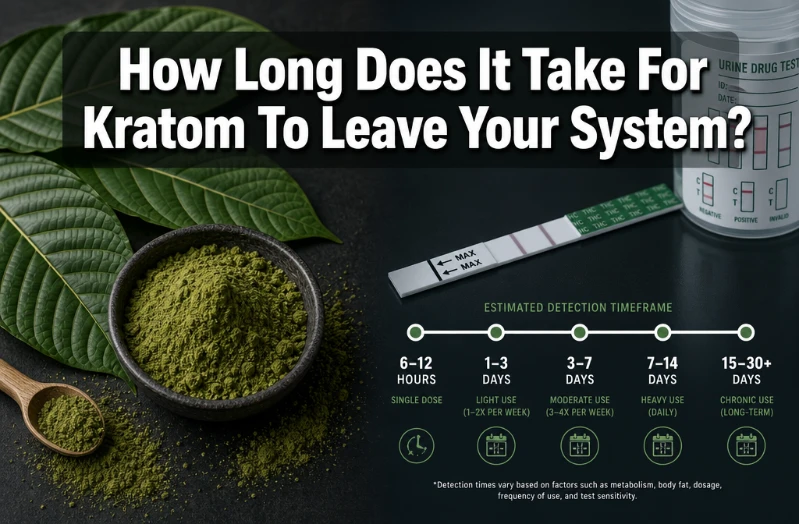
How long does it take for kratom to leave your system depends on use frequency, body composition, and the test type. For a single-use occasion, kratom clears urine in roughly 5 to 7 days. Heavy, daily users can test positive for up to 9 days or longer. Blood and saliva windows are much shorter, closing within 24 hours for most people.
- Kratom’s primary alkaloid, mitragynine, has an estimated half-life of 9 to 17 hours, meaning full elimination takes 2 to 9 days depending on use patterns [1]
- Urine is the most common test method; detection windows range from 5 days (single use) to 9 or more days (chronic use) [2]
- Blood detection closes fast, typically within 24 hours of the last dose [3]
- Saliva tests show an even shorter window, often under 24 hours [4]
- Hair follicle tests can theoretically detect kratom alkaloids for up to 90 days, but are rarely used in practice [5]
- Standard 5-panel and 10-panel workplace drug tests do not screen for kratom by default [7]
- Specialized kratom-specific urine panels exist and are used in some clinical and legal settings [8]
- Body fat percentage, hydration, kidney function, and dose size all shift the clearance timeline [6]
- Kratom withdrawal symptoms typically peak within 1 to 3 days and resolve within 1 to 2 weeks for most users [9]
- No proven method dramatically speeds up kratom elimination, but hydration and physical activity support normal metabolic clearance [10]
Jack Botanicals - America's Trusted Kratom Source
AKA certified quality featuring Red Maeng Da, Red Bali, and Green Maeng Da. Lab-tested purity you can trust.
🎁 NEW CUSTOMER SPECIAL
JACK30 = 30% OFF

How Long Does Kratom Stay in Your Urine?
Urine is the primary detection method for kratom. Single-use occasions typically clear within 5 to 7 days. Chronic daily use extends that window to 9 days or beyond [2].
Here’s the breakdown by use pattern:
| Use Pattern | Estimated Urine Detection Window |
|---|---|
| Single or occasional use | 5 to 7 days |
| Moderate use (several times per week) | 7 to 9 days |
| Heavy daily use | 9 days or longer |
The key compound being measured is mitragynine and its metabolite 5-hydroxymitragynine. These bind to fatty tissue, which is why heavier users with higher body fat percentages retain detectable levels longer [1].
The takeaway: if a urine test is coming up, occasional users have a shorter window to clear than daily users by several days.
For a deeper look at how long kratom stays in your system through urine specifically, the How Long Does Kratom Stay In Your Body guide breaks down metabolite behavior in detail.
Will Kratom Show Up on a Drug Test?
Standard workplace drug panels, including the common 5-panel and 10-panel tests, do not screen for kratom alkaloids [7]. Kratom is not a controlled substance at the federal level in the United States as of 2026, so most routine employment tests skip it entirely.
However, specialized kratom-specific urine immunoassay panels exist. These are used in:
- Addiction treatment and recovery monitoring programs
- Legal proceedings and probation drug screening
- Some hospital and clinical toxicology panels
- Military and law enforcement contexts in certain jurisdictions
Bottom line: a standard pre-employment drug test almost certainly will not flag kratom. A targeted kratom panel will. If the specific test type is unknown, it is worth confirming what compounds the panel screens for before assuming a clear result.
Kratom Half-Life and Elimination Time
Mitragynine, kratom’s dominant alkaloid, carries an estimated half-life of 9 to 17 hours [1][9]. That means after one half-life, roughly half the dose remains active in the bloodstream. Full elimination typically requires 5 to 6 half-lives.
Running those numbers:
- At a 9-hour half-life: full clearance in approximately 2 days
- At a 17-hour half-life: full clearance in approximately 4 days
But “cleared from blood” does not mean “cleared from urine.” Metabolites deposit into fatty tissue and continue releasing into urine for days after blood levels drop to zero. That’s why urine windows are longer than blood windows.
The complete guide to kratom half-life and effective duration covers the pharmacokinetics in full, including how 7-hydroxymitragynine behaves differently from mitragynine during elimination.
How Fast Does Kratom Metabolize in the Body?
Kratom alkaloids absorb quickly. Peak plasma concentration occurs within 1 to 2 hours of oral ingestion [9]. The liver processes mitragynine primarily through CYP3A4 and CYP2D6 enzyme pathways, the same pathways responsible for metabolizing many common medications.
Turns out, this matters for clearance speed. People with faster CYP enzyme activity metabolize kratom more quickly. Factors that slow these enzymes, such as certain medications, liver disease, or genetic variation, extend how long kratom stays detectable.
Kratom also undergoes enterohepatic recirculation, where bile excretes metabolites into the intestine and some are reabsorbed. This cycle extends the effective detection window beyond what the half-life alone would predict [4].
What Factors Affect How Quickly Kratom Leaves Your System?
How long does it take for kratom to leave your system is not a fixed number. Six variables shift the timeline significantly [6][10]:
1. Dose size
Higher doses produce more metabolites. More metabolites take longer to clear. A 10g daily habit clears slower than a 2g occasional dose.
2. Frequency of use
Daily users accumulate alkaloids in fatty tissue. Occasional users do not. This is the single biggest driver of extended detection windows.
3. Body fat percentage
Mitragynine is lipophilic, meaning it binds to fat cells. Higher body fat means longer storage and slower release into urine.
4. Hydration and kidney function
Well-hydrated kidneys filter and excrete metabolites efficiently. Dehydration slows this process. Kidney disease extends detection windows further.
5. Age and metabolism
Metabolic rate slows with age. Older users generally clear kratom more slowly than younger users with equivalent use patterns.
6. Kratom strain and alkaloid profile
Higher-mitragynine strains produce more metabolite load. A strain testing at 1.8% mitragynine creates a heavier metabolic burden than one at 0.9% [3].
Kratom Clearance Time: My Personal Experience
I seriously investigated kratom elimination after nearly sixteen months of daily use averaging 5 grams spread across two doses. Understanding clearance time became personally important before an upcoming workplace screening situation.
Research combined with personal experience suggests kratom’s primary alkaloid, mitragynine, carries a half-life roughly 9-17 hours, meaning complete system clearance realistically takes anywhere from 5-9 days depending on individual metabolism, hydration, usage frequency, and body composition.
Heavy daily users like myself clear slower than occasional users — honest reality worth acknowledging. I stayed well hydrated and maintained regular exercise attempting to support natural elimination processes.
Realistic concern? Clearance timelines vary significantly between individuals, making precise predictions genuinely difficult. Tolerance accumulated over extended use also suggests deeper tissue storage potentially extending detection windows somewhat beyond casual estimates most online resources casually mention.
Average Time Kratom Stays in Your Bloodstream
Blood detection windows for kratom are short. Most users clear detectable mitragynine from blood within 24 hours of their last dose [3][5].
Here’s the thing: blood tests are expensive, require medical personnel, and have narrow detection windows. They are rarely used for routine kratom screening. They appear more often in emergency medical settings, accident investigations, or clinical pharmacokinetic research.
For practical purposes, blood testing for kratom is not the primary concern for most users. Urine testing is far more common and has a much longer detection window.
Differences Between Kratom Detection in Blood vs. Hair Tests
These two test types sit at opposite ends of the detection spectrum.
Blood tests:
- Detection window: up to 24 hours
- Use case: acute intoxication, emergency medicine
- Practical frequency: rare for kratom specifically
Hair follicle tests:
- Detection window: theoretically up to 90 days [5][8]
- Use case: long-term use history, forensic investigation
- Practical frequency: very rare for kratom; no standardized commercial panel exists as of 2026
The pattern with hair testing is consistent across substances: a 1.5-inch hair segment represents approximately 90 days of growth, capturing alkaloid deposits from that period. However, hair testing for kratom lacks standardized cutoff thresholds, making results difficult to interpret reliably [8].
Comparison shows that blood tests catch recent use, while hair tests reveal historical patterns. Neither is commonly used for kratom in standard workplace or clinical settings.
Is Kratom Detectable in Saliva Tests?
Saliva testing for kratom has a very short detection window, typically under 24 hours from the last dose [4][6]. Oral fluid tests are not widely used for kratom because the window closes so quickly that they produce frequent false negatives even in active users.
No commercially standardized saliva panel for kratom alkaloids exists in widespread use as of 2026. Saliva tests are occasionally used in roadside impairment testing research, but kratom-specific saliva screening remains uncommon in practice.
Real quick: if someone is concerned about a saliva test, the detection window is the shortest of all test types. Most users will clear saliva detection within one day.
How Long Does Kratom Withdrawal Last?
Kratom withdrawal symptoms typically begin within 12 to 24 hours of the last dose for daily users. Peak intensity occurs at 2 to 3 days. Most physical symptoms resolve within 5 to 10 days [9].
Common withdrawal symptoms include:
- Muscle aches and joint pain
- Irritability and anxiety
- Insomnia and restless sleep
- Nausea and decreased appetite
- Sweating and hot flashes
- Strong cravings for kratom
The kratom withdrawal timeline and recovery guide provides a day-by-day breakdown for users managing cessation. Psychological symptoms, particularly anxiety and low mood, can persist for several weeks beyond the physical phase in heavy long-term users.
Understanding how long it takes for kratom to leave your system during withdrawal helps users set realistic expectations for both symptom duration and test clearance timelines.
How Long Does It Take For Kratom To Leave Your System: By Test Type Summary
Kratom Detection Time Estimator
Estimate how long kratom alkaloids remain detectable based on your use pattern and body type. Results are estimates only, not medical advice.
Estimated Detection Windows
These estimates are based on published pharmacokinetic data and clinical reports. Individual results vary based on metabolism, kidney function, hydration, and strain alkaloid content. This tool is for informational purposes only and does not constitute medical or legal advice.
How Long Do Kratom Alkaloids Remain Detectable?
The answer varies by alkaloid and test type. Mitragynine is the primary target in most kratom-specific panels. Its metabolite 5-hydroxymitragynine is also screened in some advanced panels [1][2].
Detection persistence by compound:
- Mitragynine in urine: 5 to 9 days depending on use frequency
- 5-hydroxymitragynine in urine: similar window, sometimes slightly shorter
- 7-hydroxymitragynine: present in smaller concentrations; detection window less documented
The results show that metabolite accumulation from chronic use is the dominant factor in extended detection. A single 3g dose from a strain with 1.5% mitragynine produces far less metabolite load than 8g daily for two weeks [3].
For a detailed look at how long kratom alkaloids remain detectable across different use scenarios, the kratom detection methods guide covers current testing panel standards.
Can You Detox From Kratom Quickly?
No method is proven to dramatically accelerate kratom elimination beyond normal metabolic clearance. The body processes mitragynine through fixed enzymatic pathways that cannot be meaningfully overridden [10].
What does not work:
- Niacin flushing (no evidence of effectiveness)
- Detox teas or herbal supplements (no clinical support)
- Excessive water intake beyond normal hydration (dilutes urine but does not speed elimination; can also flag a diluted sample on a drug test)
What supports normal clearance:
- Consistent hydration at normal levels (2 to 3 liters of water daily)
- Regular aerobic exercise to support metabolic rate and fat mobilization
- Adequate sleep for liver function
- Avoiding other substances that compete for CYP3A4 enzyme pathways
The kratom detox process and safety guide covers medically supported cessation options for heavy users who want structured support.
What works is time. The body clears kratom on its own schedule, and that schedule depends almost entirely on use history and individual physiology.
Tips for Clearing Kratom From Your System Faster
These are practical steps that support the body's natural clearance, not shortcuts that bypass pharmacokinetics [6][10]:
- Stop use immediately. Every additional dose resets the metabolite accumulation clock.
- Hydrate consistently. Aim for 2 to 3 liters of water daily. This supports kidney filtration without over-diluting urine.
- Exercise regularly. Moderate cardio increases metabolic rate and supports fat mobilization, where mitragynine is stored.
- Eat a high-fiber diet. Fiber supports gut motility and reduces enterohepatic recirculation of metabolites.
- Avoid CYP3A4 inhibitors. Grapefruit juice, certain antibiotics, and some antifungals slow the same enzymes that metabolize mitragynine.
- Prioritize sleep. Liver detoxification processes are most active during sleep.
For users managing dosage before a planned break, the safe kratom dosing facts guide provides context on how dose size directly affects clearance timelines.

How Long Does It Take For Kratom To Leave Your System: The Full Picture
Understanding how long does it take for kratom to leave your system requires combining half-life data, metabolite behavior, and individual physiology. No single number applies to everyone.
The pattern across all available data points to the same conclusions [1][2][3][4][5]:
- Occasional users are looking at roughly 5 to 7 days for urine clearance
- Daily users should expect 7 to 9 days minimum, sometimes longer
- Blood and saliva clear within 24 hours for most use patterns
- Hair retains evidence the longest but is almost never tested for kratom
Users researching their own clearance timelines often find community data valuable alongside clinical estimates. The Reddit-sourced kratom system clearance guide aggregates real user-reported timelines that align closely with clinical pharmacokinetic data.
For users also tracking how long effects last relative to when kratom clears, the kratom duration and effects guide separates the active effect window (3 to 6 hours) from the much longer metabolite detection window.
How Long Does It Take for Kratom to Leave Your System - FaQs
How long does it take for kratom to leave your system?
Kratom does not leave everyone's system at the same rate. In many cases, most of the active compounds are processed within several days, but traces may remain longer depending on individual factors. Age, body composition, metabolism, frequency of use, and overall health can all influence how long kratom stays in the body.
Can kratom be detected in a drug test?
Standard workplace drug tests do not typically screen for kratom. However, some specialized laboratory tests may be able to detect kratom compounds. Detection depends on the type of test used, the amount consumed, and the time that has passed since the last use.
What factors affect how long kratom stays in your body?
- How often kratom is used
- The amount taken per serving
- Individual metabolism and body composition
- Hydration and dietary habits
- General liver and kidney function
How long can kratom be detected in urine?
Detection times in urine can vary widely. Some studies and reports suggest that kratom compounds may be detectable for several days after use, while longer detection windows may occur in frequent users. Actual detection periods depend on the testing method and personal biological factors.
Does taking kratom regularly make it stay in the system longer?
- Frequent use may increase overall exposure to kratom compounds
- The body may require more time to process repeated intake
- Detection windows can vary from person to person
- Usage patterns often influence elimination time
Can drinking water help kratom leave the body faster?
Staying hydrated supports normal bodily functions, but there is no reliable evidence that drinking large amounts of water will significantly speed up the removal of kratom from the body. The body's natural metabolic and elimination processes are the primary factors that determine clearance time.
What are common signs that kratom is being processed by the body?
- Effects gradually become less noticeable over time
- Normal daily functioning returns as effects wear off
- The body continues natural metabolic processes
- Elimination occurs through normal biological pathways
Conclusion
How long does it take for kratom to leave your system comes down to three core variables: how often you use it, how much you take, and your individual metabolism. Single-use occasions clear urine in 5 to 7 days. Daily heavy use can extend that to 9 days or more. Blood and saliva windows close within 24 hours. Hair tests can theoretically reach 90 days but are rarely used for kratom in any standard screening context.
Standard workplace drug panels do not test for kratom. Specialized panels do exist and are used in clinical and legal settings. Knowing which type of test applies to a specific situation is the most important practical step before drawing any conclusions about clearance timelines.
No supplement or detox protocol meaningfully accelerates elimination beyond what normal hydration, sleep, and exercise already support. Time is the only reliable factor.
For users managing cessation, the withdrawal timeline runs parallel to the clearance timeline, with physical symptoms peaking at 2 to 3 days and resolving within 1 to 2 weeks. Understanding both timelines together gives a complete picture of what to expect after stopping use.
The next step is straightforward: identify the specific test type, apply the correct detection window for the use pattern, and plan accordingly using the data above rather than guesswork.
References
[1] How Long Kratom Stay In Your System - https://pathwaysrecovery.com/blog/how-long-kratom-stay-in-your-system/
[2] Detection Time - https://www.rehabcenter.net/kratom/detection-time/
[3] How Long Does Kratom Stay In Your System - https://hopeharborwellness.com/how-long-does-kratom-stay-in-your-system/
[4] How Long Does Kratom Stay In Your System - https://anrclinic.com/blog/how-long-does-kratom-stay-in-your-system/
[5] How Long Does Kratom Stay In Your System - https://alpaswellnesscenters.org/how-long-does-kratom-stay-in-your-system/
[6] How Long It Stays In Your System - https://alliancerecovery.com/krtaom/how-long-it-stays-in-your-system/
[7] Does Kratom Show Up On A Drug Test - https://windwardway.com/rehab-blog/does-kratom-show-up-on-a-drug-test/
[8] Stay In System - https://greenhousetreatment.com/kratom/stay-in-system/
[9] How Long Last - https://americanaddictioncenters.org/kratom/how-long-last
[10] How Long Does Kratom Stay In Your System - https://porchlighthealth.com/how-long-does-kratom-stay-in-your-system/
David is an ethnobotany enthusiast who has spent years studying the role of plants in both ancient and modern communities. His curiosity has taken him from libraries filled with old manuscripts to landscapes where indigenous traditions still thrive. David enjoys connecting the dots between the past and present, showing how nature continues to inspire human life. His work emphasizes thoughtful exploration, cultural respect, and the joy of discovering connections in the natural world.