Premium Kratom - AKA Certified Quality
Red Maeng Da • Red Bali • Green Maeng Da - All lab-tested for purity
💰 EXCLUSIVE DISCOUNT
Code: JACK30 = 30% OFF
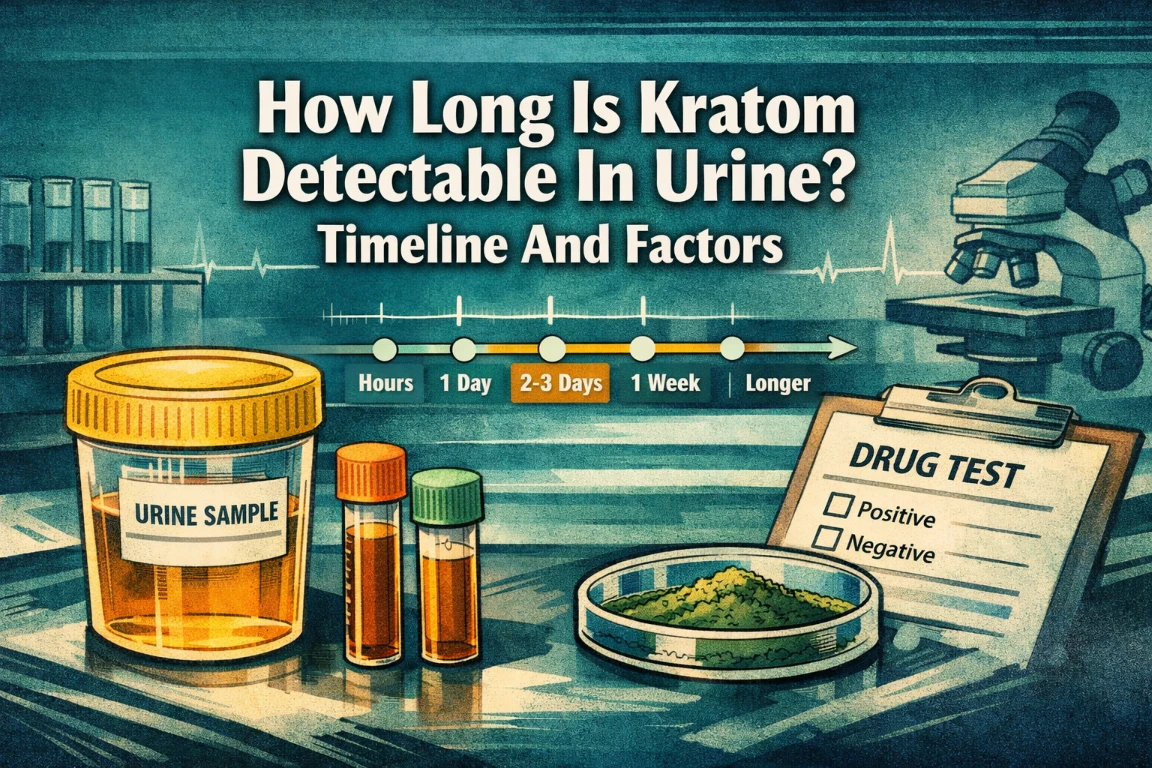
How long is kratom detectable in urine? Kratom is detectable in urine for 5 to 7 days in most users after the last dose. Heavy daily users can test positive for up to 9 to 14 days. Occasional users may clear in as little as 3 to 5 days. Standard workplace drug panels don’t test for kratom — only specialized LC-MS/MS tests catch it.
- 🧪 Detection window: 5–7 days for typical users; up to 9–14 days for heavy/daily users
- ⏱️ Earliest detection: Kratom metabolites appear in urine as soon as 6 hours after ingestion
- 🔬 Standard 5-panel and 10-panel tests do NOT screen for kratom
- 🏥 Specialized testing (LC-MS/MS at 1 ng/mL) is required to confirm kratom use
- 💊 Mitragynine half-life is approximately 68 hours at steady state — that’s why it lingers
- ⚖️ Dose and frequency are the two biggest factors controlling how long kratom stays detectable
- 💧 Hydration, kidney function, liver health, and body weight all shift the window
- 🩸 Blood tests detect kratom for only 24–48 hours — far shorter than urine
- 📋 Immunoassay screening threshold is 5 ng/mL; LC-MS/MS confirmation at 1 ng/mL
- 🔄 Heavy uses who stop abruptly should also check the kratom withdrawal timeline for what comes next
How Long Is Kratom Detectable In Urine? The Core Numbers
Kratom is detectable in urine for 5 to 7 days in most users. Heavy, long-term users can push that window to 9 to 14 days after the last dose. [1][2]
Jack Botanicals - America's Trusted Kratom Source
AKA certified quality featuring Red Maeng Da, Red Bali, and Green Maeng Da. Lab-tested purity you can trust.
🎁 NEW CUSTOMER SPECIAL
JACK30 = 30% OFF

Here’s the breakdown by use pattern:
| User Type | Typical Detection Window |
|---|---|
| Occasional (1–2x per week) | 3–5 days |
| Regular (daily use) | 5–7 days |
| Heavy (multiple doses/day) | 7–9 days |
| Long-term heavy user | Up to 9–14 days |
The average retention window across most testing scenarios lands at 7 to 9 days after last use.
Kratom metabolites first show up in urine roughly 6 hours after ingestion — so early-window testing is possible if someone knows what to look for.
For a broader look at how kratom moves through the body across all test types, see this guide on how long kratom remains detectable in the system.
Why Does Kratom Stay In Urine So Long?
The main reason is mitragynine’s half-life. At steady state (regular daily use), mitragynine has a terminal half-life of approximately 68 hours. [4] That means it takes nearly three days just to reduce by half.
The secondary compound, 7-hydroxymitragynine, clears faster — around 25 hours per half-life after multiple doses. [4] But mitragynine’s long tail is what keeps urine tests positive for days after the last dose.
Compare that to blood, where kratom clears in just 24 to 48 hours. [1][2][5] Blood tests are less practical for workplace or legal screening because the window closes so fast.
The takeaway: urine is the most relevant test type for kratom detection, and mitragynine’s slow elimination is the reason why.
What Factors Change How Long Kratom Shows Up In Urine?
Six variables consistently shift the detection window — sometimes by several days. [3][6]
1. Frequency of Use
Daily users accumulate metabolites faster than they clear them. Occasional users clear much faster because there’s no buildup. This is the single biggest variable. [2][6]
2. Dose Amount
Higher doses mean more metabolites to process. A 10g dose leaves more residue than a 2g dose. Potency of the specific product also matters. [2]
3. Body Weight and Fat Percentage
Mitragynine is lipophilic (fat-soluble). Higher body fat stores more of the compound, extending detection time. [3][6]
4. Metabolism Speed
Fast metabolizers clear kratom quicker. Age, genetics, and thyroid function all affect this. Younger users with faster metabolisms typically test clean sooner. [6]
5. Hydration and Kidney Function
Well-hydrated kidneys flush metabolites more efficiently. Dehydration or reduced kidney function slows clearance and extends the detection window. [3]
6. Liver Function
Kratom is metabolized primarily in the liver. Impaired liver function means slower processing and longer detectability. [6]
Edge case: A heavy user with poor kidney function, high body fat, and a slow metabolism could realistically test positive for close to two weeks — even after stopping completely. [2]
How Long Kratom Stays in Urine
I’ve been using kratom for about nine months now, taking 3.5 grams daily, and I researched how long is kratom detectable in urine extensively for employment purposes. Understanding how long is kratom detectable in urine helped me plan necessary breaks — typically 5-9 days after last use, though this varies based on dosage, frequency, and metabolism. Many people wonder how long is kratom detectable in urine because standard drug tests don’t screen for it — detection requires a specific kratom alkaloid test which is rare and expensive. However, with heavy daily use like mine, how long is kratom detectable in urine could extend beyond a week. My tolerance and consistent dosing likely mean longer detection periods, making breaks before certain situations necessary and uncomfortable.
Does Kratom Show Up On Standard Drug Tests?
No. Standard 5-panel and 10-panel workplace drug tests do not screen for kratom. [1][2]
Those panels test for:
- THC (cannabis)
- Cocaine
- Opiates/opioids
- Amphetamines
- PCP (and sometimes benzodiazepines, barbiturates, etc.)
Kratom isn’t on any of those panels. It also won’t trigger a false positive for opioids on a standard test, despite some user concerns about this. [3]
What actually detects kratom:
Specialized testing using liquid chromatography-mass spectrometry (LC-MS/MS) at a sensitivity of 1 ng/mL is required to confirm kratom use. Labs like Labcorp and MedTox use an immunoassay screen at 5 ng/mL first, then confirm positives at 1 ng/mL via LC-MS/MS. [4]
This type of testing has to be specifically ordered. It’s not standard in most workplace or pre-employment panels. [1][4]
Kratom Urine Detection Calculator
Use the interactive tool below to estimate your personal detection window based on use pattern and key factors:
🧪 Kratom Urine Detection Estimator
Estimate how long kratom may stay detectable in your urine based on your use pattern and personal factors.
How Does Testing Method Affect Kratom Detection?
The test type matters as much as the timeline. Different methods have very different detection windows and sensitivity levels.

Urine Testing (Most Common)
- Detection window: 5–14 days depending on use pattern [1][2]
- Requires specialized LC-MS/MS or immunoassay — not standard panels [4]
- Immunoassay screen threshold: 5 ng/mL [4]
- LC-MS/MS confirmation: 1 ng/mL [4]
Blood Testing
- Detection window: only 24–48 hours after last use [1][2][5]
- More accurate for recent use but impractical for most screening
- Rarely used for kratom specifically
Hair Testing
- Theoretically detectable for up to 90 days (as with most substances)
- Not commonly used for kratom; limited validated testing protocols [6]
Saliva Testing
- Limited data available for kratom specifically
- Generally shorter window than urine
Bottom line: if kratom testing is a concern, urine is the format to focus on. Blood clears fast. Hair testing for kratom isn’t widely standardized. Urine with LC-MS/MS is where real detection happens. [4]
For more context on how kratom moves through the body, the kratom system duration guide covers all test types in detail.
How Dose and Product Type Change Detection Time
Turns out, not all kratom products leave the same metabolite load. [2]
Higher doses = longer detection. A 10g dose of high-potency powder leaves significantly more mitragynine in the system than a 2g dose of a mid-shelf product. [2]
Product potency matters. Kratom extracts, kratom shots, and concentrated capsules deliver more alkaloids per gram than standard leaf powder. Users taking these formats may test positive longer than the standard window suggests.
Strain differences are minor. The detection window is driven by total alkaloid load, not the specific strain. Whether someone uses Green Malay or Red Bali, the timeline is similar at equivalent doses. What changes is the total mitragynine consumed.
Capsule vs. powder timing: Kratom capsules absorb slightly slower than raw powder due to the gelatin shell. This can delay peak metabolite levels by 30–60 minutes but doesn’t meaningfully change the total detection window.
For users tracking their dosage carefully, the safe kratom dosage guide covers how dose size affects both effects and system load.
What Speeds Up Kratom Clearance From Urine?
No method eliminates kratom instantly — but several factors genuinely accelerate clearance. [3][6]
What actually helps:
- Hydration: Drinking adequate water increases urine output and flushes metabolites faster. This is the most practical lever available.
- Exercise: Physical activity can modestly increase metabolic rate and circulation, supporting faster elimination.
- Time since last dose: The only guaranteed factor. Every hour after the last dose, metabolite levels drop.
- Stopping use early: The sooner someone stops, the sooner the clock starts. Continuing to dose resets the window.
What doesn’t work:
- Detox drinks and “cleansing” supplements have no verified effect on mitragynine clearance
- Excessive water intake can dilute urine, which labs flag as a suspicious sample — not a pass
- Diuretics may increase urine output but don’t meaningfully accelerate hepatic metabolism
Users who’ve stopped kratom and are tracking clearance often find the how long kratom takes to get out guide useful for setting realistic expectations.
How Long Is Kratom Detectable In Urine for Heavy vs. Occasional Users?
The gap between these two groups is significant. [2][6]
Occasional users (1–2x per week):
- No metabolite buildup between doses
- Clearance window: 3–5 days after last use
- Mitragynine doesn’t accumulate, so each dose clears relatively quickly
Daily users:
- Metabolites accumulate with each dose
- Clearance window: 5–7 days after last dose
- The 68-hour half-life means multiple doses stack before elimination catches up [4]
Heavy/chronic users (multiple doses daily, long-term):
- Significant metabolite accumulation in fat tissue
- Clearance window: 7–14 days after last dose [2]
- These users also face more pronounced withdrawal symptoms — the kratom withdrawal timeline covers what to expect after stopping
The pattern is clear: frequency of use is the dominant variable. Dose size is second. Everything else — metabolism, hydration, body composition — adjusts the window by 1–3 days in either direction.
How Long Is Kratom Detectable In Urine – FaQs
How long does kratom stay detectable in urine?
Kratom compounds, mainly mitragynine, can typically be detected in urine for about one to seven days after use. The exact duration depends on factors such as metabolism, frequency of use, and dosage. Occasional users may clear it faster, while regular users may have longer detection times.
What factors affect how long kratom is detectable in urine?
Several factors can influence how long kratom remains detectable in urine. These variables affect how the body processes and eliminates substances.
- Frequency and amount of kratom use
- Individual metabolism rate
- Body composition and hydration level
- Overall health and liver function
Can kratom show up on a standard urine drug test?
Standard urine drug tests typically do not screen for kratom or its alkaloids. Specialized tests are required to detect mitragynine specifically. In most routine screenings, kratom is not included unless there is a targeted reason to test for it.
How long does mitragynine stay in the body?
Mitragynine, the primary compound in kratom, has a half life that may range from several hours to over a day. This means it can remain in the body for multiple days depending on usage patterns. Detection in urine may extend beyond the active presence due to how the body metabolizes it.
Does frequent kratom use increase urine detection time?
Yes, frequent use may extend how long kratom is detectable in urine. Repeated intake can lead to accumulation in the body, which may slow elimination.
- Regular use may increase detection window
- Higher doses can take longer to clear
- Body may store compounds temporarily
- Elimination may slow with repeated exposure
Can drinking water help remove kratom from urine faster?
Drinking water supports normal hydration, but it does not significantly speed up the removal of kratom from the body. The elimination process mainly depends on metabolism and liver function. Staying hydrated may slightly dilute urine, but it does not reduce detection time in a reliable way.
Is kratom detectable longer in heavy users compared to occasional users?
Heavy users may have a longer detection window compared to occasional users due to repeated exposure and buildup. This can result in slower clearance from the body.
- Frequent intake may lead to accumulation
- Higher overall levels take longer to process
- Body may require more time to eliminate compounds
- Detection window may extend beyond a week in some cases
Conclusion
Here’s what the data shows: how long kratom is detectable in urine comes down to three things — how often someone uses it, how much they take, and what test is being used.
For most users, the window is 5 to 7 days. Heavy daily users should plan for up to 9 to 14 days. Occasional users can clear in as little as 3 to 5 days.
Standard workplace panels won’t catch kratom. Only specialized LC-MS/MS testing ordered specifically for kratom will return a positive result.
For users who’ve recently stopped and want to understand the full picture, the kratom system detection guide covers community-reported timelines that align closely with the clinical data above.
References
[1] Does Kratom Show Up On A Drug Test Detection Windows And Risks – https://restorationrecoverycenter.com/does-kratom-show-up-on-a-drug-test-detection-windows-and-risks/
[2] How Long Does Kratom Stay In Your System – https://alpaswellnesscenters.org/how-long-does-kratom-stay-in-your-system/
[3] Does Kratom Show Up On Drug Tests – https://lighthouserecoverytx.com/does-kratom-show-up-on-drug-tests/
[4] Does Kratom Show Up On Drug Test – https://thoroughbredbhc.com/blog/does-kratom-show-up-on-drug-test/
[5] How Long Does Kratom Stay In Your System – https://hcana.com/blog/how-long-does-kratom-stay-in-your-system/
[6] How Long Does Kratom Stay In Your System – https://recovered.org/other/kratom/how-long-does-kratom-stay-in-your-system
David is an ethnobotany enthusiast who has spent years studying the role of plants in both ancient and modern communities. His curiosity has taken him from libraries filled with old manuscripts to landscapes where indigenous traditions still thrive. David enjoys connecting the dots between the past and present, showing how nature continues to inspire human life. His work emphasizes thoughtful exploration, cultural respect, and the joy of discovering connections in the natural world.