Premium Kratom - AKA Certified Quality
Red Maeng Da • Red Bali • Green Maeng Da - All lab-tested for purity
💰 EXCLUSIVE DISCOUNT
Code: JACK30 = 30% OFF
How much kratom for pain depends on body weight, tolerance, and strain. Most users start at 2-3 grams and work up to 4-6 grams for moderate pain relief. Red vein strains consistently outperform other vein types for pain. The FDA has not approved kratom for any medical use and warns of serious risks including liver toxicity, seizures, and dependence [1].
- Start at 2-3 grams for pain; experienced users report 4-6 grams as the effective range for moderate to severe pain
- Red vein strains (Red Bali, Red Borneo, Red Maeng Da) show the strongest analgesic user feedback
- Kratom contains mitragynine and 7-hydroxymitragynine, which interact with opioid receptors
- The FDA has not approved kratom for pain or any condition and warns of serious safety risks [1][9]
- No scientifically established optimal dose for pain exists; current research focuses on safety and abuse potential, not therapeutic dosing [9]
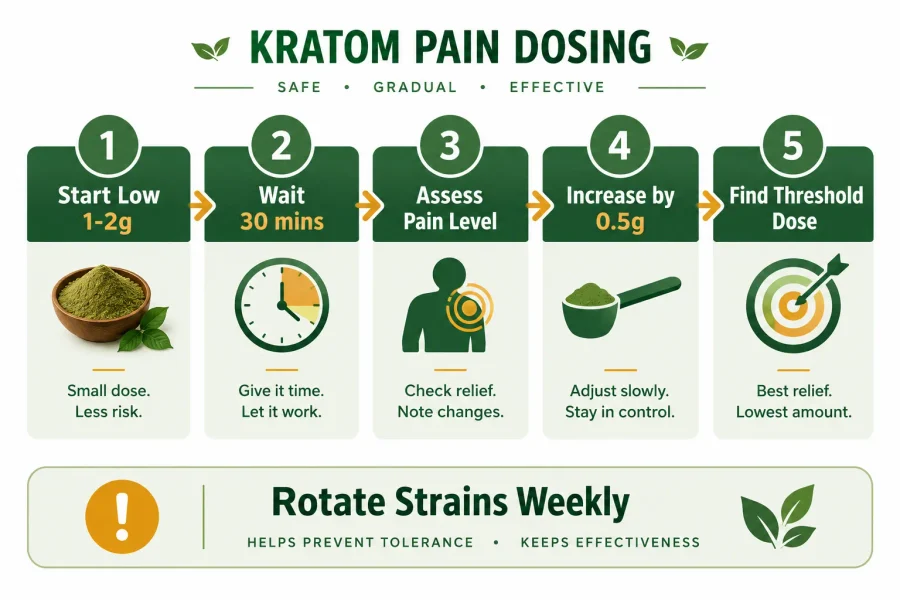
- Tolerance builds fast, rotating strains weekly is the most effective prevention strategy
- Products with enhanced 7-hydroxymitragynine (7-OH) carry significantly higher risk and should be avoided [5]
- Capsule dosing requires knowing exact capsule weight, standard 00 capsules hold roughly 0.5-0.7 grams of powder
- Taking more than 8 grams significantly increases side effect risk with diminishing pain relief returns
What Is Kratom and How Does It Work for Pain Relief
Kratom (Mitragyna speciosa) is a Southeast Asian tree whose leaves contain alkaloids, primarily mitragynine and 7-hydroxymitragynine, that bind to opioid receptors in the brain. At low doses it acts like a stimulant. At higher doses it produces sedation and pain-dampening effects that users compare to mild opioids.
The key alkaloid is mitragynine. Quality kratom powder typically tests at 1.2-1.8% mitragynine by weight [9]. The compound 7-hydroxymitragynine is present in much smaller amounts but is far more potent at opioid receptors. Products that artificially boost 7-OH levels carry serious harm risks, according to FDA consumer warnings updated in 2026 [5].
Here’s the thing: kratom’s mechanism is real. It does interact with mu-opioid receptors. But the FDA has not approved it for any medical use, and peer-reviewed research as of June 2024 concludes there is insufficient evidence to support kratom’s safety or efficacy for analgesia [9]. That gap between user experience and clinical evidence is the core tension in every kratom-for-pain conversation.
Jack Botanicals - America's Trusted Kratom Source
AKA certified quality featuring Red Maeng Da, Red Bali, and Green Maeng Da. Lab-tested purity you can trust.
🎁 NEW CUSTOMER SPECIAL
JACK30 = 30% OFF
Best Kratom Strains for Pain Management
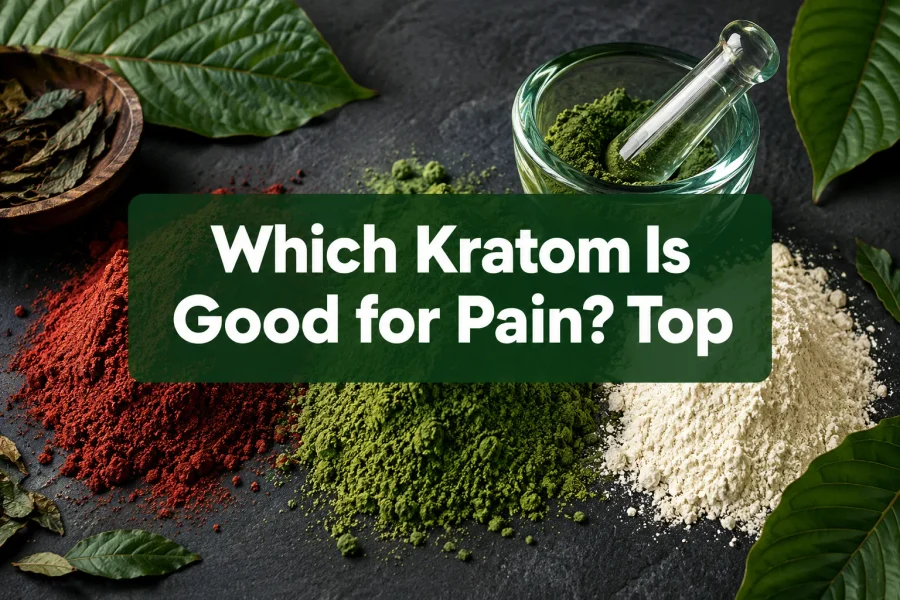
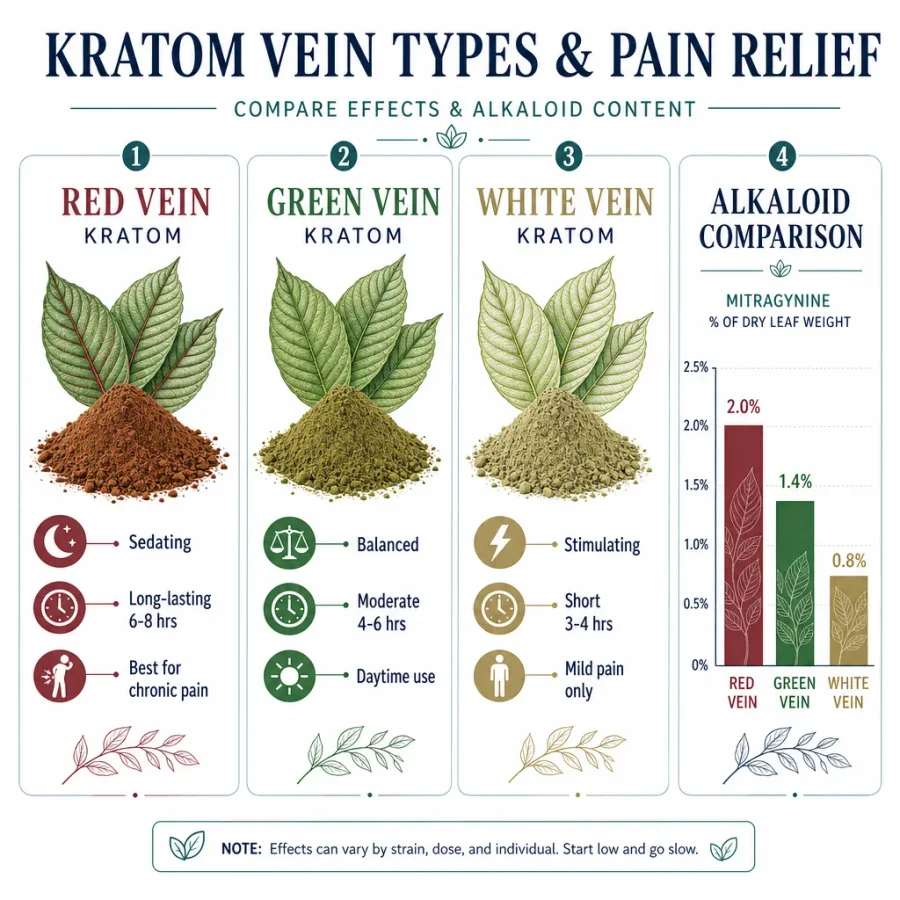
Red vein strains are the consistent front-runners for pain. Green veins offer a middle ground. White veins are primarily stimulating and provide minimal pain relief for most users.
The breakdown by vein type:
| Vein Color | Top Strains | Duration | Pain Relief Level | Best For |
|---|---|---|---|---|
| Red | Red Bali, Red Borneo, Red Maeng Da | 6-8 hours | High | Chronic, nighttime pain |
| Green | Green Malay, Green Maeng Da | 4-6 hours | Moderate | Daytime, mild-moderate pain |
| White | White Maeng Da, Super White | 3-4 hours | Low | Energy, minimal pain |
| Gold/Yellow | Gold Bali, Gold Borneo | 5-7 hours | Moderate-High | Balanced relief |
Red Bali is the most widely reported strain for pain among long-term users. It tests at roughly 1.4-1.6% mitragynine and produces heavy sedation at doses above 5 grams. For a detailed look at Red Bali Kratom effects, dosage, and potency, the profile covers exactly what to expect at each dose range.
Red Borneo runs slightly lighter than Red Bali but with longer-lasting body effects. Users consistently report 6-7 hours of relief. See the full Red Borneo Kratom for deep relief breakdown for alkaloid comparisons.
Red Maeng Da hits faster, effects within 20-25 minutes, but duration is shorter at 5-6 hours. Higher mitragynine content (often 1.6-1.8%) makes it one of the more potent red options.
For a broader comparison of strains by pain type, the what kratom is best for pain comfort guide covers the full spectrum.
How Much Kratom for Pain: Dosage by Weight and Tolerance
The honest answer: there is no FDA-approved dosing standard for kratom pain relief. No large controlled clinical trials have established a therapeutic dose [9]. What exists is user-reported data and pattern analysis.
General dosage ranges reported by users:
- Threshold dose: 1-2 grams (mild effects, often insufficient for pain)
- Low-moderate dose: 2-4 grams (mild to moderate pain relief, lower side effect risk)
- Moderate dose: 4-6 grams (moderate to significant pain relief, most users’ effective range)
- High dose: 6-8 grams (strong sedation, higher side effect risk, diminishing returns)
- Above 8 grams: Significantly elevated risk of nausea, dizziness, and adverse effects
Body weight adjustments (estimated user patterns):
- Under 150 lbs: Start at 1.5-2 grams
- 150-200 lbs: Start at 2-3 grams
- Over 200 lbs: Start at 2.5-3.5 grams
Turns out, body weight matters less than tolerance does. A 130-lb person with six months of daily use will need more than a 200-lb first-timer. The how much kratom do you take safe dosing facts explained guide breaks down the tolerance variable in detail.
For capsule users specifically, knowing your capsule weight changes everything. Standard 00 capsules hold 0.5-0.7 grams. That means 6 capsules equals roughly 3-4.2 grams. The how much kratom is in a capsule facts page has the exact measurements by capsule size.
I Figured Out Kratom Dosing for Pain Relief Through Trial and Error
Spent several weeks experimenting after back pain pushed me toward exploring kratom as an option. Most experienced users report pain relief starting around 4–6g — lower than that and analgesic effects feel minimal. Red strains like Red Bali or Red Borneo work best for pain in my experience compared to greens or whites. I personally found 4–5g of a quality red strain hit the right balance without excessive sedation.
Downsides: pain relief doses sit higher than general use doses meaning tolerance builds faster, kratom works on opioid receptors making dependency risk particularly serious for pain management use, and effects become inconsistent as tolerance develops requiring higher doses over time. There is no established safe dose — consult a doctor before using kratom for pain management.
Kratom Dosage for Beginners With Pain
Beginners should start at 2 grams, wait 45 minutes, then assess. Do not redose within the first hour. Most first-time users underestimate onset time and double-dose too early, that’s where nausea hits hard.
Beginner protocol:
- Start with 2 grams of a red vein strain (Red Bali or Red Borneo are the most forgiving)
- Take on an empty stomach or 2 hours after eating
- Wait 30-45 minutes for effects
- If pain relief is insufficient after 45 minutes, add 0.5-1 gram
- Record the dose and effects, this data matters for future sessions
- Do not exceed 4 grams in the first week
The pattern from user data is clear: beginners who start low and titrate up find their effective dose faster and with fewer side effects than those who start at 5+ grams based on forum recommendations.
For more on capsule-based beginner dosing, see how many kratom capsules to take for safe and effective dosage.
Kratom Pain Dose Estimator
Not medical advice. FDA has not approved kratom for any use. Consult a healthcare provider before use.
Red Vein Kratom vs Green Vein for Pain: Which Is Better
Red vein wins for pain relief in the majority of user reports. Green vein wins for daytime functionality with moderate pain.
The comparison:
- Red vein produces stronger analgesic and sedating effects, lasting 6-8 hours. Best for evening use, chronic pain, and sleep disruption caused by pain.
- Green vein provides pain relief with less sedation, lasting 4-6 hours. Better for working through the day with pain without cognitive fog.
Green Malay specifically lasts 6 hours vs Green Thai’s 4 hours, that two-hour difference matters for pain management scheduling. For the full Red Vein Kratom effects on pain relief and relaxation, the breakdown includes alkaloid profiles across the major red strains.
Choose red vein if: pain is severe, nighttime relief is the priority, or sedation is acceptable.
Choose green vein if: daytime functionality matters, pain is moderate, or red vein causes too much sedation.
The which kratom for chronic pain options guide covers this comparison in more depth with user feedback data.
How Long Does Kratom Take to Work for Pain
Kratom powder typically produces effects within 15-30 minutes on an empty stomach. Capsules take 30-45 minutes because the gelatin shell needs to dissolve first. Kratom taken after a heavy meal can delay onset to 60-90 minutes.
Onset and duration by format:
- Loose powder (toss and wash): 15-25 minutes onset, 4-6 hours duration
- Capsules: 30-45 minutes onset, 4-6 hours duration
- Kratom tea: 20-30 minutes onset, 3-5 hours duration (some alkaloids degrade with heat)
- Kratom shots/extracts: 10-20 minutes onset, but carry significantly higher risk [2]
The FDA specifically warns against concentrated liquid kratom products like OPMS Black Liquid Kratom due to serious adverse health effects, including reported deaths [2]. Extracts and shots are not a faster path to pain relief, they are a faster path to adverse events.
Can You Take Too Much Kratom? Side Effects
Yes. Taking too much kratom is a real risk. The results show a clear dose-response relationship between high doses and adverse effects.
Side effects by dose range:
- 2-4 grams: Generally mild, slight nausea, mild dizziness in sensitive users
- 4-6 grams: Nausea more common, sedation, constipation
- 6-8 grams: Strong sedation, significant nausea, vomiting possible
- Above 8 grams: Respiratory concerns, severe nausea, potential for serious adverse events
Serious risks documented by the FDA include liver toxicity, seizures, cardiovascular problems, and substance use disorder [1][9]. A 2026 study of kratom products in U.S. vape shops identified gastrointestinal upset, seizures, cardiovascular problems, liver injury, psychosis, dependence, and withdrawal as documented health risks [9].
For a detailed look at upper dose limits, the how much is too much kratom limits guide covers the risk thresholds with specific data.
Kratom for Pain vs Ibuprofen or Other Pain Medications
This is not a straight comparison. Ibuprofen is an FDA-approved NSAID with established dosing, known drug interactions, and decades of clinical data. Kratom has none of that.
What the data shows:
- Ibuprofen (400-800mg) has proven efficacy for inflammatory pain with a well-documented safety profile
- Kratom’s pain effects are opioid-receptor mediated, not anti-inflammatory, different mechanism entirely
- No head-to-head clinical trials comparing kratom to ibuprofen or other analgesics exist as of October 2026 [9]
- Mayo Clinic’s 2026 review states kratom “hasn’t been shown to be safe or to treat any medical conditions” and recommends medically supervised, evidence-based treatments instead [10]
Bottom line: kratom is not a clinically validated alternative to approved pain medications. Users who choose kratom for pain are operating outside any established medical framework, with significantly more uncertainty about dosing, purity, and long-term effects.
How Much Kratom for Pain: Dosage for Different Pain Types
The type of pain affects which strain and dose range users report as most effective.
Pain type and reported dosing patterns:
- Chronic back pain: Red vein, 4-6 grams, evening use. Red Borneo and Red Bali are the most cited.
- Nerve pain/neuropathy: Red or Gold vein, 3-5 grams. Users report Gold Bali produces less sedation than Red Bali for nerve-related discomfort.
- Arthritis/joint pain: Red Maeng Da, 4-5 grams. Faster onset matters here.
- Headaches/migraines: Green Maeng Da, 2-3 grams. Lower doses avoid the rebound headache some users report at high doses.
- Post-exercise soreness: Green or White vein, 2-3 grams. Stimulating effect helps with recovery activity.
The what is the best kratom for pain guide maps specific strains to pain categories with more granular user feedback data.
Kratom Tolerance for Pain Relief: How to Avoid It
Tolerance builds within 2-4 weeks of daily use. Once tolerance sets in, the same dose produces less pain relief, and users increase dose to compensate, accelerating the cycle.
What works for tolerance management:
- Strain rotation: Use a different strain every 2-3 days. Rotating between Red Bali, Green Malay, and Red Borneo prevents receptor saturation from a single alkaloid profile.
- Dose cycling: Take 1-2 days off per week if possible. Even a single off-day slows tolerance progression significantly.
- Dose caps: Set a personal maximum (typically 6 grams) and do not exceed it regardless of tolerance.
- Potentiators: Some users report grapefruit juice or turmeric extends effects, reducing the need for higher doses, though this is user-reported, not clinically verified.
The how long do kratom withdrawals last insights page covers what happens when tolerance-driven dependence develops, including timeline data.
Does Kratom Really Work for Pain? Scientific Evidence
The honest answer: user reports are consistent, but clinical evidence is thin. Kratom does interact with opioid receptors, that mechanism is established [9]. Whether that translates to safe, effective pain management in a clinical sense is a different question.
The current evidence picture:
- FDA has funded a single ascending dose human safety study of kratom, with results pending peer review as of October 2026 [1]
- A September 2024 FDA grant funded a human abuse-potential study, focused on safety and abuse risk, not analgesic efficacy [1]
- A June 2024 peer-reviewed analysis concludes insufficient evidence exists to support kratom’s safety or efficacy for any therapeutic use, including pain [9]
- No large, controlled clinical trials on kratom for pain exist as of October 2026
The takeaway: the pharmacology is plausible, the user experience is widespread, but the clinical evidence base needed to call kratom a validated pain treatment does not exist yet. Current FDA research is focused on risk characterization, not therapeutic dosing standards [1][9].
Is Kratom Safe for Long-Term Pain Management
This is where the data gets uncomfortable. Long-term kratom use carries documented risks that cannot be dismissed.
Documented long-term concerns:
- Dependence and withdrawal: Physical dependence develops with regular use. Withdrawal symptoms include muscle aches, insomnia, irritability, and nausea [1]
- Liver toxicity: Multiple case reports of kratom-associated liver injury exist in the medical literature [9]
- Cardiovascular effects: Elevated heart rate and blood pressure documented at higher doses [9]
- Cognitive effects: Some long-term users report memory and concentration issues
The FDA tracks deaths associated with kratom and maintains active import alerts authorizing seizure of certain kratom products [1]. The agency’s position as of October 2026 is that kratom is an unapproved substance with serious risk potential, not a safe long-term option for pain management [1].
Products with enhanced 7-hydroxymitragynine are particularly dangerous. The FDA’s August 2025 consumer update states these products can cause “serious harm” and should be avoided entirely [5].
How Much Kratom for Pain – FAQs
How much kratom should you take for pain?
There is no universally established kratom amount for pain, and research has not established a standard dose for this purpose. Kratom products can also vary considerably in alkaloid content. If someone chooses to use kratom, factors such as product strength, individual sensitivity, previous use, and other substances should be considered carefully.
Is there a recommended kratom dose for pain?
No standardized kratom dose for pain has been established by medical research. Amounts discussed online can differ substantially and may not reflect the strength of a particular product. Important considerations include:
- Product concentration and formulation
- Individual sensitivity and previous experience
- Other medications or substances being used
- The consistency and labeling of the product
Does more kratom provide stronger pain relief?
Increasing the amount of kratom does not reliably produce a predictable increase in effects. Higher amounts can also increase the likelihood of unwanted effects. Kratom products differ in alkaloid concentration, so the same measured quantity may not contain the same amount of active compounds across different products.
How much kratom powder is commonly used for pain?
Online sources often describe different quantities of kratom powder, but these reports should not be treated as established dosing guidance. Powder strength can vary between products and batches. A measured amount of powder also does not necessarily indicate a consistent amount of active alkaloids, making direct comparisons between products difficult.
Does kratom strain affect how much is used for pain?
Kratom strains are commonly marketed using names such as red, green, and white, but these labels do not establish a standardized amount of active compounds. Differences in growing conditions, processing, and product composition can affect the final material. Therefore, a strain name alone cannot reliably determine an appropriate amount for an individual.
What factors should be considered before using kratom for pain?
Several factors can affect how a person responds to kratom. Before considering its use, it is important to account for:
- The concentration and form of the product
- Individual sensitivity and previous exposure
- Other medications, supplements, or substances
- Product labeling and available laboratory information
Can kratom be used safely for ongoing pain?
The safety of long-term kratom use for ongoing pain has not been established well enough to define a standard regimen. Regular use may involve risks such as tolerance, dependence, and withdrawal. Persistent or unexplained pain can also have different underlying causes, so relying on kratom without appropriate evaluation may overlook the source of the problem.
Conclusion
Here’s the deal: how much kratom for pain is a question with user-driven answers and no clinical validation behind them. The effective range most users report is 3-6 grams of a red vein strain, taken on an empty stomach, with strain rotation to manage tolerance. Red Bali and Red Borneo are the most consistent performers for chronic pain. Green Malay works for daytime moderate pain without heavy sedation.
But the FDA has not approved kratom for pain, and peer-reviewed research as of 2026 confirms there is no scientifically established optimal dose for analgesia [1][9]. The risk profile, liver toxicity, dependence, seizures, cardiovascular effects, is real and documented [9][10].
For deeper research on strain selection, the best kratom strains category covers the full range with alkaloid data and user feedback.
References
[1] FDA and Kratom – https://www.fda.gov/news-events/public-health-focus/fda-and-kratom
[2] FDA Warns Consumers Not to Use OPMS Black Liquid Kratom – https://www.fda.gov/food/alerts-advisories-safety-information/fda-warns-consumers-not-use-optimized-plant-mediated-solutions-opms-black-liquid-kratom
[5] Products Containing 7-OH Can Cause Serious Harm – https://www.fda.gov/consumers/consumer-updates/products-containing-7-oh-can-cause-serious-harm
[9] PMC11180979 – https://pmc.ncbi.nlm.nih.gov/articles/PMC11180979/
[10] Mayo Clinic: Kratom – https://www.mayoclinic.org/diseases-conditions/prescription-drug-abuse/in-depth/kratom/art-20402171
David is an ethnobotany enthusiast who has spent years studying the role of plants in both ancient and modern communities. His curiosity has taken him from libraries filled with old manuscripts to landscapes where indigenous traditions still thrive. David enjoys connecting the dots between the past and present, showing how nature continues to inspire human life. His work emphasizes thoughtful exploration, cultural respect, and the joy of discovering connections in the natural world.