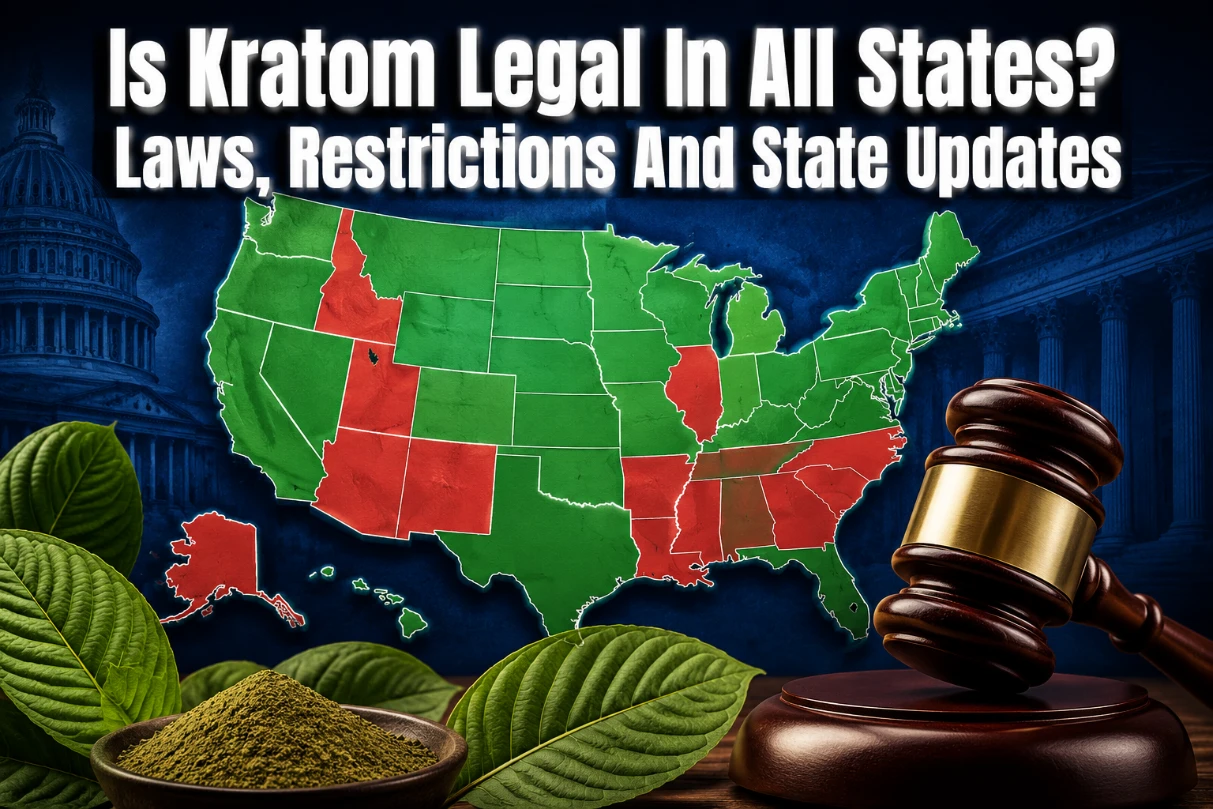
Premium Kratom - AKA Certified Quality
Red Maeng Da • Red Bali • Green Maeng Da - All lab-tested for purity
💰 EXCLUSIVE DISCOUNT
Code: JACK30 = 30% OFF
Kratom is not legal to sell for human consumption in California. The California Department of Public Health (CDPH) classifies kratom as an adulterated food product under California Health & Safety Code sections 110555 and 111295, making its retail sale illegal statewide. Possession by individuals is not explicitly criminalized, but buying it locally is effectively blocked.
- Kratom is banned from retail sale for human consumption across all of California under state food safety law
- The CDPH has issued multiple enforcement actions and consumer warnings targeting kratom products [3]
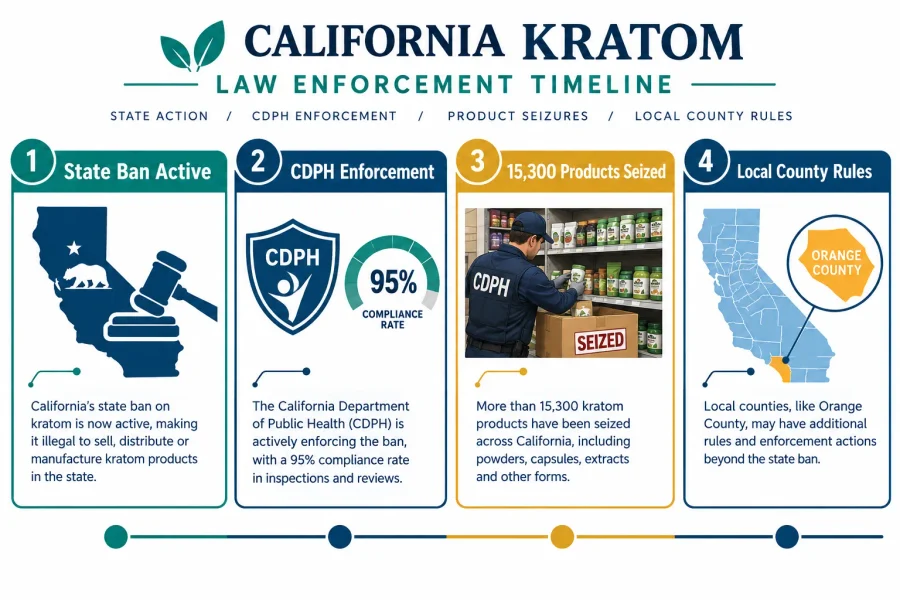
- Governor Newsom’s administration reported 95% retailer compliance with the kratom sales prohibition as of March 2026 [5]
- Nearly 15,300 illegal kratom, hemp, and 7-OH products were removed from California store shelves as of September 2026 [4]
- Local jurisdictions, including Los Angeles County, have issued separate retailer notices reinforcing the state ban
- Online orders to California addresses exist in a gray area, but state law still applies to any product sold for human consumption
- California is actively influencing federal kratom policy, with state officials claiming federal agencies are following California’s lead
- Kratom carries real health risks including dependence, liver toxicity, and dangerous drug interactions, per CDPH guidance [3]
What Is Kratom and How Does It Work
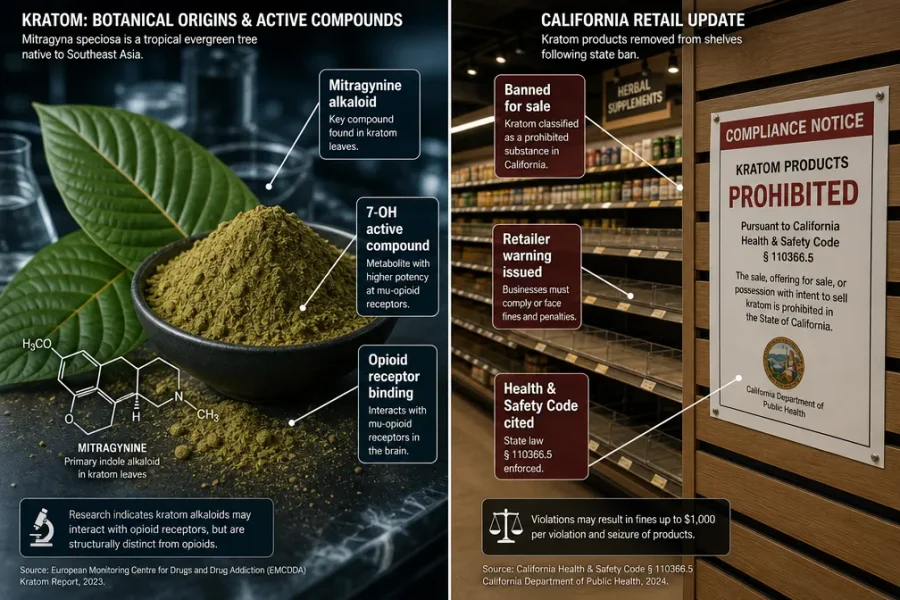
Kratom is a plant-based substance derived from the leaves of Mitragyna speciosa, a tree native to Southeast Asia. Its two primary active alkaloids, mitragynine and 7-hydroxymitragynine, bind to opioid receptors in the brain, producing stimulant effects at low doses (1-5 grams) and sedative, pain-relieving effects at higher doses (5-15 grams).
The alkaloid content varies significantly by strain and batch. Lab-tested kratom products typically show mitragynine concentrations ranging from 0.5% to 1.8% by weight. The 7-hydroxymitragynine content is lower but far more potent, which is why dosing consistency matters. For a breakdown of how strains compare by alkaloid profile, the complete guide to kratom laws and effects covers this in detail.
The pattern here is clear: kratom’s opioid receptor activity is exactly why regulators treat it differently from standard herbal supplements. It’s not a simple botanical tea.
Is Kratom Legal in California Right Now
Kratom is not legal for retail sale in California as of 2026. The CDPH classifies kratom-containing products as adulterated under California Health & Safety Code sections 110555 and 111295, which prohibit the sale of adulterated food products [3].
The state has not passed a specific “kratom ban” bill. Instead, enforcement runs through food safety law. The CDPH issued formal guidance to tobacco and retail businesses, explicitly stating that kratom products cannot be sold for human consumption. This applies to powder, capsules, extracts, and any other product form.
What this means practically:
- Retailers who stock kratom for sale face product seizures and potential fines
- The ban covers all product forms: loose powder, capsules, tablets, and liquid extracts
- Kratom sold as “not for human consumption” is treated as a labeling workaround, not a legal exemption
- Individual possession is not explicitly criminalized under current state law, but the legal picture is still developing
For context on how California compares to other states, the kratom legal map showing state laws gives a full national picture.
Jack Botanicals - America's Trusted Kratom Source
AKA certified quality featuring Red Maeng Da, Red Bali, and Green Maeng Da. Lab-tested purity you can trust.
🎁 NEW CUSTOMER SPECIAL
JACK30 = 30% OFF
Kratom Banned Cities in California and County-Level Rules
The statewide ban is the primary enforcement mechanism, but local jurisdictions have added their own layers. Los Angeles County’s Environmental Health division issued a direct notice to retail businesses specifically naming kratom, 7-OH, and tianeptine as prohibited products. This reinforces the state prohibition at the county level and signals active local enforcement.
Orange County has taken a particularly firm stance, with enforcement targeting synthetic kratom products and extracts. These high-potency synthetic variants carry even greater health risks than traditional kratom powder, and local health officials have moved aggressively to remove them from shelves.
The takeaway for buyers: Even if a shop in your city appears to sell kratom, that sale is non-compliant with state law. The 95% compliance rate reported in March 2026 means roughly 5% of retailers were still stocking these products [5], but enforcement is ongoing.
How to find out if kratom is legal in your specific California city:
- Check with your city or county health department directly
- Review the CDPH’s official kratom guidance page [3]
- Contact the California Department of Public Health at their official channels
- Check whether your county has issued its own retailer notices beyond the state mandate
Why Is Kratom Banned in California
The CDPH’s position is grounded in health risk data and the absence of FDA approval for kratom as a food or supplement ingredient. Here’s the core reasoning behind the ban:
Health concerns cited by CDPH [3]:
- Kratom has been linked to liver toxicity, seizures, and cardiovascular effects
- Dependence and withdrawal symptoms are documented in regular users
- Dangerous interactions with opioids, benzodiazepines, and antidepressants
- No established safe dosage exists under current regulatory frameworks
- Products frequently contain undisclosed additives or contaminants
The CDPH issued a formal consumer warning stating that kratom products pose significant health risks and that no kratom product has been approved by the FDA for any use [3]. California’s enforcement actions escalated through 2026, with the state explicitly framing itself as a national leader on this issue.
Governor Newsom’s office announced in July 2026 that California’s crackdown is influencing federal regulatory action, with federal agencies reportedly following California’s enforcement model. This signals the ban is not going away soon.
Kratom Enforcement Numbers: What the Data Shows
The scale of California’s enforcement is significant. Here are the verified numbers:
| Enforcement Action | Data Point | Source |
|---|---|---|
| Retailer compliance rate | 95% as of March 2026 | [5] |
| Products removed from shelves | ~15,300 (kratom, hemp, 7-OH combined) | [4] |
| Enforcement scope | Statewide, all retail formats | [3] |
| Legal basis | CA Health & Safety Code 110555, 111295 | [3] |
The September 2026 announcement from Governor Newsom’s office confirmed that nearly 15,300 illegal products had been pulled from California stores, covering kratom alongside hemp-derived 7-OH products [4]. The CDPH’s social media channels also flagged ongoing enforcement actions in 2026.
Can You Order Kratom Online to California
Online ordering to California addresses is a gray area, but it carries real legal risk. The state ban targets retailers and sellers, not individual possession. However, any vendor selling kratom for human consumption to a California address is technically violating state law.
The reality: Many online vendors still ship to California. Some use “not for human consumption” labeling as a workaround. The CDPH has been clear that this labeling does not make the sale legal if the product is marketed or used as a consumable [3].
What buyers should know:
- Receiving kratom by mail is not explicitly criminalized for personal use under current California law
- Vendors shipping to California may face legal exposure under state food safety statutes
- Product quality from unregulated online sources is inconsistent, with lab testing showing wide variation in alkaloid content
- The federal kratom legal status adds another layer, as the FDA has taken enforcement actions against kratom vendors nationally
For buyers in other states wondering how California compares, the complete state-by-state kratom legal guide for 2026 is worth reviewing.
Kratom Side Effects and Safety Concerns
The CDPH’s health risk profile for kratom is not speculative. Documented adverse effects include:
Short-term effects:
- Nausea, vomiting, and constipation at higher doses
- Elevated heart rate and blood pressure
- Dizziness and sedation
Long-term and serious risks:
- Liver toxicity (hepatotoxicity) with regular use
- Physical dependence with withdrawal symptoms resembling opioid withdrawal
- Seizures, particularly when combined with other substances
- Psychosis reported in high-dose chronic users
The CDPH consumer warning [3] specifically flags that kratom’s opioid receptor activity makes it behave more like a controlled substance than a dietary supplement. This is the core reason California treats it differently from, say, valerian root or kava.
Users interested in understanding how kratom affects neurotransmitter systems can review what kratom does to serotonin levels for a deeper look at the pharmacology.
Kratom Quality and Purity: What to Look For
Testing reveals massive quality variation across kratom products. This matters because inconsistent alkaloid content drives unpredictable effects and increases risk.
What lab-tested kratom should show:
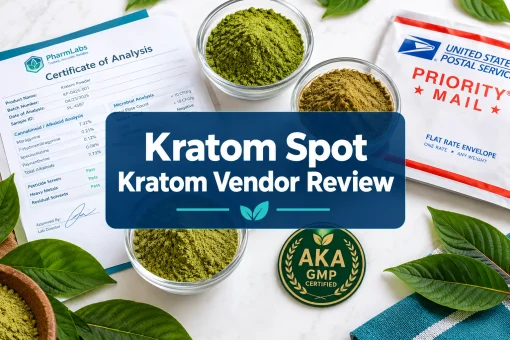
- Mitragynine content: 1.0% to 1.8% in quality powder (below 0.5% suggests old or adulterated stock)
- 7-hydroxymitragynine: present but typically below 0.1% in natural leaf products (higher levels suggest synthetic adulteration)
- Heavy metals panel: lead, mercury, arsenic, cadmium all below USP limits
- Microbial testing: negative for Salmonella and E. coli
- No undisclosed additives or synthetic alkaloids
Red flags in unverified products:
- No Certificate of Analysis (COA) available
- COA from an in-house lab rather than an accredited third party
- Mitragynine levels above 2% (possible synthetic enhancement)
- Unusually low pricing (under $60/kg for bulk) often correlates with poor sourcing
For strain-specific comparisons, what is Maeng Da kratom and its effects and what is Bali kratom break down the differences with actual alkaloid data.
Best Kratom Strains for Beginners
For anyone in a state where kratom is legal, beginners should start with strains that have moderate alkaloid profiles and predictable effects. Here’s the direct comparison:
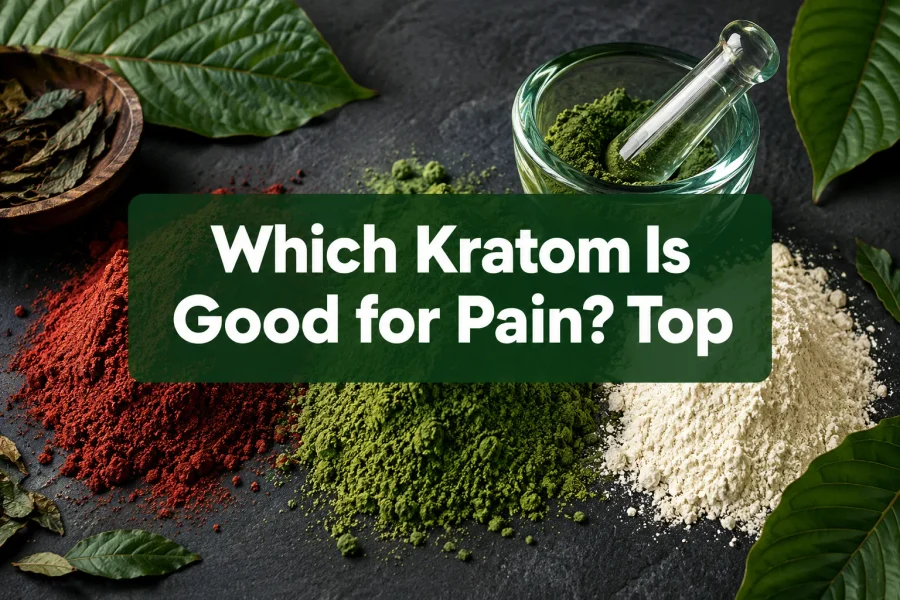
Green Malay: Mitragynine typically 1.3-1.5%. Effects last 5-6 hours. Balanced energy and mild analgesia. Lower risk of sedation at standard doses (2-4 grams).
Red Bali: Mitragynine typically 1.0-1.4%. Effects last 4-5 hours. More sedating. Better for evening use. Higher dependence risk with daily use.
White Borneo: Mitragynine typically 1.2-1.6%. Effects last 3-4 hours. Stimulant-dominant. Higher risk of anxiety at doses above 5 grams.
Comparison shows: Green vein strains are generally the safest starting point. They sit between the stimulant and sedative extremes, making dosing errors less dramatic. Start at 2 grams, wait 45 minutes, and assess before adding more.
The dosing guide for kratom has specific gram-by-gram breakdowns for new users.
Kratom vs Other Herbal Supplements: The Comparison
Kratom is not comparable to most herbal supplements in terms of mechanism or risk profile. Here’s the direct breakdown:
| Supplement | Primary Mechanism | Dependence Risk | Regulatory Status |
|---|---|---|---|
| Kratom | Opioid receptor agonist | High | Banned in CA |
| Kava | GABA receptor modulation | Low-moderate | Legal in CA |
| Valerian | GABA-A receptor | Low | Legal in CA |
| CBD | Endocannabinoid system | Very low | Regulated in CA |
The key difference: kratom’s opioid receptor binding is what separates it from adaptogens and anxiolytics. Kava, for comparison, works on GABA receptors and carries a different risk profile. The kava and kratom comparison guide covers this distinction in detail.
Kratom Legal Alternatives If Banned in Your Area
If kratom is unavailable due to California’s ban, the options depend on what effect a user is seeking.
For energy and focus:
- Green tea extract (L-theanine + caffeine)
- Rhodiola rosea (adaptogen, evidence-backed for fatigue)
- Panax ginseng
For pain management:
- Consult a licensed healthcare provider for evidence-based options
- CBD products (legal in California when compliant with state hemp law)
- Magnesium glycinate for muscle tension
For mood support:
- Ashwagandha (KSM-66 extract, 300-600mg daily)
- Saffron extract (30mg, studied for mood)
- Kava (traditional preparation, hepatotoxicity risk with heavy use)
None of these replicate kratom’s opioid receptor activity. That’s the point. The alternatives work through different pathways and carry lower dependence risk.
Kratom Possession Penalties in California
California does not have a specific kratom possession statute with defined criminal penalties. The state’s enforcement approach targets sellers and retailers, not individual users.
Current legal picture for possession:
- No state law explicitly criminalizes personal possession of kratom
- Retailers face product seizures and civil enforcement under food safety law
- Selling kratom for human consumption exposes vendors to fines and product confiscation
- Law enforcement focus remains on supply-side enforcement, not user prosecution
The caveat: This can change. California’s aggressive enforcement posture in 2026 and its stated goal of influencing federal policy suggest the regulatory environment will continue tightening. Users relying on the current absence of possession penalties should monitor CDPH and legislative updates closely.
For comparison, states with explicit kratom bans and possession penalties take a harder line. The what states is kratom legal updates guide tracks current possession laws across all 50 states.
Kratom Legal California – FAQs
Is kratom legal in California?
California does not treat kratom as an approved food, dietary supplement, or drug for consumption. The California Department of Public Health states that kratom-containing products are illegal to sell or manufacture for consumption. However, state rules concerning possession or personal use are different from the restrictions on commercial sale and manufacturing.
Can you buy kratom in California?
Commercial sales of kratom for consumption are prohibited under California’s current public-health enforcement position. The California Department of Public Health has stated that kratom products cannot legally be sold online or in stores for consumption. Finding a product offered by a retailer does not necessarily mean that the sale complies with California law.
Is it legal to possess kratom in California?
California’s statewide prohibition focuses on the sale and manufacture of kratom products for consumption rather than creating a blanket statewide possession offense. However, local rules can be stricter. Before determining whether possession is permitted, it is important to consider the specific city or county because some California jurisdictions have adopted additional restrictions.
Are there California cities or counties that ban kratom?
Yes. Local governments in California have adopted different kratom restrictions, so the rules can vary by location. Examples include:
- Some jurisdictions prohibit the sale and distribution of kratom products.
- Some local laws also restrict possession of kratom.
- Some jurisdictions impose age restrictions or limits on certain products.
- Rules can differ between incorporated cities and surrounding county areas.
Is 7-OH treated the same as kratom in California?
California regulates kratom-derived products and 7-hydroxymitragynine, commonly called 7-OH, through its public-health and food-safety framework. The California Department of Public Health states that products containing kratom or 7-OH are illegal to sell or manufacture for consumption. Local ordinances may also establish additional restrictions on specific 7-OH products.
Can California retailers legally sell kratom products?
California retailers cannot legally sell kratom products for consumption under the state’s current public-health interpretation. The California Department of Public Health has directed attention toward removing kratom and 7-OH products from retail shelves. Enforcement has included products marketed as foods, dietary supplements, drinks, gummies, and other consumable forms.
Why do some California stores still have kratom products?
Kratom products may still appear in some California stores despite the state’s restrictions. The California Department of Public Health has noted that continued availability can result from confusion about applicable laws, misinformation, and consumer demand. Retail availability should not be considered evidence that a product is legally approved for sale or consumption in California.
Conclusion
The bottom line on kratom legal in California: the state has one of the most active enforcement regimes in the country. Retail sale is banned under food safety law, 95% of retailers are now compliant [5], and nearly 15,300 products have been pulled from shelves [4]. California is not softening its position. If anything, it’s exporting its enforcement model to the federal level.
For buyers, the actionable steps are straightforward:
- Do not expect to find compliant kratom at California retailers
- Understand that online orders still carry legal and quality risks
- If you are in a state where kratom is legal, prioritize vendors with third-party COAs showing mitragynine content, heavy metals panels, and microbial testing
- Monitor CDPH announcements for any regulatory updates
- If you are currently using kratom and concerned about dependence, consult a healthcare provider familiar with opioid receptor-active substances
The kratom legal in California situation is not a gray area. The law is clear, enforcement is real, and the trend is toward stricter regulation, not looser. Plan accordingly.
References
[1] NR25-016, California Department of Public Health – https://www.cdph.ca.gov/Programs/OPA/Pages/NR25-016.aspx
[2] NR26-005, California Department of Public Health – https://www.cdph.ca.gov/Programs/OPA/Pages/NR26-005.aspx
[3] About Kratom, California Department of Public Health – https://www.cdph.ca.gov/Programs/CEH/DFDCS/Pages/FDBPrograms/FoodSafetyProgram/AboutKratom.aspx
[4] Governor Newsom Announces Nearly 15,300 Illegal Hemp, Kratom and 7-OH Products Removed From California Store Shelves – https://www.gov.ca.gov/2026/09/02/governor-newsom-announces-nearly-15300-illegal-hemp-kratom-and-7-oh-products-removed-from-california-store-shelves/
[5] Governor Newsom Announces 95% Compliance With Prohibition Of Illegal Kratom Products – https://www.gov.ca.gov/2026/03/03/governor-newsom-announces-95-compliance-with-prohibition-of-illegal-kratom-products/
Jonathan is an enthusiast of traditional plant practices and cultural history. His work reflects a genuine fascination with how nature has shaped human stories throughout time. Jonathan believes that sharing knowledge about plants can build connections across cultures and generations. Through careful research and respectful exploration, he hopes to provide readers with thoughtful perspectives that celebrate heritage, encourage curiosity, and inspire a greater awareness of our relationship with nature.