Premium Kratom - AKA Certified Quality
Red Maeng Da • Red Bali • Green Maeng Da - All lab-tested for purity
💰 EXCLUSIVE DISCOUNT
Code: JACK30 = 30% OFF
As of 2026, kratom exists in a legal gray area in the Dominican Republic. The country’s primary drug law, Law 50-88, does not explicitly list kratom or its alkaloids as controlled substances. That said, the absence of an explicit ban does not equal a green light, enforcement is unpredictable, and travelers have been flagged at customs for carrying botanical supplements that look suspicious to officers unfamiliar with kratom.
- Is kratom legal in Dominican Republic? No explicit ban exists under Law 50-88, but kratom is not formally approved either
- Kratom occupies a regulatory gray area, not controlled, not authorized
- Bringing kratom into the Dominican Republic carries real risk due to customs discretion
- Small personal-use quantities are less likely to trigger enforcement than bulk amounts
- No licensed kratom retailers operate openly in the Dominican Republic as of 2026
- Dominican Republic airports do screen for suspicious botanical substances
- 7-hydroxymitragynine, a key kratom alkaloid, faces increasing global scrutiny
- Organizations like the Peace Corps ban kratom use regardless of local law
- Neighboring Caribbean nations have varied and sometimes stricter rules
- Consulting a local attorney before travel with kratom is the safest approach
Is Kratom Legal in Dominican Republic Under Current Drug Law?
The Dominican Republic’s main drug control framework is Law 50-88, enacted in 1988. This law governs narcotics, psychotropics, and controlled substances. Kratom (Mitragyna speciosa) does not appear on the controlled substances schedule under this law [1][3].
Jack Botanicals - America's Trusted Kratom Source
AKA certified quality featuring Red Maeng Da, Red Bali, and Green Maeng Da. Lab-tested purity you can trust.
🎁 NEW CUSTOMER SPECIAL
JACK30 = 30% OFF
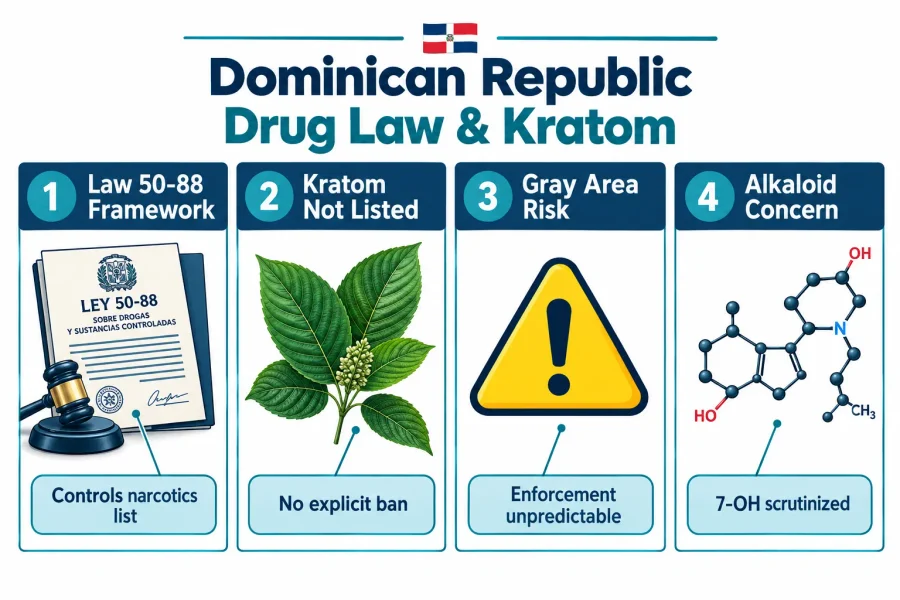
Here’s the thing: absence from a controlled substances list is not the same as legal approval. The Dominican Republic has not issued any formal guidance, health ministry ruling, or regulatory framework specifically addressing kratom. That gap creates a gray area where customs officers, law enforcement, and health authorities can interpret kratom’s status however they see fit [2][5].
The pattern across Caribbean nations mirrors this uncertainty. Most did not anticipate kratom’s rise in popularity and simply haven’t updated their drug schedules to address it. The Dominican Republic falls squarely into that category as of 2026.
For broader context on how kratom’s legal status varies across jurisdictions, the complete guide to kratom laws by state and country breaks down the regulatory landscape in detail.
Bottom line: Kratom is not explicitly illegal in the Dominican Republic, but it is not explicitly legal either. That ambiguity is the core risk.
Dominican Republic Drug Laws and Kratom: What the Framework Actually Says
Law 50-88 targets substances with recognized abuse potential, cocaine, heroin, cannabis, synthetic opioids, and their analogs. Kratom’s primary alkaloids, mitragynine and 7-hydroxymitragynine, are not listed under this framework [1].
However, Dominican authorities retain broad discretion to classify novel substances. If an officer or health inspector determines that a substance acts like a controlled drug, they can refer it for review or detain it pending analysis. This is not theoretical, it has happened with other botanical supplements in the region.
Key facts about Dominican drug enforcement:
- Law 50-88 is the governing statute, last significantly updated in the early 2000s
- The Consejo Nacional de Drogas (National Drug Council) oversees enforcement
- Novel psychoactive substances (NPS) can be flagged even without a formal schedule listing
- Kratom has not been the subject of any published Dominican health ministry ruling as of 2026 [3][5]
The results show that the legal framework was simply not designed with kratom in mind. That creates real-world risk for travelers who assume “not listed = legal.”
Can You Bring Kratom to the Dominican Republic?
Technically, no law explicitly prohibits importing kratom into the Dominican Republic for personal use. Practically, bringing kratom into the country carries meaningful risk that every traveler should weigh carefully [2].
Customs officers at Las Americas International Airport (SDQ) and other entry points have broad authority to inspect and seize substances they cannot identify or that raise suspicion. Kratom powder, capsules, or extracts can easily be mistaken for illicit drugs during visual inspection or when flagged by detection equipment.
What travelers have reported (2024-2026):
- Most travelers carrying small personal-use amounts (under 50 grams) have passed through without issue
- Bulk quantities or extracts draw more scrutiny
- Unlabeled packaging is a consistent trigger for secondary inspection
- Officers unfamiliar with kratom may detain it for lab analysis, causing significant delays
For anyone flying internationally with kratom, the facts about flying with kratom legally covers TSA rules, international considerations, and packaging best practices in detail.
Kratom Import Rules Dominican Republic: Customs and Declaration
Dominican Republic customs regulations require travelers to declare any botanical supplements, herbal products, or substances that could be classified as medicinal or controlled. Kratom technically falls into a category that warrants declaration [5].
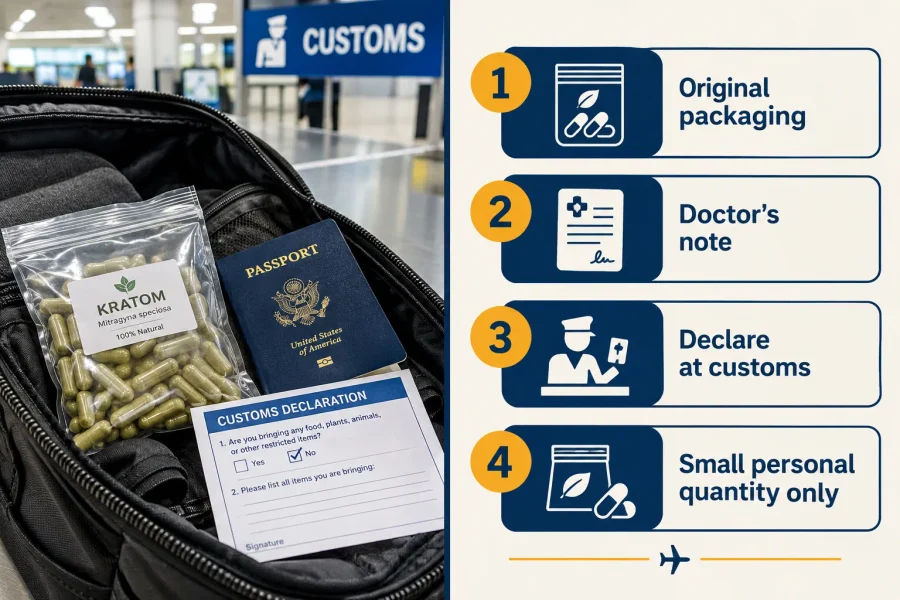
Practical import guidelines if you choose to travel with kratom:
- Keep kratom in its original, labeled manufacturer packaging
- Carry documentation, a letter from a physician explaining the supplement’s purpose helps
- Declare it on your customs form under “food supplements” or “herbal products”
- Bring only personal-use quantities, 50 grams or less is a reasonable threshold
- Avoid extracts or concentrated forms, which look more like drug preparations
- Store separately from other medications to avoid confusion during inspection
Turns out, the biggest risk is not a specific law, it is officer discretion. An officer who has never encountered kratom may confiscate it pending review, even if no law technically supports that seizure.
What Happens If You Get Caught with Kratom in Dominican Republic?
There is no specific kratom possession penalty under Dominican law because kratom is not a scheduled substance. However, if authorities classify kratom as a novel psychoactive substance or a controlled substance analog, penalties under Law 50-88 can be severe [1][3].
Possible outcomes, ranked by likelihood:
| Scenario | Likelihood | Outcome |
|---|---|---|
| Confiscation at customs | Moderate | Kratom seized, traveler released |
| Detention for questioning | Low-moderate | Hours of delay, possible fine |
| Formal arrest under NPS provisions | Low | Requires lab analysis confirming psychoactive classification |
| Criminal charges under Law 50-88 | Very low | Only if classified as controlled substance |
The Dominican Republic’s drug enforcement system is not lenient. Foreigners caught with substances that authorities believe are drug-related face detention, legal fees, and potential deportation even before formal charges are filed [2][5].
The takeaway: The risk is not primarily legal, it is logistical. Confiscation, detention, and travel disruption are far more likely outcomes than criminal prosecution. But none of those outcomes are acceptable when traveling for vacation or business.
Do Dominican Republic Airports Check for Kratom?
Dominican airports do not have specific kratom-detection protocols. Standard screening focuses on explosives, weapons, and known controlled substances. Kratom powder can, however, trigger secondary screening because it appears as a dense, unidentified organic material on X-ray equipment.
The pattern from traveler reports: kratom in capsule form draws less attention than loose powder. Loose powder in unlabeled bags is the highest-risk format. Extracts and resins, which are darker and more concentrated, draw more scrutiny than plain leaf powder.
Airport staff at SDQ and Puerto Plata (POP) are not trained to identify kratom specifically. If flagged, the substance goes to a supervisor and potentially to a lab. That process can take hours or days.
Is Kratom Considered a Controlled Substance in Dominican Republic?
No. As of October 2026, kratom is not listed as a controlled substance under Dominican Republic law. Mitragynine and 7-hydroxymitragynine are not scheduled under Law 50-88 or any subsequent amendment [1][3].
That said, 7-hydroxymitragynine faces growing regulatory scrutiny globally. In the United States, the DEA has examined it separately from mitragynine. Some countries have moved to schedule it independently of kratom leaf products. If the Dominican Republic updates its controlled substances list, which is possible given broader Caribbean regulatory trends, kratom’s status could change without much public notice.
For comparison, see how kratom’s federal legal status in the United States has evolved, since U.S. federal decisions often influence Caribbean regulatory thinking.
Kratom Legal Status Across Caribbean Countries
The Dominican Republic is not the only Caribbean nation where kratom’s status is ambiguous. Here’s the breakdown across the region as of 2026 [4]:
| Country | Kratom Status | Notes |
|---|---|---|
| Dominican Republic | Gray area | Not scheduled, not approved |
| Puerto Rico | Legal (U.S. territory) | Follows U.S. federal framework |
| Jamaica | Unregulated | No specific ban |
| Cuba | Effectively banned | Strict import controls on all supplements |
| Trinidad & Tobago | Gray area | No specific listing |
| Barbados | Gray area | No formal ruling |
Puerto Rico’s status is worth noting separately, as a U.S. territory, it follows a different legal framework. The current kratom rules in Puerto Rico explains that distinction in full.
For travelers who move between Caribbean destinations, the safest assumption is that no Caribbean country has formally legalized kratom, and several have the enforcement infrastructure to create serious problems for travelers carrying it.
How Much Kratom Can You Travel With to Dominican Republic?
No specific quantity limit exists in Dominican law for kratom because it is not scheduled. However, quantity is a critical factor in how customs officers interpret intent [2][5].
Quantity guidance based on traveler reports and legal risk:
- Under 50 grams: Generally treated as personal use if flagged
- 50-200 grams: Raises questions about intent; more likely to trigger secondary review
- Over 200 grams: Significant risk of confiscation and formal review for distribution intent
- Bulk kilograms: Extremely high risk; could be interpreted as commercial importation
Real quick, the personal-use vs. commercial-distribution line matters enormously under Dominican drug law. Even for unscheduled substances, importing quantities consistent with distribution can trigger investigation under broader customs and import statutes.
Kratom Alternatives Legal in Dominican Republic
Several herbal supplements with overlapping effects are legally available in the Dominican Republic. These include kava (Piper methysticum), valerian root, and passionflower extracts, all of which are sold in pharmacies and health stores without restriction.
Kava, in particular, has a growing presence in the Caribbean. A Reddit thread from the Dominican community specifically asked about kratom or kava bars in the country, with responses confirming kava availability while noting kratom’s absence from local retail.
If the goal is managing discomfort during travel without legal risk, these alternatives carry zero customs risk and are widely available locally.
Kratom in Costa Rica vs. Dominican Republic: A Regional Comparison
Travelers moving through the Caribbean and Central America often ask how neighboring countries compare. Kratom’s legal rules in Costa Rica follow a similar gray-area pattern, not explicitly banned, but not regulated or approved.
The difference is enforcement culture. Costa Rica’s customs environment is generally more familiar with herbal supplements due to ecotourism. The Dominican Republic’s enforcement culture is shaped more heavily by its history with cocaine trafficking routes, which means officers are more alert to unidentified powder substances.
That context matters when assessing actual risk, not just legal text.
Is Kratom Legal In Dominican Republic – FAQs
Is kratom legal in the Dominican Republic?
As of 2026, kratom is not specifically listed as a controlled substance under the Dominican Republic’s main controlled-drug law, Law No. 50-88. However, this does not mean kratom has a clearly regulated legal status for sale or importation. Travelers and consumers should distinguish between not being specifically scheduled and having explicit government approval.
Is kratom listed as a controlled substance in the Dominican Republic?
Kratom, also known as Mitragyna speciosa, is not specifically named in the controlled-substance categories identified under Law No. 50-88. Available legal references reviewed in 2026 also do not identify mitragynine or 7-hydroxymitragynine as specifically scheduled substances under that law. Regulations can change, so current rules should be checked before importing or possessing kratom.
Can you bring kratom into the Dominican Republic?
Bringing kratom into the Dominican Republic can involve uncertainty because the substance is not clearly regulated as an approved consumer product. Travelers should consider:
- Whether the product contains only botanical kratom
- Whether the product includes concentrated or modified ingredients
- Applicable customs and import requirements
- Current controlled-substance regulations
Is it legal to buy kratom in the Dominican Republic?
There is no clear indication in the reviewed Dominican controlled-substance law that ordinary kratom is specifically prohibited from possession or sale. However, the absence of a specific ban is different from formal authorization or regulation. Availability through a seller should not by itself be treated as proof that a product is legally approved for commercial sale.
Does Dominican Republic law specifically ban Mitragyna speciosa?
No specific prohibition of Mitragyna speciosa was identified in the controlled-substance schedules reviewed for the Dominican Republic in 2026. The plant is not named in the listed drug categories in Law No. 50-88. Other laws, customs requirements, product regulations, or future amendments may still affect how particular kratom products are handled.
Are kratom extracts legal in the Dominican Republic?
Kratom extracts should not automatically be treated the same as unprocessed botanical leaf. Extracts may have different concentrations, ingredients, or processing methods, which can affect how they are classified. The reviewed Dominican controlled-substance schedules do not specifically list ordinary kratom, but travelers should verify the status of concentrated products before importing them.
Could kratom laws change in the Dominican Republic?
Yes. Drug-control and import regulations can be amended or supplemented by government authorities. A substance that is not specifically scheduled today may receive different treatment later. Anyone researching kratom legality should check the latest Dominican Republic regulations, customs requirements, and controlled-substance information rather than relying only on older legal summaries.
Conclusion
Is kratom legal in Dominican Republic? The direct answer is: not explicitly illegal, but not legally protected either. Law 50-88 does not schedule kratom, and no Dominican health authority has issued a formal ruling on it as of 2026. That gap creates a gray area where customs discretion, officer training, and enforcement culture determine the real-world outcome, not a clear legal text.
For travelers who want to understand the full picture of kratom legality across U.S. states before an international trip, the state-by-state kratom legal map and the complete 2026 kratom legal guide are the most current resources available.
The bottom line: the risk of traveling with kratom to the Dominican Republic is real, even without a specific law banning it. Customs discretion, enforcement culture, and the potential for law updates all point toward caution. If kratom is essential to your travel routine, consult a Dominican attorney before your trip.
References
[1] Is Kratom Legal In The Dominican Republic – https://huntingtonblogs.org/is-kratom-legal-in-the-dominican-republic/
[2] Kratom In Dominican Republic Is It Legal – https://bulkkratomnow.com/kratom-in-dominican-republic-is-it-legal/
[3] Is Kratom Legal In Dominican Republic – https://starlightkratom.com/is-kratom-legal-in-dominican-republic/
[4] Legality Of Kratom By Country – https://vivadzen.com/en/blog/legality-of-kratom-by-country
[5] Is Kratom Legal In The Dominican Republic – https://konakratom.com/is-kratom-legal-in-the-dominican-republic/
Jonathan is an enthusiast of traditional plant practices and cultural history. His work reflects a genuine fascination with how nature has shaped human stories throughout time. Jonathan believes that sharing knowledge about plants can build connections across cultures and generations. Through careful research and respectful exploration, he hopes to provide readers with thoughtful perspectives that celebrate heritage, encourage curiosity, and inspire a greater awareness of our relationship with nature.