Premium Kratom - AKA Certified Quality
Red Maeng Da • Red Bali • Green Maeng Da - All lab-tested for purity
💰 EXCLUSIVE DISCOUNT
Code: JACK30 = 30% OFF
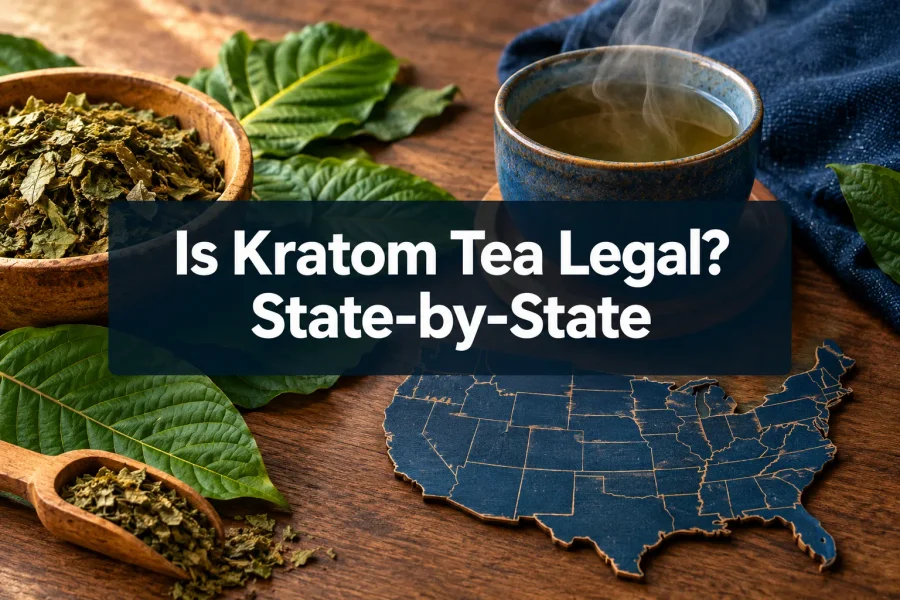
Is kratom tea legal? At the federal level, yes, kratom remains unscheduled under U.S. law as of October 2026. But 11 states have banned it outright, and two more (Kansas and Tennessee) added bans effective July 1, 2026. Brewing kratom as tea does not change its legal status, the law covers the plant material itself, not how you prepare it [1].
- Kratom tea is federally legal in the U.S. but banned in at least 11 states as of 2026 [1]
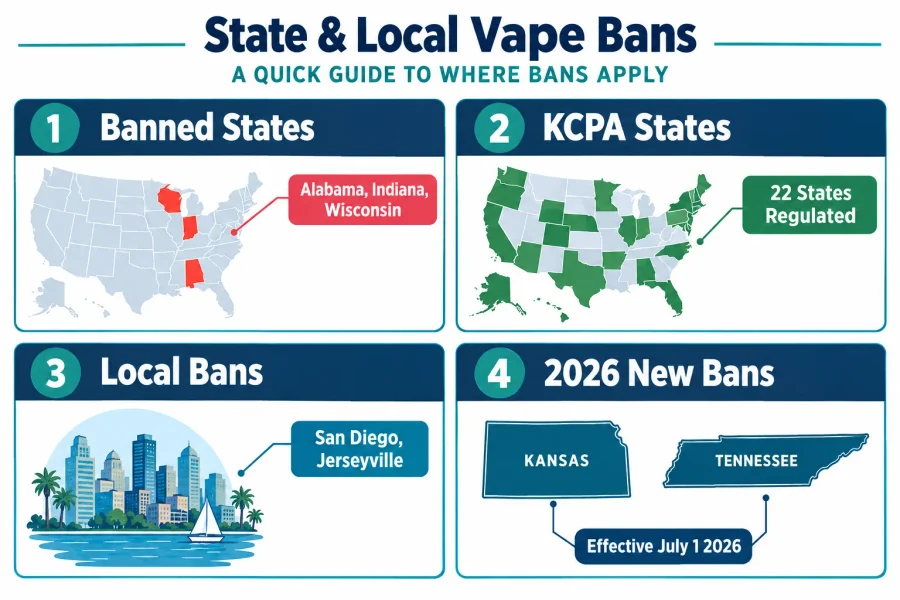
- Kansas and Tennessee enacted new bans effective July 1, 2026 [3]
- Roughly 22 states have Kratom Consumer Protection Act (KCPA) frameworks that regulate rather than ban kratom
- Preparing kratom as tea does not exempt it from state or local bans
- Kratom-related poison center reports rose approximately 1,200% from 2015 to 2025
- The FDA has no approved medical uses for kratom and advises consumers to avoid it [5]
- Local bans exist even inside legal states, San Diego and Jerseyville are examples
- 7-hydroxymitragynine (7-OH), a potent kratom derivative, faces separate targeted restrictions in several states [3]
- Always verify current state and local rules before purchasing, the legal map changes within a single legislative session [1][3]
What Is Kratom Tea and How Does It Work
Kratom tea is made by steeping powdered or crushed leaves of Mitragyna speciosa, a tree native to Southeast Asia, in hot water. The active alkaloids, primarily mitragynine and 7-hydroxymitragynine, absorb into the liquid and produce effects ranging from mild stimulation at low doses to sedation and pain relief at higher doses.
The two main alkaloids bind to opioid receptors in the brain. Mitragynine typically makes up 1-2% of dried leaf weight by alkaloid content, while 7-OH is present in smaller amounts but is significantly more potent. Because kratom tea uses the same leaf material as capsules or powder, its pharmacological profile is essentially identical to other kratom formats, only the delivery method differs.
Users report onset within 15-30 minutes and effects lasting 3-6 hours depending on dose and strain. The pattern across user reports shows that tea form may produce slightly faster onset than capsules because the alkaloids are already dissolved.
Is Kratom Tea Legal in the US, Federal and State Overview
Jack Botanicals - America's Trusted Kratom Source
AKA certified quality featuring Red Maeng Da, Red Bali, and Green Maeng Da. Lab-tested purity you can trust.
🎁 NEW CUSTOMER SPECIAL
JACK30 = 30% OFF
Kratom tea is legal under federal U.S. law. The DEA considered scheduling kratom as a Schedule I substance in 2016 but withdrew the proposal after significant public pushback. As of October 2026, kratom has no federal controlled substance classification [5][1].
That said, the question “is kratom tea legal” has no single national answer. State law controls everything.
Here is the breakdown as of October 2026:
States with outright bans (kratom illegal):
- Alabama, Arkansas, Indiana, Rhode Island, Vermont, Wisconsin, longstanding bans
- Kansas and Tennessee, bans effective July 1, 2026 [3]
- Several additional states with full prohibitions [1]
States with KCPA-style regulation (legal with rules):
Arizona, Colorado, Florida, Georgia, Illinois, Kentucky, Maryland, Minnesota, Mississippi, Nebraska, Nevada, New York, Oklahoma, Oregon, South Carolina, South Dakota, Texas, Utah, Virginia, West Virginia, and others, roughly 22 states total. These frameworks set age limits (typically 18 or 21), labeling requirements, and product testing standards.
States with no specific regulation:
Kratom is legal but unregulated, no age limits, no testing mandates.
For a full interactive map, see the kratom legal map showing state laws.
For state-specific detail, check Is Kratom Legal in the United States? Federal Laws Explained.
Why Is Kratom Banned in Some States
States ban kratom primarily over public health and safety concerns. The core arguments regulators cite: addiction potential, lack of FDA approval, contamination risks, and increasing poison center reports.
The data supports the concern. Kratom-related exposure reports to U.S. poison centers rose approximately 1,200%, from 258 cases in 2015 to 3,434 in 2025. The CDC documents adverse effects including seizures, addiction, and multi-substance overdoses.
The FDA has flagged kratom for liver toxicity and has investigated multistate Salmonella outbreaks linked to kratom products [4][5]. A July 2026 advisory from U.S. poison centers specifically flagged 7-OH as a high-potency derivative with no approved medical uses [5].
The September 2026 deaths of two University of Mississippi students, where kratom was suspected to have played a role, renewed scrutiny of local access rules in states where kratom remains technically legal.
States like Indiana and Alabama banned kratom early. More recent bans in Kansas and Tennessee reflect a legislative trend: as poison data accumulates and high-profile incidents occur, state legislatures move toward criminalization [3].
How to Brew Kratom Tea Properly
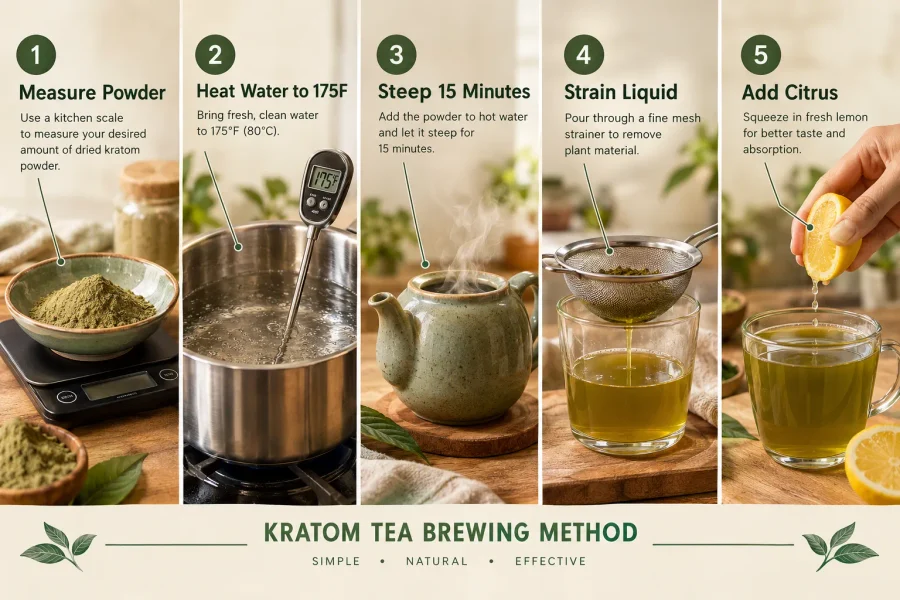
Kratom tea is straightforward to brew, but technique affects both alkaloid extraction and taste. Here is what works:
Basic brewing method:
- Measure 2-4 grams of kratom powder for a standard dose (beginners: start at 2 grams)
- Heat water to 175-185°F (80-85°C), do not boil, as excessive heat may degrade alkaloids
- Add kratom powder to the water
- Steep for 10-20 minutes, stirring occasionally
- Strain through a fine mesh strainer or cheesecloth into a cup
- Add lemon juice or another acidic ingredient, citric acid helps extract alkaloids more efficiently
What works: Adding citric acid (lemon juice) before steeping improves alkaloid solubility. Users report noticeably stronger effects compared to plain water extraction.
What doesn’t: Boiling water for extended periods. The pattern in user reports shows diminished effects when kratom is simmered hard for more than 20 minutes.
For tips on maximizing potency, see how to make kratom stronger.
Taste note: Kratom tea is bitter. Honey, ginger, or mint help significantly. Cold brewing (room temperature water, 8-12 hours) produces a milder-tasting tea but with slower onset.
Kratom Tea Side Effects and Safety
Kratom tea carries real risks. The FDA advises consumers to avoid kratom in all forms [5]. Here is what the data shows.
Common side effects:
- Nausea and vomiting (especially at higher doses)
- Dizziness and sedation
- Constipation
- Elevated heart rate
Serious adverse events documented by the FDA:
- Liver toxicity
- Seizures
- Substance use disorder
- Multi-substance overdose interactions [5][4]
Contamination risk: The FDA has investigated multistate Salmonella outbreaks linked to kratom products [4]. This applies to any form, powder, capsule, or tea.
Drug interactions: Kratom combined with opioids, benzodiazepines, or alcohol significantly raises overdose risk. The CDC notes increasing complexity in kratom-related adverse events, often involving multiple substances.
Pregnancy: No safe dose has been established. Kratom should be avoided during pregnancy.
The takeaway: the risk profile is not trivial. Anyone using kratom tea should buy only from vendors that follow state KCPA testing and labeling standards where those laws apply.
Can You Get Addicted to Kratom
Yes. Kratom carries genuine addiction potential. Because mitragynine and 7-OH bind to opioid receptors, regular use can produce physical dependence. Users report withdrawal symptoms including muscle aches, insomnia, irritability, and nausea, a pattern consistent with opioid-type withdrawal.
The American Medical Association includes kratom in overdose-epidemic briefings and has noted state legislative moves to classify it as a controlled substance. The FDA explicitly lists substance use disorder as a documented adverse event [5].
Dependence risk increases with:
- Daily use
- High doses (above 8 grams per session)
- Combining with other substances
- Using high-potency extracts or 7-OH products
If dependence has developed, tapering rather than abrupt cessation is the standard harm-reduction approach. See how to stop kratom safely for tapering methods.
Will Kratom Show Up on a Drug Test
Standard 5-panel drug tests do not screen for kratom alkaloids. Kratom is not an opiate, and mitragynine will not trigger a positive result on standard opioid panels.
However, specialized kratom-specific tests do exist. Some employers, courts, and treatment programs use expanded panels that include mitragynine. The detection window for mitragynine in urine is estimated at 5-7 days for occasional users and potentially longer for daily users, though research on exact windows remains limited.
Bottom line: assume a standard workplace drug test will not flag kratom. But do not assume that applies to all testing contexts, confirm which panel is being used if this matters for your situation.
Kratom Tea for Pain Relief, Does It Work
Some users report meaningful pain relief from kratom tea, particularly with red vein strains at moderate doses (4-6 grams). The mechanism is opioid receptor binding, which is pharmacologically consistent with analgesic effects.
However, the FDA has not approved kratom for any medical use, including pain management [5]. No large-scale clinical trials have established efficacy or safe dosing for pain. The evidence base is primarily user reports and small studies.
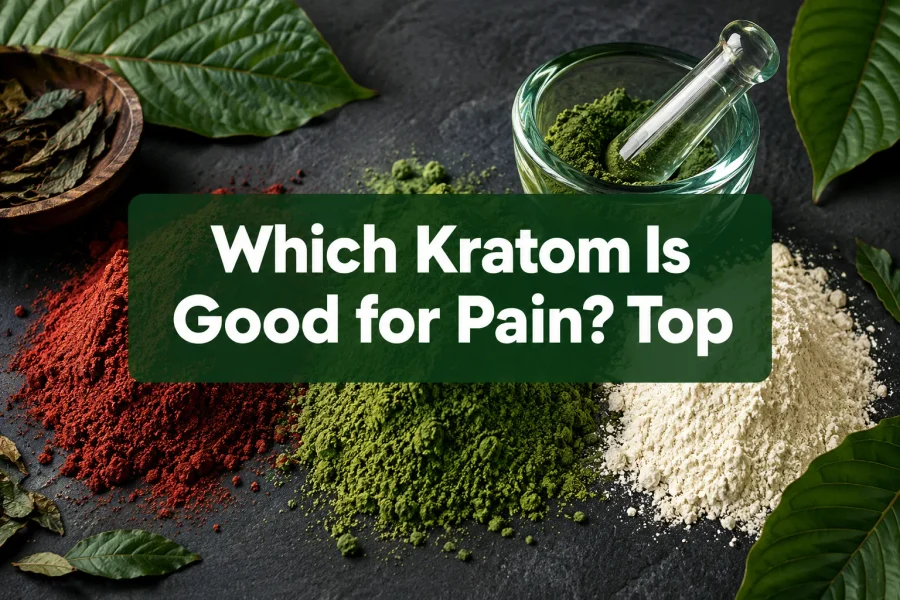
For users researching kratom for pain specifically, see what is the best kratom for pain for a strain-by-strain breakdown.
The pattern in user reports: red vein strains (Red Bali, Red Borneo) are most consistently associated with pain-relief effects. Green veins offer a middle ground between stimulation and relief. White veins skew stimulating with less analgesic effect.
Best Kratom Strains for Beginners
For someone new to kratom tea, strain selection matters. Here is a direct comparison:
| Strain | Vein Color | Primary Effect | Duration | Beginner-Friendly |
|---|---|---|---|---|
| Green Malay | Green | Balanced energy + mild relief | 5-6 hours | Yes |
| Red Bali | Red | Relaxation, pain relief | 4-5 hours | Yes |
| White Borneo | White | Energy, focus | 3-4 hours | Moderate |
| Maeng Da | Green/Red/White | Potent, variable | 4-6 hours | No |
Comparison shows: Green Malay lasts 5-6 hours vs White Borneo’s 3-4 hours. For beginners, Green Malay or Red Bali at 2-3 grams is the standard starting point. Maeng Da is higher potency and not recommended for first-time users.
Local Bans and the Patchwork Problem
Even in states where is kratom tea legal at the state level, local governments can ban it. This creates a patchwork that catches users off guard.
Examples of local bans within otherwise-legal states:
- San Diego, California
- Jerseyville, Illinois
- Lafayette County, Mississippi
- Denver, Colorado allows kratom but restricts its sale for “human consumption”
The September 2026 Ole Miss student deaths drew attention to Mississippi’s Lafayette County ban, a county-level prohibition that exists within a state that otherwise has a KCPA framework.
The American Kratom Association reports active efforts to replace proposed bans with regulatory frameworks in states like Minnesota and North Dakota [2]. But the legislative pace is fast, analysts expect more states to shift from unregulated-but-legal to either banned or strictly regulated within the next few sessions [3][1].
For specific state guidance:
- Is Kratom Legal in Washington State?
- Is Kratom Legal in Indiana?
- Is Kratom Legal in Alabama?
- Kratom Legal in Texas
Is Kratom Safe for Long-Term Use
Long-term kratom safety data is limited. No large controlled studies have tracked health outcomes over years of regular use. What exists is adverse event reporting and case studies.
The documented concerns for long-term use include:
- Physical dependence and withdrawal
- Liver toxicity in susceptible individuals
- Potential cardiovascular effects
- Contamination exposure (heavy metals, pathogens) from unregulated products
The FDA’s position has not changed in 2026: no approved uses, advises avoidance [5]. The 1,200% increase in poison center reports from 2015 to 2025 reflects both growing use and growing harm documentation.
Harm-reduction guidance for users who continue using kratom tea:
- Limit frequency (avoid daily use)
- Keep doses low (2-4 grams)
- Avoid combining with other CNS depressants
- Buy only from vendors that follow KCPA testing standards where applicable
- Take regular breaks to reduce dependence risk
Kratom Tea Legal – FAQs
Is kratom tea legal in the United States?
The legal status of kratom tea varies across the United States. Kratom is not federally scheduled as a controlled substance in the U.S., but individual states and local jurisdictions may have different rules. Some locations restrict kratom products, while others allow them under specific conditions. Laws can also change over time.
Does making kratom into tea change its legal status?
Turning kratom leaves or powder into tea does not automatically determine its legal status. Regulations may apply to kratom itself regardless of whether it is sold as powder, capsules, tea, or another preparation. Relevant rules can depend on the jurisdiction, product labeling, and applicable local regulations.
Are there states where kratom tea is restricted?
Yes, some U.S. jurisdictions have restrictions involving kratom, which can affect kratom tea as well. Depending on the location, rules may include:
- Statewide restrictions or prohibitions.
- Local city or county regulations.
- Age-related sales requirements.
- Product labeling or registration rules.
Is kratom tea legal to make at home?
Whether preparing kratom tea at home is permitted depends on the laws where you live. In places where kratom itself is restricted or prohibited, preparing it as tea may also be subject to those restrictions. Local rules should be considered separately because regulations can differ between states, counties, and municipalities.
Can you travel with kratom tea?
Traveling with kratom tea can involve different rules depending on the places involved. Before traveling, consider:
- The laws of your departure location.
- The rules at your destination.
- Any jurisdictions crossed during travel.
- Transportation or carrier requirements.
Is kratom tea legal in every state?
No. Kratom tea is not governed by one uniform rule across every U.S. state. State and local regulations can differ, and some jurisdictions have adopted restrictions that affect kratom products. Because laws may change, the applicable rules should be checked for the specific state or locality being considered.
Do local laws affect whether kratom tea is legal?
Yes. In addition to state-level regulations, some cities and counties may establish their own restrictions involving kratom. This means a product may be treated differently in neighboring jurisdictions. When determining whether kratom tea is permitted, both state law and applicable local regulations may need to be considered.
Conclusion
Is kratom tea legal? The short answer: federally yes, but state law is what actually controls access, and that map is shifting fast. As of October 2026, 11-plus states ban kratom outright, including Kansas and Tennessee after July 1, 2026. Another 22 states regulate it under KCPA frameworks. Local bans add another layer of complexity even inside legal states [1][3].
Brewing kratom as tea does not create a legal workaround. The law covers the plant material. If kratom is banned in your state, kratom tea is banned too.
The legal landscape for kratom is one of the fastest-moving areas in U.S. drug policy right now. What was legal in your state last year may not be legal today. Check before you buy.
References
[1] USA Today, https://www.usatoday.com/story/news/health/2026/09/30/kratom-still-legal-most-states-see-map/91940420007/
[2] American Kratom Association News, https://www.americankratom.org/news
[3] Kratom Science, Kratom Under Attack: New 2026 Bills Aim To Criminalize Consumers Across The U.S., https://www.kratomscience.com/2026/01/27/kratom-under-attack-new-2026-bills-aim-to-criminalize-consumers-across-the-u-s/
[4] FDA, Multistate Salmonella Outbreak Linked to Kratom Products, https://www.fda.gov/food/hfp-constituent-updates/fda-investigates-multistate-outbreak-salmonella-infections-linked-products-reported-contain-kratom
[5] FDA, FDA and Kratom, https://www.fda.gov/news-events/public-health-focus/fda-and-kratom
Jonathan is an enthusiast of traditional plant practices and cultural history. His work reflects a genuine fascination with how nature has shaped human stories throughout time. Jonathan believes that sharing knowledge about plants can build connections across cultures and generations. Through careful research and respectful exploration, he hopes to provide readers with thoughtful perspectives that celebrate heritage, encourage curiosity, and inspire a greater awareness of our relationship with nature.