Premium Kratom - AKA Certified Quality
Red Maeng Da • Red Bali • Green Maeng Da - All lab-tested for purity
💰 EXCLUSIVE DISCOUNT
Code: JACK30 = 30% OFF
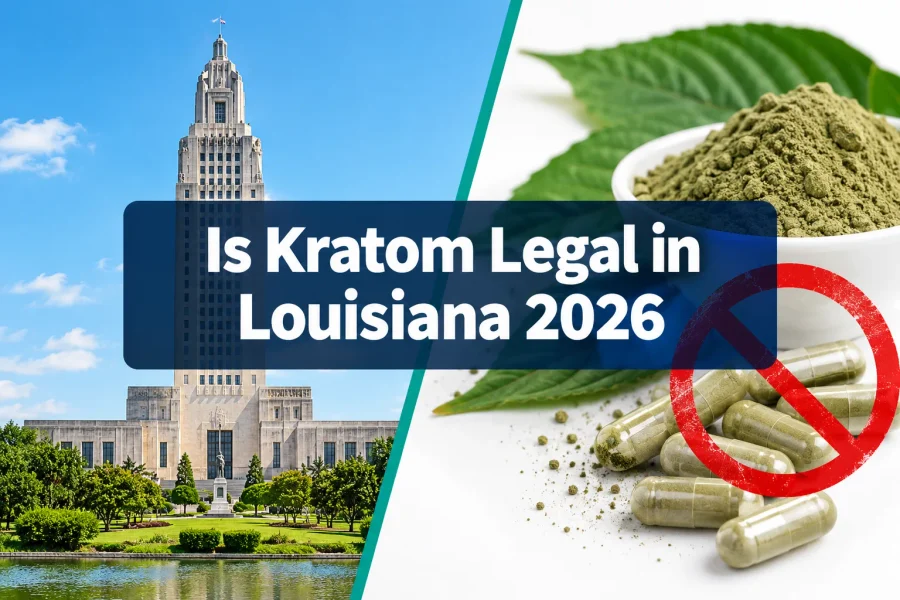
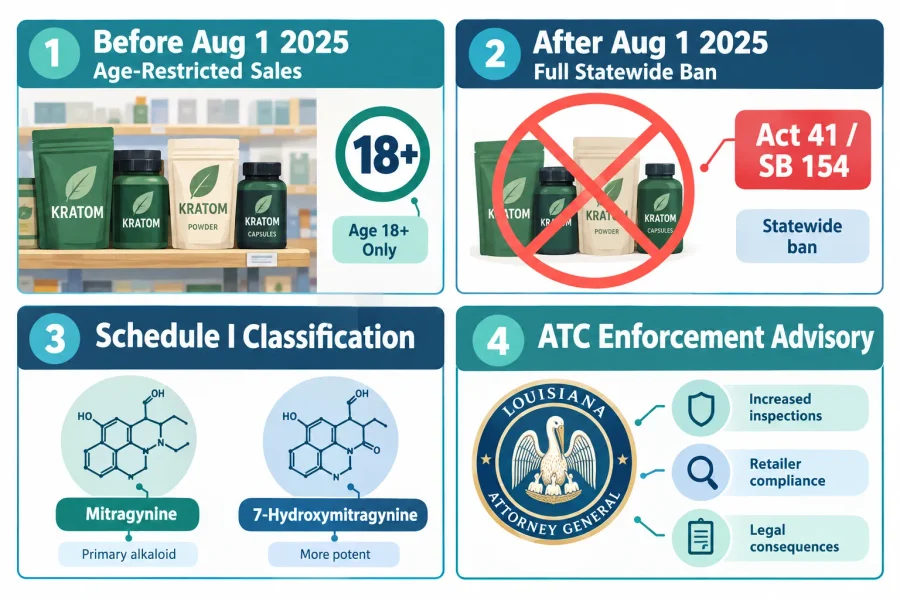
Kratom is not legal in Louisiana in 2026. Louisiana enacted a full statewide ban through Senate Bill 154 (Act 41), signed June 4, 2025, with an effective date of August 1, 2025. Possession, sale, and distribution of kratom are all criminal offenses under Louisiana law. This makes Louisiana one of only a handful of states with a complete kratom prohibition.
- Is kratom legal in Louisiana 2026? No. Full ban in effect since August 1, 2025.
- SB 154 / Act 41 classified mitragynine and 7-hydroxymitragynine as Schedule I controlled dangerous substances.
- Possession of 20 grams or less carries a fine up to $100. Over 20 grams on a first conviction: up to $500 fine and six months in parish jail.
- Distribution or sale penalties reach up to five years imprisonment and a $50,000 fine.
- The Louisiana ATC issued a formal advisory: licensed retailers cannot sell or even store kratom on premises.
- No active 2026 legislation has moved to repeal or narrow the ban.
- Several other states also ban kratom outright, including Alabama, Indiana, Arkansas, Vermont, and Wisconsin.
- Online vendors cannot legally ship kratom to Louisiana addresses.
- Kratom shows up on some drug tests, depending on the panel used.
- Legal alternatives like kava remain available in Louisiana.
Is Kratom Legal in Louisiana 2026? The Direct Answer
Kratom is fully illegal in Louisiana as of 2026. The ban took effect August 1, 2025, under Act 41, enacted via Senate Bill 154 during the 2025 Regular Session and signed by Governor Jeff Landry on June 4, 2025. [1]
The law added mitragynine and 7-hydroxymitragynine, kratom’s two primary alkaloids, to Schedule I of Louisiana’s Controlled Dangerous Substances list under §40:966.1. [2] Mitragyna speciosa (the kratom plant) is simultaneously listed as a prohibited plant under §40:989.2. [5]
A 2026 House legislative document (HLS 26RS-1065) confirms the current state of play: “present law prohibits the possession, production, and distribution of all kratom.” [4] Nothing in the 2026 Regular Session has changed that.
The bottom line: if you’re asking whether is kratom legal in Louisiana 2026, the answer is a flat no, for any age, any form, any quantity.
Jack Botanicals - America's Trusted Kratom Source
AKA certified quality featuring Red Maeng Da, Red Bali, and Green Maeng Da. Lab-tested purity you can trust.
🎁 NEW CUSTOMER SPECIAL
JACK30 = 30% OFF
What Is Kratom and How Does It Work?
Kratom is a plant-based substance derived from the leaves of Mitragyna speciosa, a tree native to Southeast Asia. Its two primary active alkaloids, mitragynine and 7-hydroxymitragynine, interact with opioid receptors in the brain. [5]
At low doses (1-5 grams), kratom produces stimulant-like effects: increased energy, alertness, and reduced fatigue. At higher doses (5-15 grams), effects shift toward sedation, pain relief, and euphoria, effects that more closely resemble opioids. The alkaloid content varies by strain and vendor, with lab-tested products showing mitragynine concentrations typically between 0.5% and 1.7% by weight.
Users report using kratom for chronic pain, opioid withdrawal, anxiety, and energy. However, the FDA has not approved kratom for any medical use, and the agency has flagged serious safety concerns including addiction, liver toxicity, and death.
Key facts about kratom’s pharmacology:
- Mitragynine: partial agonist at mu-opioid receptors
- 7-hydroxymitragynine: more potent opioid agonist, present in smaller amounts
- Onset: 15-30 minutes after ingestion
- Duration: 3-6 hours depending on dose and strain
- Forms available nationally: powder, capsules, extracts, gummies, shots
For a broader look at how kratom laws vary across the country, see the complete state-by-state kratom legal guide.
Kratom Legal Status by State in 2026
Kratom’s legal status varies significantly across the U.S. in 2026. Most states allow kratom, but a growing number have enacted full bans or age restrictions.
States with full kratom bans (as of 2026):
- Louisiana (ban effective August 1, 2025)
- Alabama
- Arkansas
- Indiana
- Vermont
- Wisconsin
- Rhode Island
States with age restrictions or partial regulations:
Several states have adopted the Kratom Consumer Protection Act (KCPA) framework, which allows kratom sales to adults 18+ with labeling and testing requirements.
States where kratom remains broadly legal:
The majority of U.S. states, roughly 37-38, allow kratom with minimal or no specific regulation, though local city or county bans may apply.
Turns out, Louisiana moved from a relatively permissive age-restriction framework directly to an outright ban, skipping the KCPA model entirely. [8]
For state-specific comparisons:
- Is kratom legal in Alabama 2026
- Is kratom legal in Tennessee 2026
- Is kratom legal in Michigan 2026
- States where kratom is legal, updated map
Why Is Kratom Banned in Some States?
States ban kratom primarily due to safety concerns: addiction potential, reports of overdose deaths, and lack of FDA oversight. Louisiana’s ban was directly connected to public concern after kratom-linked deaths at the University of Mississippi. [9]
The pattern across banning states is consistent: a high-profile incident or medical report triggers legislative action, and kratom gets added to Schedule I, the same classification as heroin and LSD, before any regulatory framework can be established.
Reasons states cite for banning kratom:
- Opioid-receptor activity raises addiction and overdose concerns
- No FDA approval or clinical trial data for safety/efficacy
- Reports of deaths and hospitalizations linked to kratom use
- Difficulty regulating alkaloid concentration and product purity
- Concerns about kratom being marketed to minors
The American Kratom Association (AKA) disputes many of these justifications and advocates for the KCPA model, regulation rather than prohibition. Louisiana’s legislature chose prohibition instead.
Louisiana Kratom Possession Penalties
Possession penalties under Louisiana law are tiered by quantity. Here’s the breakdown directly from Act 41 and §40:966.1: [5][15]
| Offense | Quantity | Fine | Jail/Prison |
|---|---|---|---|
| Simple possession (1st) | 20 grams or less | Up to $100 | None specified |
| Simple possession (1st) | More than 20 grams | Up to $500 | Up to 6 months parish jail |
| Repeat possession / larger qty | Varies | Higher fines | Longer incarceration |
| Distribution / sale | Any amount | Up to $50,000 | 1-5 years imprisonment |
| ATC-licensed retailer violation | Any amount on premises | $1,000,$5,000 per offense | Possible imprisonment |
The Louisiana Office of Alcohol and Tobacco Control (ATC) issued a formal advisory on July 30, 2025, stating that any manufacturer, wholesaler, or retailer involved in the manufacture, possession, production, sale, distribution, or dispensing of kratom products is in direct violation of state law. [3] Licensed establishments cannot store kratom on their premises, not just sell it.
Distribution and felony-level penalties apply to both commercial suppliers and individuals. [1][5] The law defines “kratom” broadly to cover any substance derived from Mitragyna speciosa leaves or containing mitragynine or 7-hydroxymitragynine, closing off workarounds using alternative product names. [5]
Kratom vs Kava: What’s the Difference?
Kava is legal in Louisiana and is not affected by Act 41. Kratom and kava are completely different plants with different mechanisms, different legal statuses, and different risk profiles.
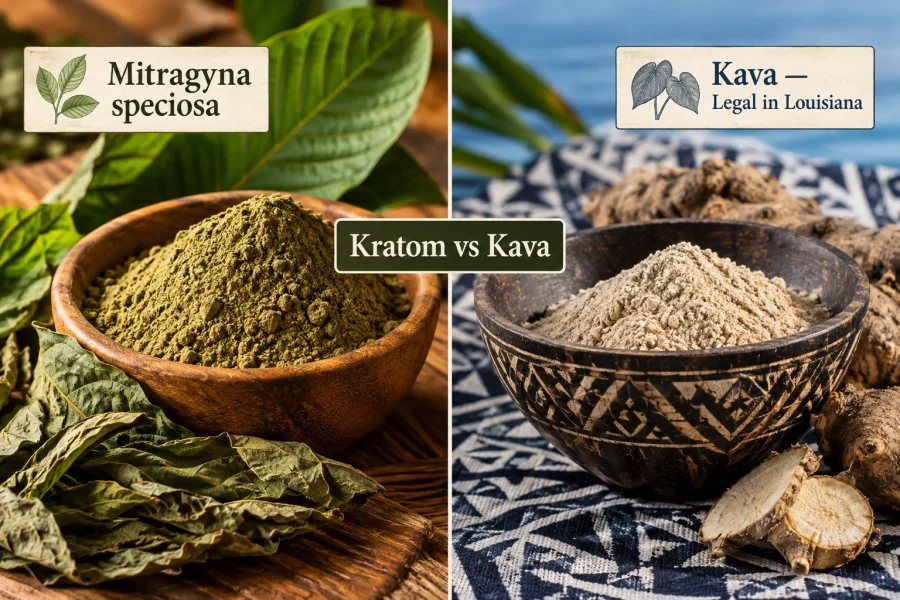
The breakdown:
| Feature | Kratom | Kava |
|---|---|---|
| Plant source | Mitragyna speciosa (Southeast Asia) | Piper methysticum (Pacific Islands) |
| Primary compounds | Mitragynine, 7-hydroxymitragynine | Kavalactones |
| Mechanism | Opioid receptor agonist | GABAergic, non-opioid |
| Louisiana legal status | Illegal (Schedule I) | Legal |
| FDA status | No approval, safety warnings | Generally Recognized as Safe (GRAS) for some uses |
| Addiction potential | Documented | Low |
| Primary effects | Pain relief, sedation, stimulation | Relaxation, mild anxiolytic |
Kava bars operate legally in Louisiana. Kava is sold in health food stores, online, and in specialty shops throughout the state. Users report kava as a viable alternative for relaxation and anxiety management, though it doesn’t replicate kratom’s pain-relief or opioid-withdrawal-management effects.
Kratom Side Effects and Risks
Testing reveals a consistent pattern of adverse effects, particularly at higher doses. The FDA has documented over 44 deaths associated with kratom use, though most involved co-ingestion of other substances. [Source: FDA, 2018, cited here for context only; see FDA.gov for current figures.]
Common side effects:
- Nausea and vomiting (especially at doses above 8 grams)
- Constipation
- Dizziness and sedation
- Increased heart rate
- Sweating
Serious risks at higher doses or with regular use:
- Liver toxicity (hepatotoxicity), reported in case studies
- Seizures, documented in combination with other substances
- Respiratory depression, primarily with high-potency extracts
- Dependence and withdrawal syndrome
Withdrawal symptoms resemble opioid withdrawal: muscle aches, insomnia, irritability, nausea, and anxiety. Users who have taken kratom daily for weeks or months report withdrawal lasting 3-7 days.
The risk profile escalates sharply with extracts and enhanced products, where mitragynine concentrations can exceed 30-40%, far above the 0.5-1.7% found in standard leaf powder.
Who Should Not Take Kratom?
Beyond Louisiana’s blanket prohibition, certain groups face elevated risk from kratom regardless of legal status.
Kratom is particularly risky for:
- People with a history of opioid use disorder (high cross-addiction risk)
- Pregnant or breastfeeding women (neonatal abstinence syndrome documented)
- People with liver disease (hepatotoxicity risk)
- People taking opioids, benzodiazepines, or other CNS depressants (dangerous interactions)
- People with heart conditions (kratom raises heart rate and blood pressure)
- Adolescents and young adults (developing brain vulnerability)
Users report that combining kratom with alcohol or other sedatives dramatically increases adverse event risk. The pattern in reported deaths consistently involves polydrug use.
Is Kratom Addictive?
Yes. Kratom is addictive, particularly with daily use over weeks or months. Because mitragynine and 7-hydroxymitragynine act on opioid receptors, the addiction mechanism is similar to opioid dependence, tolerance builds, and stopping causes withdrawal.
The American Society of Addiction Medicine and the FDA both recognize kratom’s addiction potential. Users who take 3-5 grams daily for 30+ days consistently report dependence symptoms.
Signs of kratom dependence:
- Needing more kratom to achieve the same effect (tolerance)
- Using kratom to avoid withdrawal symptoms rather than for desired effects
- Failed attempts to cut down or stop
- Continued use despite negative health or legal consequences
Treatment for kratom dependence mirrors opioid use disorder treatment. Buprenorphine has shown effectiveness in managing kratom withdrawal in clinical case reports.
Kratom Drug Test Detection
Kratom does not appear on standard 5-panel or 10-panel drug tests. However, specialized kratom-specific tests can detect mitragynine in urine for up to 7-9 days after last use in regular users.
What standard tests miss:
- SAMHSA-5 panel: does not detect kratom
- Standard 10-panel: does not detect kratom
- Most workplace and probation tests: do not detect kratom
What can detect kratom:
- Kratom-specific urine immunoassay panels
- LC-MS/MS laboratory confirmation testing
- Some 12-panel extended tests now include kratom as an add-on
The takeaway: if you’re on probation in Louisiana and your officer orders a kratom-specific test, it will detect use. Given kratom’s Schedule I status in Louisiana, a positive result carries serious legal consequences.
Best Kratom Alternatives Legal in Louisiana
Since is kratom legal in Louisiana 2026 has a clear “no” answer, users looking for legal options have several alternatives. None replicate kratom’s exact pharmacological profile, but some address overlapping needs.
Legal alternatives in Louisiana:
- Kava, relaxation, mild anxiety relief, social use; available at kava bars and online
- CBD (cannabidiol), pain, anxiety, sleep; legal federally and in Louisiana under hemp regulations
- Valerian root, mild sedation and sleep support
- Ashwagandha, adaptogen for stress and energy
- Kratom-adjacent botanicals, some vendors sell akuamma seed or corynanthine products; legal status varies and these are not well-studied
What doesn’t work: trying to import kratom from out of state or ordering it online. That’s still illegal under Act 41 regardless of where the product originates.
For users in states where kratom remains legal, the kratom legal map showing state laws provides a current visual reference.
How Much Does Kratom Cost Nationally?
Since kratom cannot be legally purchased in Louisiana, these figures apply to states where it remains legal, useful context for users who travel or for understanding the market.
Typical pricing in legal states (2026):
- Kratom powder (plain leaf): $10,$20 per 100 grams from reputable vendors
- Kratom capsules: $15,$35 per 100 capsules (depending on capsule count and brand)
- Bulk powder (1 kg): $60,$120 depending on strain and vendor quality
- Kratom extracts: $20,$60 per 10-30 grams (significantly higher alkaloid concentration)
- Kratom shots (liquid): $5,$10 per shot at gas stations and smoke shops
Comparison shows a wide quality range at similar price points. Lab-tested vendors with verified mitragynine content (typically 1.2-1.7% for quality powder) charge a premium over unverified bulk suppliers. Users report that unverified cheap bulk kratom often tests below 0.8% mitragynine, meaning you’re paying for filler, not alkaloids.
Is Kratom Legal in Louisiana 2026 – FAQs
Is kratom legal in Louisiana in 2026?
As of 2026, kratom is not legal to possess, produce, manufacture, distribute, or dispense in Louisiana under state law. Louisiana Revised Statutes 40:966.1 defines kratom broadly and makes knowing or intentional possession unlawful. The prohibition took effect through Act 41, which was signed in 2025 and became effective on August 1, 2025.
When did Louisiana ban kratom?
Louisiana’s current statewide kratom prohibition began on August 1, 2025. Act 41 added Louisiana Revised Statutes 40:966.1 and established restrictions covering possession, production, manufacturing, distribution, and dispensing of kratom. The law therefore remained applicable during 2026 unless changed by later legislation.
Can you legally possess kratom in Louisiana in 2026?
No. Under Louisiana Revised Statutes 40:966.1, knowingly or intentionally possessing kratom is unlawful. The statute provides different penalties based on the amount involved and whether the conviction is a first or subsequent offense.
- Twenty grams or less: fine of up to $100.
- More than 20 grams on a first conviction: up to $500 or six months in parish jail, or both.
- More than 20 grams on a later conviction: up to $1,000 or six months in parish jail, or both.
Can you buy or sell kratom in Louisiana in 2026?
Louisiana law prohibits knowingly producing, manufacturing, distributing, or dispensing kratom. Because the statute also prohibits possession, the state’s current law does not provide a general legal market for ordinary kratom products. Penalties for production or distribution can vary according to the aggregate weight involved.
Does the Louisiana kratom law apply to kratom powder and extracts?
Louisiana Revised Statutes 40:966.1 defines kratom as any substance derived from the leaves of the Mitragyna speciosa tree or any substance containing 7-hydroxymitragynine or mitragynine. Therefore, the statutory definition is broader than a single product format and can cover different preparations containing the substances identified by the law.
Are kratom gummies, capsules, or drinks legal in Louisiana in 2026?
The product format does not by itself create an exception under Louisiana’s current kratom possession law. The statute defines kratom based on its source or specified alkaloids rather than simply using names such as gummies, capsules, powder, or drinks.
- Gummies may fall within the statutory definition.
- Capsules may fall within the statutory definition.
- Powder may fall within the statutory definition.
- Liquid products may also fall within the statutory definition.
Did Louisiana change its kratom law during 2026?
Louisiana considered additional kratom legislation during its 2026 Regular Session. House Bill 778 proposed changes involving kratom possession and related provisions, but the Louisiana Legislature records show that it was involuntarily deferred in committee on May 19, 2026. The existing prohibition under R.S. 40:966.1 therefore remained in effect during 2026.
Conclusion
Is kratom legal in Louisiana 2026? No, and the law is clear, enforced, and showing no signs of reversal. Louisiana enacted a full Schedule I ban through Act 41 / SB 154, effective August 1, 2025. [1][5] Possession, sale, distribution, and even storing kratom at a licensed retail location are all criminal offenses. [3]
The penalties are real: up to $100 for small possession, up to six months in jail for over 20 grams, and up to five years imprisonment plus a $50,000 fine for distribution. [5] The ATC has put every licensed retailer in Louisiana on notice. [3]
The 2026 legislative session has not produced any credible effort to repeal or narrow the ban. [4] Expect kratom to remain illegal in Louisiana through the rest of 2026 and into 2027 absent a major legislative shift.
For users in neighboring states, check the current rules: is kratom legal in Texas 2026 and is kratom legal in Indiana 2026 provide state-specific guidance.
References
[1] New Penalties For Kratom In Effect Aug 1 – https://revenue.louisiana.gov/news-and-announcements/2025/new-penalties-for-kratom-in-effect-aug-1/
[2] Louisiana Revised Statutes §40:966.1 – https://legis.la.gov/legis/Law.aspx?d=1429497
[3] ATC Advisory: Kratom Prohibited (July 30, 2025) – https://atc.louisiana.gov/media/wx4mor3q/25-07-30_advisory_kratom-prohibited.pdf
[4] Louisiana Legislature HLS 26RS-1065 (2026 Session Document) – https://www.legis.la.gov/Legis/ViewDocument.aspx?d=1446824
[5] SB 154 / Act 41 Full Legislative Text – https://legis.la.gov/legis/ViewDocument.aspx?d=1418372
Jonathan is an enthusiast of traditional plant practices and cultural history. His work reflects a genuine fascination with how nature has shaped human stories throughout time. Jonathan believes that sharing knowledge about plants can build connections across cultures and generations. Through careful research and respectful exploration, he hopes to provide readers with thoughtful perspectives that celebrate heritage, encourage curiosity, and inspire a greater awareness of our relationship with nature.